
About Rahul Sir
Rahul Sir is a renowned Aptitude and Reasoning trainer with extensive experience preparing students for competitive examinations such as IBPS PO, IBPS Clerk, SBI PO, SBI Clerk, SSC, Railways, and other government exams. Known for his simple teaching style and practical shortcut techniques, he helps students solve complex aptitude problems quickly and accurately. His teaching focuses on building strong fundamentals, improving calculation speed, and mastering exam-oriented tricks that save valuable time during competitive exams. Through structured lessons, real exam questions, and regular practice sessions, Rahul Sir has guided thousands of aspirants toward achieving their career goals. In this article, Rahul Sir breaks down one of the most scoring yet often misunderstood topics in Quantitative Aptitude — Alligation and Mixture — into simple, exam-ready techniques that you can apply within seconds during your IBPS PO and Clerk exams.
1. What is Alligation and Why It Matters in Banking Exams
Alligation is a mathematical technique used to solve problems involving the mixing of two or more ingredients, quantities, or values that have different properties — such as price, concentration, or ratio — to find a resultant mixture with a specific average value. In IBPS PO and Clerk exams, Alligation questions typically appear in the Quantitative Aptitude section and can involve mixing liquids of different prices, milk-water solutions, different grades of items, or even average-based problems disguised as mixtures.
This topic is important because it usually takes candidates a long time to solve using conventional algebraic methods, but with the Alligation rule, the same question can be solved in under 20 seconds. Banking exams are highly time-sensitive, with candidates having roughly a minute or less per question, so mastering a fast method for mixture problems gives you a real edge over other aspirants.
Alligation questions are also popular because examiners can twist them in many ways — replacement of mixtures, mixing more than two components, or combining alligation with ratio-proportion and profit-loss concepts. Understanding the core logic thoroughly, rather than memorizing formulas blindly, ensures you can adapt to any variation the exam throws at you, making this one of the highest-value topics to master for scoring well in the Quant section.
2. The Basic Alligation Rule (Formula and Logic)
The foundation of solving any Alligation question lies in one simple rule: the ratio in which two quantities at different values must be mixed to produce a mixture at a given average value is inversely proportional to the difference of the extreme values from the average value.
The standard formula is written as:
Quantity of Cheaper : Quantity of Dearer = (Dearer Value − Mean Value) : (Mean Value − Cheaper Value)
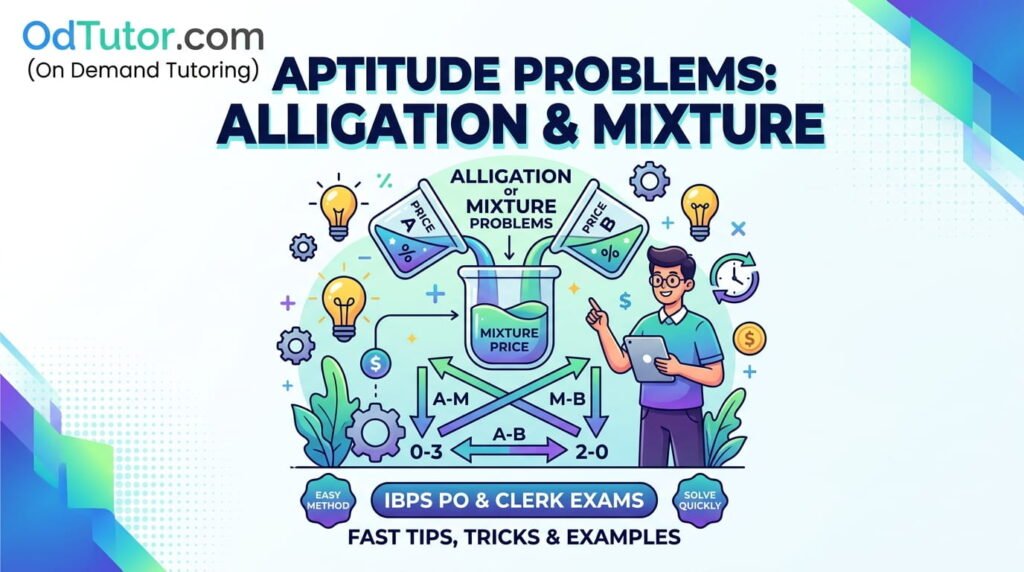
This is best visualized using the well-known Alligation Cross Method, where the cheaper value (C) and dearer value (D) are placed at the top two corners, the mean value (M) is placed in the middle, and the differences (D − M) and (M − C) are cross-multiplied diagonally to get the ratio.
For example, if a shopkeeper mixes tea worth ₹60/kg with tea worth ₹80/kg to get a mixture worth ₹68/kg, the ratio of cheaper to dearer tea is (80−68):(68−60) = 12:8 = 3:2. This means for every 3 units of the ₹60 tea, you need 2 units of the ₹80 tea.
Rahul Sir emphasizes that students should not just memorize this formula but understand why it works — the mean value always divides the mixture in inverse proportion to how far each component’s value is from the average. Once this logic is internalized, even unfamiliar or twisted questions become manageable within seconds, without needing to write a single equation.
3. Alligation Cross Method — Step-by-Step Visual Trick
The Alligation Cross Method is the single most powerful visual shortcut for solving mixture problems quickly, and Rahul Sir recommends practicing it until it becomes second nature. Here’s how to apply it step by step:
Step 1: Draw a cross (X) diagram. Write the cheaper quantity’s value at the top-left corner and the dearer quantity’s value at the top-right corner.
Step 2: Write the mean (average) value of the final mixture in the center of the cross.
Step 3: Subtract diagonally — subtract the mean value from the dearer value, and write this result at the bottom-left corner (this becomes the ratio of the cheaper quantity). Then subtract the cheaper value from the mean value, and write this at the bottom-right corner (this becomes the ratio of the dearer quantity).
Step 4: The bottom-left and bottom-right numbers, simplified, give the required ratio of cheaper to dearer quantities.
Example: A trader mixes two varieties of rice costing ₹40/kg and ₹60/kg to make a mixture worth ₹52/kg. Using the cross method: (60−52):(52−40) = 8:12 = 2:3. So the cheaper rice and dearer rice must be mixed in a 2:3 ratio.
This visual method eliminates the need for algebraic equations entirely. Rahul Sir advises students to practice drawing this cross quickly on rough paper during mock tests until they can compute the ratio mentally within 10-15 seconds, which is essential given the strict time constraints of IBPS PO and Clerk exams.
4. Solving Mixture Problems Involving Milk and Water
One of the most frequently tested variations of Alligation in IBPS exams involves milk-and-water mixtures, where a vessel contains milk mixed with water in a certain ratio, and candidates must find the ratio needed to achieve a desired concentration, or determine how much water must be added or removed.
For pure milk-water problems, treat pure milk as having a “value” of 100% (or 1) and water as having a “value” of 0%, then apply the same alligation cross rule using percentages instead of prices.
Example: In what ratio should a milkman mix pure milk with water to get a mixture that is 80% pure milk? Using alligation: pure milk = 100%, water = 0%, mean = 80%. Ratio = (100−80):(80−0) = 20:80 = 1:4. So milk and water should be mixed in a 1:4 ratio.
A trickier variant involves mixing two different milk solutions, each already diluted with water in different ratios, to get a new desired concentration. Here, first convert each solution’s milk content into a percentage, then apply the standard cross method treating these percentages as the “values” to mix.
Rahul Sir advises students to always convert given ratios into percentages first when dealing with milk-water problems, since this standardizes the approach and prevents confusion when the two mixtures being combined have different total quantities or different original ratios. This percentage-based approach also extends smoothly to other concentration problems, such as mixing acid solutions or alcohol solutions of different strengths.
5. Replacement Method (Successive Dilution) Trick
Replacement-type Alligation questions are considered advanced and frequently appear in the IBPS PO exam to test deeper conceptual understanding. In this type, a certain quantity of mixture is repeatedly removed from a vessel and replaced with pure water (or another substance), and candidates must determine the quantity of the original substance remaining after several such operations.
The formula for this is:
Final Quantity of Original Substance = Initial Quantity × (1 − Replaced Quantity / Total Quantity)ⁿ
where n is the number of times the replacement process is repeated.
Example: A container has 40 litres of milk. 4 litres of milk is withdrawn and replaced with water. This process is repeated 3 times. How much milk remains?
Using the formula: Remaining milk = 40 × (1 − 4/40)³ = 40 × (0.9)³ = 40 × 0.729 = 29.16 litres.
Rahul Sir recommends students memorize this formula thoroughly since deriving it during the exam wastes precious time. He also suggests practicing calculating powers of common fractions like (9/10), (4/5), and (3/4) up to the third power in advance, since these appear repeatedly in replacement questions, allowing you to substitute values instantly rather than performing lengthy multiplication under exam pressure.
This topic often intimidates students, but once the formula is memorized and a few fraction powers are practiced, replacement questions become one of the fastest-scoring question types in the exam, often solvable in under 30 seconds.
6. Alligation with More Than Two Ingredients
While most textbook examples cover mixing just two quantities, IBPS PO exams occasionally include questions involving three or more ingredients mixed together, which requires a slightly extended approach beyond the basic cross method.
For three-ingredient problems, Rahul Sir recommends the pairwise combination technique: first combine any two of the three ingredients using the standard alligation rule to get an intermediate mixture and its mean value, then combine this intermediate mixture with the third ingredient using alligation again to reach the final mean value.
Example: Three varieties of sugar costing ₹20/kg, ₹25/kg, and ₹30/kg are mixed to get a blend worth ₹26/kg using equal quantities of the first two varieties. First combine the ₹20 and ₹25 varieties in equal quantity to get a mean of ₹22.5/kg, then apply alligation between this ₹22.5/kg blend and the ₹30/kg variety against the target mean of ₹26/kg to find the final ratio.
Alternatively, for problems where all ingredient quantities are unknown variables, setting up a weighted average equation directly (Sum of value × quantity = Mean × Total quantity) is often faster than nested alligation crosses.
Rahul Sir advises students to identify whether a three-ingredient question provides enough information for direct pairwise alligation or requires a weighted-average equation, since choosing the wrong method wastes time. Practicing both approaches on previous year IBPS papers builds the pattern recognition needed to instantly pick the right technique during the actual exam.
7. Common Mistakes Students Make in Alligation Questions
Even after learning the alligation formula, many students lose marks due to avoidable errors under exam pressure. Rahul Sir highlights the most common mistakes he observes among his students:
Mistake 1 — Reversing the ratio: Students often forget that the ratio obtained from the cross method corresponds to (cheaper : dearer) in that specific order, based on which corner produced which difference. Reversing this ratio is one of the most frequent errors.
Mistake 2 — Ignoring units: When one quantity is given in litres and another in a different unit, or when quantities represent percentages versus absolute amounts, students sometimes apply alligation directly without converting to a common base, leading to wrong answers.
Mistake 3 — Misidentifying the mean value: In some questions, the “mean” isn’t stated directly but must be calculated first — for instance, from a total cost and total quantity — and skipping this step leads to using the wrong number in the alligation cross.
Mistake 4 — Confusing profit/loss-based mixture questions: When mixture questions are combined with profit and loss (e.g., mixing at cost price but selling at a profit), students forget to first convert to effective cost price before applying alligation.
Mistake 5 — Rushing replacement formula calculations: Small errors in calculating the fraction or the power in replacement problems lead to significantly wrong final answers.
Rahul Sir stresses that reviewing mock test errors specifically for these five patterns helps students eliminate silly mistakes, which is often the real difference between an average score and a top score in the Quantitative Aptitude section.
8. Time-Saving Shortcuts for Speed in the Exam
Given the strict time limits in IBPS PO and Clerk exams, Rahul Sir shares several speed-boosting shortcuts specifically for alligation and mixture questions:
Shortcut 1 — Simplify differences before cross-multiplying: Instead of working with large numbers, immediately reduce the differences (D−M) and (M−C) to their simplest ratio before proceeding, which avoids unnecessary calculation with big numbers.
Shortcut 2 — Use option elimination: In many MCQ-based alligation questions, especially those asking for the quantity of one ingredient, you can often eliminate 2-3 options quickly using estimation (checking whether the ratio should favor the cheaper or dearer component) before doing exact calculations.
Shortcut 3 — Memorize common ratio-to-fraction conversions: Quickly recognizing that ratios like 3:2, 2:3, 1:4, and 4:1 correspond to specific percentage splits (60%-40%, 40%-60%, 20%-80%, 80%-20%) saves calculation time in percentage-based mixture problems.
Shortcut 4 — Practice mental cross-multiplication: Since the cross method only involves subtraction and simple ratio simplification, practicing this mentally — without writing every step — can cut solving time in half once mastered.
Shortcut 5 — Recognize question patterns instantly: Learn to identify within the first few seconds of reading whether a question is a simple two-ingredient mix, a milk-water dilution, a replacement problem, or a multi-ingredient mix, since each has its own fastest solving path.
Rahul Sir recommends timing yourself on sets of 10 alligation questions regularly, gradually reducing your average time per question from 60 seconds down to 20-25 seconds through consistent practice.
9. Solved Examples from Previous IBPS PO and Clerk Exam Patterns
Practicing exam-pattern questions is the best way to internalize alligation concepts. Rahul Sir walks through a few representative examples based on the style of questions seen in past IBPS exams:
Example 1 (Price-based mixture): A shopkeeper mixes two types of rice, one costing ₹42/kg and another costing ₹56/kg, in a certain ratio to get a mixture worth ₹48/kg. Find the ratio. Solution: (56−48):(48−42) = 8:6 = 4:3.
Example 2 (Milk-water percentage): A container has a milk-water mixture with 75% milk. How much water must be added to 20 litres of this mixture to reduce the milk concentration to 60%? Solution: Original milk = 15 litres, water = 5 litres. Let water added = x. New concentration: 15/(20+x) = 60/100, solving gives x = 5 litres.
Example 3 (Average marks — alligation applied to statistics): In a class, the average score of boys is 72 and of girls is 84. If the overall class average is 76, find the ratio of boys to girls. Solution: (84−76):(76−72) = 8:4 = 2:1.
Example 4 (Replacement type): A 60-litre mixture contains milk and water in the ratio 2:1. If 12 litres of the mixture is replaced with water, find the new ratio of milk to water. Solution: Milk = 40 litres, water = 20 litres. Milk removed in 12 litres = 8 litres, water removed = 4 litres. New milk = 32, new water = 20−4+12 = 28. New ratio = 32:28 = 8:7.
These examples show how alligation logic extends beyond simple price mixtures into averages, statistics, and multi-step dilution problems commonly tested in banking exams.
10. Study Plan and Practice Strategy to Master Alligation
To truly master Alligation and Mixture for IBPS PO and Clerk exams, Rahul Sir recommends a structured, progressive study plan rather than random practice:
Week 1 — Build the foundation: Focus purely on understanding the alligation cross method with simple two-ingredient price-based questions. Aim for conceptual clarity over speed at this stage.
Week 2 — Expand to percentage and milk-water problems: Practice converting ratios to percentages and applying the cross method to concentration-based questions, including basic dilution and mixture-strength problems.
Week 3 — Master the replacement formula: Memorize the successive replacement formula, practice calculating powers of common fractions, and solve at least 20-30 replacement-type questions to build familiarity.
Week 4 — Tackle advanced and multi-ingredient problems: Practice three-ingredient mixtures, alligation combined with profit-loss or average-based questions, and previous year IBPS PO/Clerk questions specifically.
Throughout this plan, Rahul Sir emphasizes maintaining an error log — noting down every mistake made during practice, categorizing it (calculation error, concept error, or silly mistake), and reviewing this log weekly. He also recommends taking timed topic-wise mock tests exclusively on Simplification, Quadratic Equations, and Alligation together, since these three topics are typically the fastest-scoring ones when practiced well, and strong performance here can significantly boost your overall Quant sectional score and help you comfortably clear the sectional cut-off in IBPS exams.
How Teachers from OdTutor.com Can Help
Mastering Alligation and Mixture on your own through videos and PDFs can only take you so far — real improvement comes from personalized guidance and doubt resolution, which is exactly what OdTutor.com offers. As an on-demand tutoring platform covering multiple subjects and topics, OdTutor connects you directly with experienced trainers like Rahul Sir for one-on-one or small-group sessions tailored to your specific weak areas in Quantitative Aptitude. Instead of getting stuck on a confusing replacement-type question or a multi-ingredient mixture problem, you can get instant, step-by-step clarification from a real tutor who understands exactly how IBPS PO and Clerk exams test these concepts. OdTutor’s flexible, on-demand format means you can schedule sessions around your existing study routine, get personalized practice sets, receive feedback on your mock test performance, and track your improvement over time. Whether you’re just starting with the basics of alligation or refining your speed for the final stretch before your exam, OdTutor’s teachers provide the structured mentorship and accountability that self-study alone often lacks — helping you convert conceptual understanding into consistent, exam-day accuracy and speed.