
Hello students, I am Rahul Sir, and for many years now I have been training aspirants for IBPS PO, IBPS Clerk, SBI PO, SBI Clerk, SSC, and Railway exams. Over thousands of classroom hours, I have noticed one thing again and again — students fear Boats and Streams not because the concept is hard, but because they never sat down and understood the logic behind the formulas. They memorize blindly, get confused under exam pressure, and lose marks on questions that are actually quite simple once the basics are clear.
At OdTutor, my teaching philosophy has always been the same: understand first, then practice, then speed up. In this article, I am going to break down Boats and Streams exactly the way I teach it in my live batches — step by step, with real exam-style examples, so that by the end, you will be solving these questions faster than the person sitting next to you in the exam hall.
Let’s begin.
1. Understanding the Basic Concept
Before touching any formula, you must understand what is actually happening physically. Imagine a boat moving in a river. The river itself has a current, which we call the “stream.” This stream has its own speed, and it affects how fast the boat appears to move.
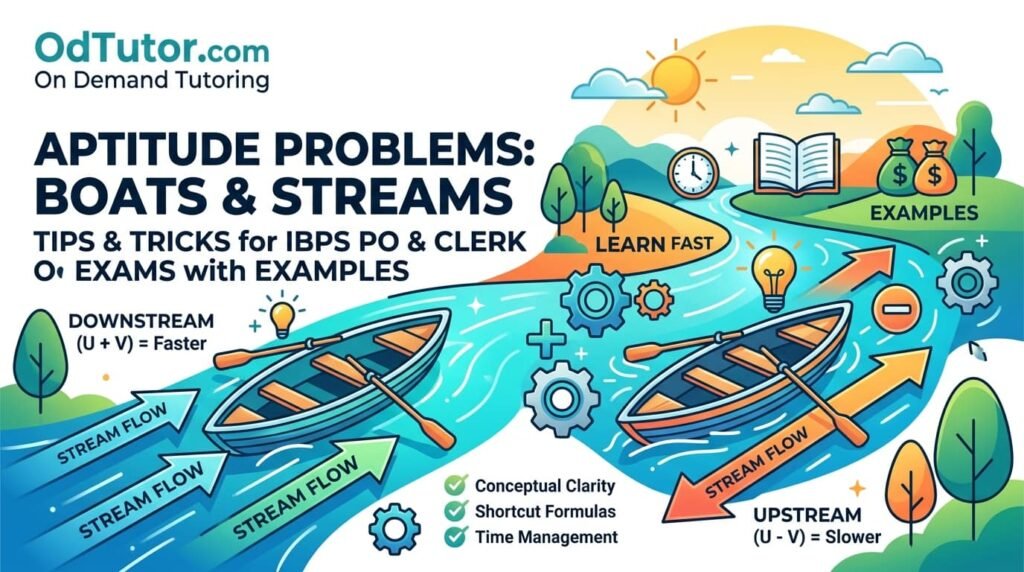
When the boat moves in the same direction as the stream, the river is pushing the boat forward, so the boat’s effective speed increases. This is called moving “downstream.” When the boat moves against the direction of the stream, the river is pushing against it, slowing it down. This is called moving “upstream.”
Here is the key insight I always give my students: the boat has its own speed in still water, and the stream has its own speed. These two speeds simply add up or subtract from each other depending on direction. That’s it. There is no rocket science here.
So we define two terms clearly:
- Speed of boat in still water (b): the speed the boat would have if there were no current at all.
- Speed of stream (s): the speed of the flowing water itself.
Once you fix these two values in your mind, every single Boats and Streams question becomes a simple speed-time-distance problem, just like the ones you’ve already solved in basic motion chapters. The trick is not in new mathematics — it is in correctly identifying which speed to use in which situation. I tell my students: get this concept rock solid first, because every formula ahead is built on top of it.
2. The Two Core Formulas You Must Memorize
Now that the concept is clear, let’s lock in the two formulas that form the backbone of this entire chapter. I want you to write these on a sticky note and paste it on your study table.
Downstream Speed = (b + s)
When the boat moves with the current, the current’s speed adds to the boat’s own speed. So if a boat’s speed in still water is 10 km/hr and the stream’s speed is 2 km/hr, the downstream speed becomes 10 + 2 = 12 km/hr.
Upstream Speed = (b − s)
When the boat moves against the current, the current’s speed gets subtracted from the boat’s speed. Using the same numbers, the upstream speed would be 10 − 2 = 8 km/hr.
Now, here is something extremely important for exams: once you know the downstream speed (let’s call it D) and the upstream speed (let’s call it U), you can directly find the boat’s speed and the stream’s speed using these reverse formulas:
Speed of boat in still water = (D + U) / 2
Speed of stream = (D − U) / 2
I cannot stress enough how often these two reverse formulas appear in IBPS PO and Clerk papers. Many students only memorize the first set and panic when the question gives downstream and upstream speeds and asks for the boat’s speed or stream’s speed. Don’t be that student. Master both directions of these formulas so you can move from any given information to any required answer without hesitation.
Practice writing these four formulas from memory at least ten times until they become instinct, not something you have to think about during the exam.
3. Solved Example: Finding Downstream and Upstream Speed
Let’s apply what we just learned with a typical exam question.
Question: A boat’s speed in still water is 15 km/hr, and the speed of the stream is 3 km/hr. Find the downstream and upstream speeds of the boat.
Solution:
Here, b = 15 km/hr and s = 3 km/hr.
Downstream speed = b + s = 15 + 3 = 18 km/hr
Upstream speed = b − s = 15 − 3 = 12 km/hr
That’s all there is to it. I know this looks almost too simple, and that’s exactly the point — in the actual exam, IBPS rarely asks such a direct question alone. Instead, they wrap this basic concept inside a distance or time problem, which is why understanding this foundational step deeply matters. If you fumble here, the entire question collapses.
A small variation IBPS loves to ask:
Question: The downstream speed of a boat is 20 km/hr and the upstream speed is 12 km/hr. Find the speed of the boat in still water and the speed of the stream.
Solution:
Speed of boat in still water = (D + U)/2 = (20 + 12)/2 = 32/2 = 16 km/hr
Speed of stream = (D − U)/2 = (20 − 12)/2 = 8/2 = 4 km/hr
Notice how this is simply the reverse application of the same formula. I always tell my students in class: don’t treat “find b and s from D and U” as a different question type. It’s the same coin, just flipped. Once this clicks, you’ll never get confused between which formula to apply.
4. Solved Example: Distance, Speed and Time Combined
Now let’s bring in the classic distance-speed-time relationship, since most real exam questions combine Boats and Streams with this formula:
Distance = Speed × Time
Question: A boat covers a distance of 36 km downstream in 3 hours. The speed of the boat in still water is 10 km/hr. Find the speed of the stream.
Solution:
First, find the downstream speed using distance and time:
Downstream speed = Distance / Time = 36 / 3 = 12 km/hr
Now, we know Downstream speed = b + s
So, 12 = 10 + s
Therefore, s = 12 − 10 = 2 km/hr
The speed of the stream is 2 km/hr.
This is a perfect example of how IBPS exams test you — they rarely give you the speed directly. Instead, they make you calculate it first from distance and time, and only then ask you to apply the Boats and Streams formula. I always advise my students to read the question twice: first to identify what type of speed (downstream or upstream) is being described, and second to identify what intermediate calculation is needed before you can plug values into the boat-stream formula.
Another quick example:
Question: A boat takes 4 hours to travel 48 km upstream. If the speed of the stream is 4 km/hr, find the speed of the boat in still water.
Solution:
Upstream speed = 48/4 = 12 km/hr
Upstream speed = b − s, so 12 = b − 4, which gives b = 16 km/hr.
5. The “Same Distance, Different Time” Question Type
This is one of the most frequently repeated patterns in IBPS PO and Clerk exams, so pay close attention here. In this type, a boat covers the same distance upstream and downstream, but takes different amounts of time, and you’re asked to find the speed of the boat or the stream.
Question: A boat covers a certain distance downstream in 2 hours and the same distance upstream in 3 hours. If the speed of the stream is 5 km/hr, find the speed of the boat in still water.
Solution:
Let the distance be the same in both cases. Let downstream speed = D and upstream speed = U.
Since distance is equal: D × 2 = U × 3
This means the ratio of downstream speed to upstream speed is D : U = 3 : 2
Now here’s a useful trick I teach: if D : U = 3 : 2, we can assume D = 3x and U = 2x for some value x.
We know: Speed of stream = (D − U)/2
5 = (3x − 2x)/2 = x/2
So x = 10
Therefore, D = 3x = 30 km/hr, and U = 2x = 20 km/hr
Speed of boat in still water = (D + U)/2 = (30 + 20)/2 = 25 km/hr
This ratio-based approach saves enormous time compared to setting up algebraic equations with distance as an unknown variable. I always encourage my students to spot this pattern immediately: “same distance, different time” is a clear signal to set up a time ratio and convert it into a speed ratio. Practicing this pattern repeatedly will make it second nature, and you’ll solve such questions within 30-40 seconds in the actual exam, which is exactly the speed IBPS expects from a strong candidate.
6. Average Speed for the Entire Journey
Many students get confused when asked to calculate the average speed of a boat that travels downstream and then returns upstream over the same distance. The mistake almost everyone makes is taking a simple average of the two speeds — that is, (D + U)/2. This is WRONG, and I want to be very clear about why.
Average speed is NOT the average of two speeds when the time taken differs for each leg of the journey. The correct formula for average speed when the boat covers the same distance downstream and upstream is:
Average Speed = (2 × D × U) / (D + U)
Question: A boat’s downstream speed is 18 km/hr and upstream speed is 12 km/hr. The boat travels a certain distance downstream and then returns the same distance upstream. Find the average speed for the entire journey.
Solution:
Average Speed = (2 × D × U) / (D + U) = (2 × 18 × 12) / (18 + 12) = 432 / 30 = 14.4 km/hr
Notice this is NOT equal to (18+12)/2 = 15 km/hr. The correct answer, 14.4 km/hr, is always slightly less than the simple average, because the boat spends more time traveling at the slower (upstream) speed than at the faster (downstream) speed, which pulls the overall average down.
I have seen this exact conceptual trap appear in IBPS PO prelims multiple times, with the simple average given as one of the answer options specifically to catch students who haven’t understood this distinction. Memorize this formula carefully, and always double-check whether a question is asking for “average speed of still water” (different formula) versus “average speed of the entire round trip” (this formula).
7. Time-Based Problems: “How Much Time Will It Take”
Another very common question format asks you to calculate the time required to cover a certain distance, given the boat’s speed and the stream’s speed.
Question: The speed of a boat in still water is 12 km/hr and the speed of the stream is 4 km/hr. Find the time taken by the boat to travel 48 km downstream.
Solution:
Downstream speed = b + s = 12 + 4 = 16 km/hr
Time = Distance / Speed = 48 / 16 = 3 hours
A slightly trickier version:
Question: A boat covers 84 km downstream in 6 hours. The speed of the stream is 2 km/hr. How long will the boat take to cover the same distance upstream?
Solution:
Downstream speed = 84/6 = 14 km/hr
Since downstream speed = b + s, we get 14 = b + 2, so b = 12 km/hr
Upstream speed = b − s = 12 − 2 = 10 km/hr
Time taken upstream = Distance / Speed = 84/10 = 8.4 hours
I always tell my students to be extremely careful with units here — convert hours to minutes only when the question specifically asks for it, and double-check whether “8.4 hours” needs to be expressed as “8 hours 24 minutes” in the answer options. IBPS loves to present the same numerical answer in different formats across the four options, specifically to test whether you can correctly convert decimal hours into hours and minutes. This small detail trips up far more students than the actual calculation does, so always read the answer choices before finalizing your response.
8. Problems Involving Total Time for Round Trip
This question type gives you the total time taken for the round trip (going and coming back) and asks you to find the distance, or gives you the distance and asks for total time. These questions require you to add the downstream time and upstream time together.
Question: A boat’s speed in still water is 9 km/hr and the speed of the stream is 3 km/hr. If the boat takes a total of 6 hours to go to a certain place and return back, find the distance to that place.
Solution:
Downstream speed = 9 + 3 = 12 km/hr
Upstream speed = 9 − 3 = 6 km/hr
Let the distance to the place be ‘d’ km.
Time downstream = d/12, Time upstream = d/6
Total time: d/12 + d/6 = 6
Taking LCM of 12 and 6, which is 12:
d/12 + 2d/12 = 6
3d/12 = 6
d/4 = 6
d = 24 km
So the distance to the place is 24 km.
This format tests your ability to set up an equation correctly using fractions, which is why I encourage my students to practice LCM-based fraction addition separately until it becomes fast and automatic. In the exam, you won’t have time to think about how to add d/12 and d/6 — your hands should already know the LCM is 12, and the equation should flow naturally. This is purely a matter of repeated practice, not intelligence, so don’t worry if it feels slow in the beginning. Speed comes with consistent daily practice, not overnight understanding.
9. Common Mistakes Students Make (And How to Avoid Them)
Having taught thousands of students at OdTutor, I have seen the same mistakes repeated year after year. Let me list the most important ones so you can consciously avoid them.
Mistake 1: Confusing upstream and downstream. Many students forget which one is addition and which is subtraction under exam pressure. My tip: remember “Downstream = Dosti (friendship) with the stream,” meaning the stream helps the boat, so speeds add. Upstream means going against the stream, so it subtracts.
Mistake 2: Using the wrong average speed formula. As discussed in section 6, always use (2DU)/(D+U) for round-trip average speed problems, never the simple average.
Mistake 3: Mixing up units. Some questions give speed in km/hr and distance in meters, or time in minutes instead of hours. Always convert everything to the same unit system before calculating.
Mistake 4: Not reading whether the question asks for boat speed or stream speed. Students sometimes calculate correctly but submit the wrong final value because they didn’t note exactly what was asked.
Mistake 5: Rushing through ratio-based questions without setting up the ratio properly. As shown in section 5, taking the time to convert a time ratio into a speed ratio actually saves time overall, rather than wasting it.
Mistake 6: Forgetting to double-check the final answer against the given options. In objective exams, your calculated answer should match one of the four choices. If it doesn’t, you’ve made an error somewhere, and it’s better to catch it before submitting.
I always tell my students: in aptitude exams, conceptual clarity prevents 90% of mistakes; the remaining 10% comes from careless reading. Train yourself to slow down just slightly when reading the question, even while solving fast.
10. Practice Strategy for IBPS PO and Clerk Exams
Understanding the theory is only half the battle. The real skill comes from consistent, structured practice. Here is the strategy I personally recommend to my students at OdTutor.
Week 1: Focus purely on formula mastery. Solve only basic, direct questions like the ones in sections 2 and 3, without time pressure. The goal here is accuracy, not speed.
Week 2: Move to combined distance-time-speed questions and the “same distance, different time” ratio-based questions from section 5. These require a slightly deeper understanding, so take your time to internalize the logic rather than memorizing steps blindly.
Week 3: Introduce timed practice. Set a timer for 60 seconds per question and attempt a mix of all question types covered above. This builds the speed that IBPS exams demand, since Boats and Streams questions are expected to be solved in under a minute during prelims.
Week 4: Solve full-length mock tests that include Boats and Streams mixed with other quantitative aptitude topics, simulating real exam conditions. This is crucial because in the actual exam, you won’t get a dedicated block of Boats and Streams questions — they’ll be scattered among other topics, and you need to recognize and solve them quickly without losing rhythm.
Throughout this journey, maintain an error log. Every time you get a question wrong, write down exactly why — was it a concept gap, a calculation mistake, or a misread question? Reviewing this log weekly will show you your personal weak points far more accurately than generic advice ever could.
How Teachers from OdTutor Can Help
At OdTutor, our trainers don’t just teach formulas — we build genuine problem-solving instinct through structured live classes, doubt-clearing sessions, and topic-wise practice sheets tailored to IBPS, SBI, SSC, and Railway exam patterns. Each student receives personalized feedback on their mock test performance, helping identify specific weak areas in topics like Boats and Streams. With small batch sizes, real exam-level questions, and continuous progress tracking, our teachers ensure that every concept is not just understood once but reinforced until it becomes second nature. Whether you’re a beginner or revising before exam day, OdTutor’s guided approach helps you build both accuracy and speed, the two pillars every successful aspirant needs to clear the quantitative aptitude section confidently.