
Odtutor

Rachit Srivastava

Rachit Srivastava is a renowned English, Aptitude, and Reasoning trainer with extensive experience preparing students for competitive exams like IBPS PO, IBPS Clerk, SBI PO, SBI Clerk, SSC, and Railways. He holds an MBA in Management Science and brings years of experience in content writing, data analysis, and business intelligence consulting for live businesses to his teaching. Known for his simple, practical style, Rachit helps students master exam-oriented shortcuts, build strong fundamentals, and improve calculation speed. At OdTutor, he is committed to making quality education accessible through easy-to-understand explanations, solved examples, mock tests, and personalized guidance for every aspirant.

Verbal Ability Ordering of Sentences - Tips and Tricks to Solve in Exams with Examples

Verbal Ability: Ordering of Sentences – Tips and Tricks to Solve in Exams with Examples

Ten articles in now, and I want to start this one a little differently. Instead of a classroom story, let me share something from my own experience outside teaching. In my content writing and business intelligence work, I’ve reviewed hundreds of reports and presentations where the individual sentences were flawless, but the overall document read like a jumble — ideas placed in the wrong order, forcing the reader to mentally reassemble the logic themselves. That’s precisely the skill Ordering of Sentences tests, and it’s why I wanted to give it a full, dedicated space in this series, even though I touched on it briefly under Sentence Formation. For my IBPS, SBI, SSC, and Railway students, this topic often feels overwhelming at first glance — four or five complete sentences, scrambled, needing to form one coherent paragraph. But once you have the right structural approach, it becomes one of the more predictable, learnable sections in the entire paper. 1. Know Exactly What This Topic Is Testing Ordering of Sentences — often called para-jumbles — gives you a set of complete, independent sentences (usually labeled with letters or numbers) that, when arranged correctly, form a single coherent paragraph. This differs from Ordering of Words, where you’re rearranging individual words within one sentence, and it’s a more focused version of what I discussed in my Sentence Formation article, where para-jumbles were one of several formats covered. What makes this genuinely learnable is that every well-constructed paragraph follows a predictable internal logic — an idea is introduced, developed, sometimes complicated, and then concluded. Your job isn’t to guess randomly; it’s to reverse-engineer this natural structure from the scrambled pieces in front of you. Some exams also provide a fixed first and last sentence, asking you to arrange only the middle sentences — a slightly easier variant, since you already know your starting and ending anchors. Others give you the full set of sentences unordered, requiring you to identify the opening and closing sentences yourself. Recognizing which variant you’re facing shapes how much anchoring work you need to do before you start sequencing. 2. Find the Opening Sentence With Confidence I discussed this briefly in my Sentence Formation article, but it deserves a fuller treatment here, since finding the correct opening sentence is genuinely the single most important step in solving this topic accurately. An opening sentence introduces a general topic, subject, or scenario independently — it doesn’t rely on pronouns, connectors, or references that assume something has already been said. A sentence like “This eventually led to a complete overhaul of the company’s supply chain” cannot open the paragraph, since “this” refers to something that must have been introduced earlier. Similarly, a sentence beginning with “However,” “Therefore,” or “In addition” signals a response to prior content and cannot be your starting point. Instead, look for a sentence that stands independently — one that names a subject, sets a scene, or states a general fact without depending on anything before it: “Renewable energy adoption has accelerated significantly across South Asia over the past decade” is a strong opening candidate, since it introduces its topic without requiring prior context. When multiple sentences seem plausible as openers, check which one most naturally sets up the specific direction the rest of the paragraph takes — sometimes two sentences both seem “general,” but only one actually connects logically to what follows once you trace the full sequence. 3. Identify the Concluding Sentence Just as Deliberately Just as important, though often overlooked, is identifying which sentence likely concludes the paragraph. A concluding sentence typically summarizes, states an outcome or implication, or offers a final judgment or forward-looking statement — it rarely introduces brand-new information that hasn’t been set up by the sentences before it. Look for words and phrases signaling conclusion: “ultimately,” “as a result,” “in the end,” “this suggests,” or “moving forward.” A sentence like “Ultimately, this shift in policy reshaped the entire industry’s approach to sustainability” reads as a natural closing statement, tying together ideas that would have been developed in the sentences before it. Identifying both the opening and closing sentences early — before working out the full middle sequence — gives you two fixed anchors to build toward, considerably narrowing the possibilities for how the remaining sentences fit in between. This is especially useful when you’re short on time, since even correctly identifying just these two anchors often earns you a strong, educated basis for selecting the right overall answer among the given options. 4. Track Connectors and Pronouns as Your Sequencing Compass This is a technique I emphasized in my Sentence Formation article, and it remains just as central here. Words like “however,” “therefore,” “furthermore,” “as a result,” and “in contrast” signal a direct logical relationship to whatever sentence precedes them, while pronouns like “it,” “this,” “they,” and “these” point back to something that must have been named in an earlier sentence. The practical technique is this: for every sentence containing a connector or pronoun, ask yourself specifically what it’s referring back to, and scan the other sentences for the one that provides that exact reference. If one sentence says “They welcomed this decision with considerable relief,” you need to locate the earlier sentence that identifies who “they” are and what “this decision” refers to — that sentence must come directly before it in the sequence. I recommend physically underlining every connector and pronoun across all the given sentences before attempting any arrangement. This creates a web of “must follow” relationships that, in many cases, resolves the majority of the sequence almost mechanically, well before you’ve had to rely on your general sense of the paragraph’s topic alone. 5. Look for Mandatory Pairs Often, two sentences within the jumbled set are so tightly connected — through a shared pronoun reference, a direct cause-and-effect relationship, or a continued example — that they must appear consecutively, regardless of where the rest of the paragraph’s sentences fall. Identifying these “mandatory pairs” early can dramatically simplify the overall
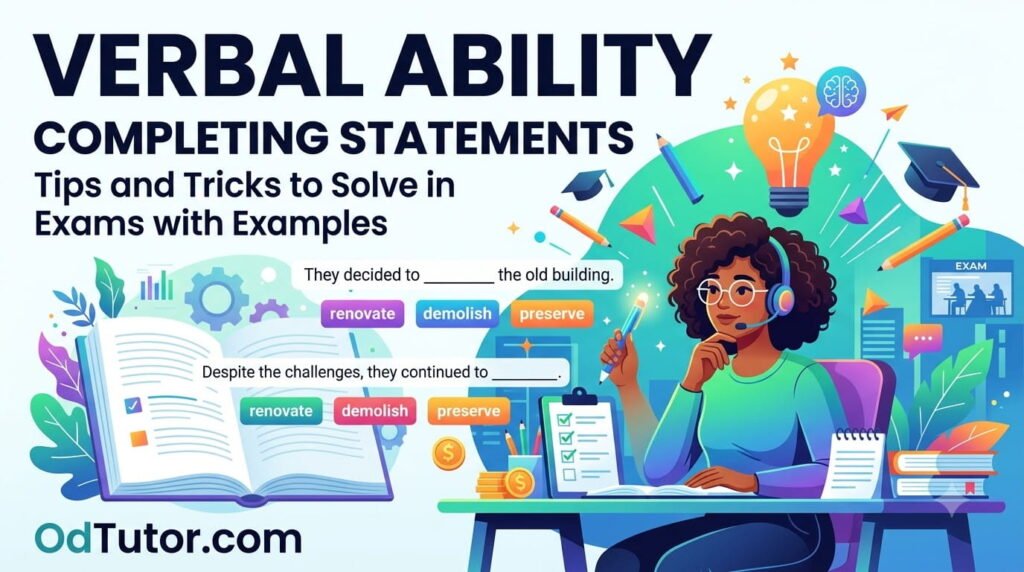
Verbal Ability Completing Statements - Tips and Tricks to Solve in Exams with Examples

Verbal Ability: Completing Statements – Tips and Tricks to Solve in Exams with Examples

Nine articles into this series now, and if you’ve been following along since Spotting Errors, Synonyms, Antonyms, Selecting Words, Spellings, Sentence Formation, Ordering of Words, and Sentence Improvement, you’ll notice something interesting: today’s topic, Completing Statements, feels like the natural meeting point of almost everything we’ve discussed so far. I say this to my students often — this section doesn’t test one narrow skill, it tests whether you can hold a sentence’s logic, tone, and grammar together in your head all at once, and then predict how it should end. Having trained IBPS, SBI, SSC, and Railway aspirants on this exact topic for years, I can tell you it’s one of the most learnable sections once you understand the underlying logic patterns exams rely on. Let’s work through it properly. 1. Understand What “Completing Statements” Actually Asks In this question type, you’re given a sentence with a portion missing — usually the second half of a compound or complex sentence — along with several options to complete it. Unlike Selecting Words, where you’re filling a single blank within a sentence, here you’re often completing an entire clause, meaning the logical relationship between the given portion and the missing portion carries much more weight than individual word choice alone. For example: “Although the company invested heavily in employee training, _____.” Here, the given clause starts with “although,” signaling contrast, so the completion needs to describe an outcome that goes against what you’d normally expect following heavy investment in training — something like “employee turnover remained surprisingly high” fits this contrast far better than a completion suggesting improved performance, which would align with, rather than contradict, the initial clause. My first piece of advice, before anything else, is to identify the logical relationship type embedded in the given portion of the sentence — contrast, cause-and-effect, condition, or addition — since this single identification does most of the heavy lifting in narrowing down a correct completion. 2. Master the Four Core Logical Relationships Nearly every Completing Statements question relies on one of four logical relationships between the given clause and its completion, and recognizing these patterns quickly is the single most valuable skill you can build for this topic. The first is contrast, signaled by words like “although,” “even though,” “despite,” “while,” and “whereas” — the completion should describe something unexpected or opposing relative to the first clause. The second is cause-and-effect, signaled by “because,” “since,” “as,” and “so,” where the completion should logically follow from, or explain, the given clause. The third is condition, signaled by “if,” “unless,” and “provided that,” where the completion describes a consequence dependent on the stated condition being met or unmet. The fourth is addition or continuation, signaled by “and,” “moreover,” “furthermore,” or simply a comma-based continuation, where the completion extends the same idea in the same direction rather than opposing or explaining it. For instance: “Since the flight was delayed by several hours, _____” clearly calls for a cause-and-effect completion — something like “passengers were offered complimentary meal vouchers” — following logically as a consequence of the delay. Training yourself to spot these four signal categories instantly, almost like flashcards in your mind, turns this section from a vague guessing exercise into a structured, predictable process. 3. Predict the Completion Before Reading the Options Just as I’ve emphasized throughout this series — particularly in my Selecting Words and Sentence Improvement articles — forming your own mental prediction before scanning the given options is the single habit that most reliably improves accuracy in Completing Statements questions. Once you’ve identified the logical relationship type, try to complete the sentence yourself, in your own words, before looking at what’s offered. This matters especially here because Completing Statements options are often longer and more elaborate than in simpler fill-in-the-blank formats, making it easier to be swayed by an option that “sounds impressive” or grammatically polished but doesn’t actually fit the sentence’s specific logic. Having your own prediction anchors you against this pull. For example: “Unless the government revises its current subsidy policy, _____.” Your prediction might be something like “farmers will continue to struggle with rising costs,” anticipating a negative consequence tied to the unmet condition. If one option offers “farmers will see improved profitability,” you’ll immediately recognize this contradicts the conditional logic (since it describes a positive outcome despite the policy not being revised), while a matching option describing continued struggle aligns with your prediction and the sentence’s actual logic. 4. Watch for Options That Are Grammatically Fine but Logically Disconnected A very common trap in this section involves options that are perfectly well-formed sentences on their own, and even loosely related to the topic of the given clause, but don’t actually follow the specific logical relationship the sentence structure demands. These distractors test whether you’re truly tracking logic, or simply looking for a “topically relevant” completion. Consider: “Even though the new software update improved processing speed significantly, _____.” A distractor option might read “the development team was proud of their achievement” — this is grammatically fine and topically related to the software update, but it doesn’t provide the contrast that “even though” demands. The correct completion needs to describe something that undercuts or complicates the positive improvement, such as “many users reported frequent compatibility issues with older systems.” This is precisely why identifying the logical relationship type in step two matters so much — it gives you a specific test to apply to each option, rather than a vague sense of “does this sound related,” which is exactly the kind of loose evaluation these distractors are designed to exploit. 5. Pay Attention to Tense and Grammatical Continuity Beyond logical fit, a correct completion must also maintain proper tense and grammatical continuity with the given clause. Even a logically sound completion can be the wrong answer if it shifts tense inappropriately or doesn’t grammatically connect to the sentence’s established structure. For example: “By the time the auditors arrived, the finance team _____.” Given the past perfect structure implied

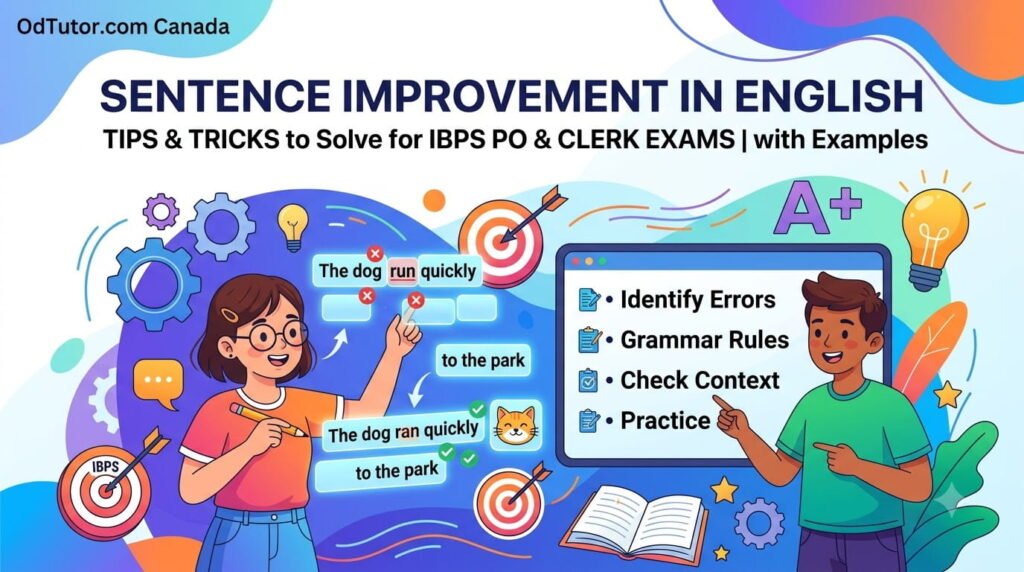
Sentence Improvement in English — Tips and Tricks to Solve in IBPS PO and Clerk Exams with Examples

Sentence Improvement in English — Tips and Tricks to Solve in IBPS PO and Clerk Exams with Examples

In my Sentence Formation article a couple of weeks ago, I touched briefly on sentence improvement as one of several related formats. But over the eight-part journey we’ve had so far in this series — Spotting Errors, Synonyms, Antonyms, Selecting Words, Spellings, Sentence Formation, and Ordering of Words — I’ve realized this topic genuinely deserves its own dedicated space, because it comes up constantly in doubt sessions with my IBPS, SBI, SSC, and Railway students. Sentence Improvement sits at an interesting intersection: it’s not just about spotting what’s wrong, like in Spotting Errors, but about actively choosing the best possible correction from several plausible-looking options. That extra decision-making layer is where most of the confusion happens, so let’s slow down and work through it properly. 1. Understand What Makes This Different From Spotting Errors In Spotting Errors, you’re identifying which part of a sentence is wrong, sometimes without even being told what the correct version should look like. In Sentence Improvement, the sentence typically has one underlined portion, and you’re given four or five alternative phrasings, one of which is the original (usually labeled “No improvement” or similar), and your job is to choose the best replacement, or confirm the original is already correct. This distinction matters because Sentence Improvement demands comparative judgment, not just error detection. You might correctly identify that something feels off about the underlined portion, but then face two or three options that all seem to fix it in slightly different ways — and only one is genuinely the best, most precise correction. My first piece of advice is to treat this as a two-stage process. First, diagnose what’s specifically wrong with the underlined portion, exactly as you would in a Spotting Errors question. Second, and separately, evaluate each option against that specific diagnosis, rather than simply picking whichever option sounds smoothest or most sophisticated on a quick read. 2. Diagnose Before You Compare The single most valuable habit I try to build in my students for this topic is diagnosing the exact problem before even glancing at the answer options. Read the sentence, isolate the underlined portion, and ask yourself specifically: is this a grammar issue (tense, subject-verb agreement, preposition), a redundancy issue, an awkward construction, or actually already correct? For example: “The manager, along with his team, are working on the proposal.” The underlined portion here is “are working,” and the diagnosis is a subject-verb agreement issue — “along with his team” is a parenthetical phrase, not part of the core subject, so the verb should agree with the singular “manager,” giving “is working.” Having this specific diagnosis in mind before scanning options prevents you from being pulled toward an option that fixes a different, perhaps more superficial issue while leaving the actual grammatical problem untouched. If you already know you’re looking for “is working” specifically, you’ll bypass distractor options far more quickly and confidently. 3. Be Alert to “Partial Fix” Distractors One of the most common traps in Sentence Improvement questions is the partial-fix distractor — an option that corrects part of the sentence’s problem but introduces a new, different error, or leaves part of the original problem unaddressed. These options are specifically designed to catch students who recognize that something needs fixing but haven’t diagnosed the issue precisely enough. Consider: “Despite of his best efforts, he could not complete the assignment on time.” The error here is “despite of,” which is a nonstandard combination — you should use either “despite” alone or “in spite of,” never both together. A partial-fix distractor might offer “In spite his best efforts,” which removes “despite” but incorrectly drops the necessary “of” from “in spite of,” introducing a new error while trying to fix the original one. The correct option, in this case, would properly read either “Despite his best efforts” or “In spite of his best efforts.” Spotting this kind of trap requires reading each option carefully and completely, rather than assuming an option is correct just because it changes the obviously problematic word. 4. Watch for Options That Are Grammatically Correct but Contextually Wrong Some Sentence Improvement questions include options that are, in isolation, perfectly grammatical sentences, but don’t fit the specific context, tone, or intended meaning established by the rest of the passage or sentence. This requires you to consider the full sentence’s meaning, not just the grammatical validity of the replacement phrase alone. For instance: “The company reported a significant loss last quarter, which surprised investors who had expected consistent growth.” If the underlined portion is “which surprised investors,” and one option changes it to “which excited investors,” this is grammatically flawless but contextually wrong, since the sentence describes a loss, and a loss would not “excite” investors expecting growth. This kind of trap reinforces something I’ve emphasized throughout this series: language questions in competitive exams test contextual precision, not just isolated grammatical correctness. Always re-read the full sentence with your chosen option substituted in, confirming that the complete sentence still makes logical sense, not just that the replacement phrase itself is grammatically sound. 5. Prioritize Concise, Formal Phrasing When Grammar Is Equal When you’re faced with two or more options that all appear grammatically correct and contextually appropriate, competitive exams typically favor the more concise, formal option over a wordier or more casual alternative, reflecting the same preference for precision I discussed in my Sentence Formation article regarding redundancy. For example, if choosing between “due to the fact that he was late” and “because he was late,” the second, more concise option is generally preferred in formal written English, assuming both are grammatically valid replacements for the underlined portion in question. That said, conciseness should never come at the cost of clarity or necessary meaning. If a shorter option strips away information that changes the sentence’s intended meaning, the longer, more complete option is the better choice despite being less concise. This is why the diagnosis-first approach matters so much — you need to know exactly what the sentence needs to

Verbal Ability Ordering of Words - Tips and Tricks to Solve in Exams with Example

Verbal Ability: Ordering of Words – Tips and Tricks to Solve in Exams with Examples

I remember a student once handing back a practice sheet and saying, “Sir, I got the meaning right, I got the grammar right, but I still lost marks because the words were in the wrong order.” That comment has stuck with me over the years, because it captures exactly what makes this topic so easy to underestimate. We’ve now covered Spotting Errors, Synonyms, Antonyms, Selecting Words, Spellings, and Sentence Formation in this series, and today we look at a close relative of that last one — Ordering of Words, where individual words within a single sentence are jumbled and need to be rearranged into a correct, meaningful order. It looks deceptively simple, but as I’ve seen with countless IBPS, SBI, SSC, and Railway aspirants, this section punishes students who rely on instinct alone rather than structured technique. Let’s fix that. 1. Understand How This Differs From Sentence and Para Rearrangement Ordering of Words questions give you a set of individual words or short phrases, jumbled out of sequence, and ask you to arrange them into one grammatically correct and meaningful sentence — sometimes selecting the correct order from given options, sometimes identifying which segment comes first, second, or last. This differs from para-jumbles, which I covered in my Sentence Formation article, because you’re working within a single sentence rather than sequencing multiple complete sentences into a paragraph. The logical connectors and pronoun-tracking techniques still matter, but here, grammatical structure plays an even bigger role, since you’re essentially rebuilding a sentence’s skeleton from scattered parts rather than sequencing already-complete units of thought. The first step, before attempting any arrangement, is to read through all the given words or phrases once, without trying to arrange them yet, simply to get a general sense of the sentence’s likely topic and tone. This initial pass primes your brain to recognize a sensible arrangement more quickly once you start actively piecing the sentence together. 2. Identify the Subject and Main Verb First Every correctly formed sentence needs a clear subject and a main verb, and identifying these two elements among your jumbled words or phrases gives you a strong anchor to build the rest of the sentence around. Once you know who or what the sentence is about, and what action or state is being described, the remaining words usually fall into place more naturally around that core. For example, given jumbled segments like “the annual report,” “was submitted,” “by the finance team,” and “before the deadline,” start by identifying the main action: “was submitted” is your verb phrase. Then ask what was submitted — “the annual report” is your subject. From there, the remaining phrases logically attach: who submitted it (“by the finance team”) and when (“before the deadline”), giving you “The annual report was submitted by the finance team before the deadline.” This subject-verb-first approach prevents you from getting distracted by smaller, modifying phrases before establishing the sentence’s core structure, which is a common mistake that leads students to build a technically fluent-sounding but structurally incorrect arrangement. 3. Use Articles and Prepositions as Positional Clues Small words like articles (“a,” “an,” “the”) and prepositions (“in,” “on,” “at,” “by,” “with,” “of”) carry surprisingly strong positional information, since they almost always attach to a specific noun or noun phrase immediately following them. Spotting these small words among your jumbled segments helps you quickly identify which phrases must stay adjacent to each other. For instance, if one jumbled segment is simply “the,” it must be immediately followed by a noun phrase, not a verb — so you can quickly eliminate pairing “the” with an action-based segment. Similarly, a segment ending in a preposition, like “responsible for,” clearly signals that whatever comes next must be the object of that preposition, such as “the project’s delay,” giving you “responsible for the project’s delay” as a fixed, connected unit. I encourage students to treat these small grammatical words as glue, actively looking for which larger phrase each one connects to before worrying about the overall sentence order. Building these smaller, connected units first — essentially pre-assembling two or three-word clusters — makes the final full-sentence arrangement considerably easier, since you’re working with fewer, larger building blocks rather than many scattered individual words. 4. Watch for Correlative and Coordinating Structures Certain word pairs and structures require specific companion words elsewhere in the sentence, and recognizing these pairs helps you lock two segments together immediately, regardless of where they initially appear among the jumbled options. Correlative conjunctions like “not only…but also,” “either…or,” “neither…nor,” and “both…and” are especially useful here, since spotting one half of the pair tells you exactly what kind of segment must appear with the other half. For example, if one jumbled segment contains “not only did he apologize,” you know there must be a corresponding segment starting with “but also,” and the grammatical structure following each half must match — if the first half uses a verb phrase, the second half should as well, maintaining the parallelism I discussed in my Spotting Errors article. Coordinating conjunctions like “and,” “but,” and “or” also give useful clues, since they typically join elements of the same grammatical type — two nouns, two verb phrases, or two complete clauses — rather than mismatched elements. If you see “and” attached to a segment, look specifically for another segment of the same grammatical form to logically pair with it. Training yourself to notice these structural signals turns what feels like a purely trial-and-error puzzle into a more systematic process, considerably speeding up your accuracy during timed practice. 5. Build the Sentence in Logical Chunks, Not Word by Word A common mistake I see is students trying to slot individual words into position one at a time, essentially guessing an overall order and then checking if it sounds right. This approach is slow and unreliable, especially under time pressure. Instead, I recommend grouping jumbled words into small, logical phrase-chunks first — as discussed in the articles-and-prepositions technique above — before worrying about the sentence’s

Verbal Ability Sentence Formation Tips and Tricks to Solve in Exams with Examples

Verbal Ability: Sentence Formation – Tips and Tricks to Solve in Exams with Examples

There’s a question I get asked in almost every doubt-clearing session: “Sir, I know all the individual rules — tenses, articles, prepositions — but when I have to build or rearrange a full sentence, I freeze.” If that sounds familiar, you’re not alone, and it’s exactly why I wanted to dedicate this sixth piece in our series to Sentence Formation, after covering Spotting Errors, Synonyms, Antonyms, Selecting Words, and Spellings. This topic pulls together almost everything we’ve discussed so far, because forming or rearranging a correct sentence requires you to apply grammar rules, logical sequencing, and word choice all at once, under time pressure. Let’s break down how to approach it calmly and systematically. 1. Understand the Different Formats This Topic Takes Sentence Formation appears in a few distinct formats across competitive exams, and recognizing which one you’re dealing with immediately shapes your approach. The first is sentence rearrangement, or para-jumbles, where you’re given several jumbled sentences and asked to arrange them in the correct logical order to form a coherent paragraph. The second is sentence improvement, where a sentence contains an underlined portion, and you must choose the best replacement from given options. The third is phrase or clause rearrangement within a single sentence, where parts of one sentence are jumbled and need to be reordered correctly. Each format tests a slightly different skill, but they all share a common foundation: understanding logical flow and grammatical correctness together, rather than either one in isolation. A rearranged paragraph might be grammatically perfect in each individual sentence but still wrong if the ideas don’t flow logically from one to the next. My first piece of advice, regardless of format, is to identify which specific version of Sentence Formation you’re facing before diving into the options, since your strategy — whether you’re hunting for logical connectors, checking grammatical fit, or tracking a narrative thread — shifts depending on the exact question type in front of you. 2. For Para-Jumbles, Find the Opening Sentence First When rearranging jumbled sentences into a coherent paragraph, the single most important step is identifying the correct opening sentence, since everything else follows logically from a properly established starting point. An opening sentence typically introduces a general topic, a subject, or a scenario without relying on pronouns or connecting words that would only make sense if something had already been said before it. For example, if one jumbled sentence begins with “However, this approach failed to consider rural areas,” it cannot be the opening sentence, since “however” signals a contrast with something stated earlier — something that must appear in a prior sentence. Similarly, a sentence starting with “This resulted in significant delays” cannot open the paragraph, since “this” refers back to something already introduced. Instead, look for a sentence that stands independently, introducing a clear subject or scenario: “The government recently launched a new initiative to improve rural infrastructure” is a strong candidate for an opening sentence, since it introduces the topic without depending on prior context. Once you’ve identified a strong candidate for the opening sentence, work outward from there, looking for the sentence that logically follows it — often signaled by a connector word, a pronoun referring back to something just introduced, or a natural continuation of the idea. 3. Track Connector Words and Pronouns as Your Sequencing Clues Beyond identifying the opening sentence, the fastest way to sequence the remaining sentences correctly is by tracking connector words and pronouns throughout the jumbled set, since these almost always point backward to something that must have appeared earlier in the paragraph. Words like “however,” “therefore,” “as a result,” “in addition,” and “consequently” all signal a logical relationship to a previous sentence, whether contrast, cause-and-effect, or continuation. If you spot “therefore” in one sentence, scan the other jumbled sentences for the one that provides the reason or cause it’s responding to — that sentence must come immediately before it. Pronouns work similarly. If a sentence uses “it,” “this,” “they,” or “these” without introducing what they refer to, that reference must be established in an earlier sentence. For instance, “They were initially skeptical about the results” requires an earlier sentence that introduces who “they” are — perhaps researchers, a committee, or a specific group mentioned by name. I always tell my students to physically underline connector words and pronouns first, before attempting a full arrangement, since this quick scan gives you a web of “must come after” relationships that often resolves the entire sequence quickly, even before you’ve fully read every sentence’s detailed content. 4. For Sentence Improvement, Predict Before You Look at Options In sentence-improvement questions, where an underlined portion needs the best replacement, the same prediction-first principle I discussed in my Selecting Words article applies strongly here too. Read the full sentence, identify what specifically feels wrong or awkward about the underlined portion — is it a grammar issue, a wordiness problem, or an unclear structure? — and form your own mental correction before scanning the given options. For example: “Being a rainy day, we decided to stay indoors.” The underlined portion “Being a rainy day” is a dangling modifier, since it illogically implies “we” were the rainy day. Before looking at options, you’d predict something like “Since it was a rainy day” or “As it was raining.” This prediction lets you quickly identify the matching option rather than being swayed by choices that fix a different, less significant issue in the sentence. This approach is particularly useful because many sentence-improvement questions include distractor options that fix a minor stylistic issue while ignoring the actual underlying grammatical error, or vice versa — options that sound smoother but don’t correct the real problem. Having a clear, specific prediction protects you from being pulled toward options that merely “sound nicer” without genuinely fixing what’s wrong. 5. Watch for Redundancy and Wordiness A frequently tested issue in sentence formation and improvement questions is unnecessary redundancy — using more words than needed to express an idea, often repeating a

Verbal Ability Spellings - Tips and Tricks to Solve in Exams with Examples

Verbal Ability: Spellings – Tips and Tricks to Solve in Exams with Examples

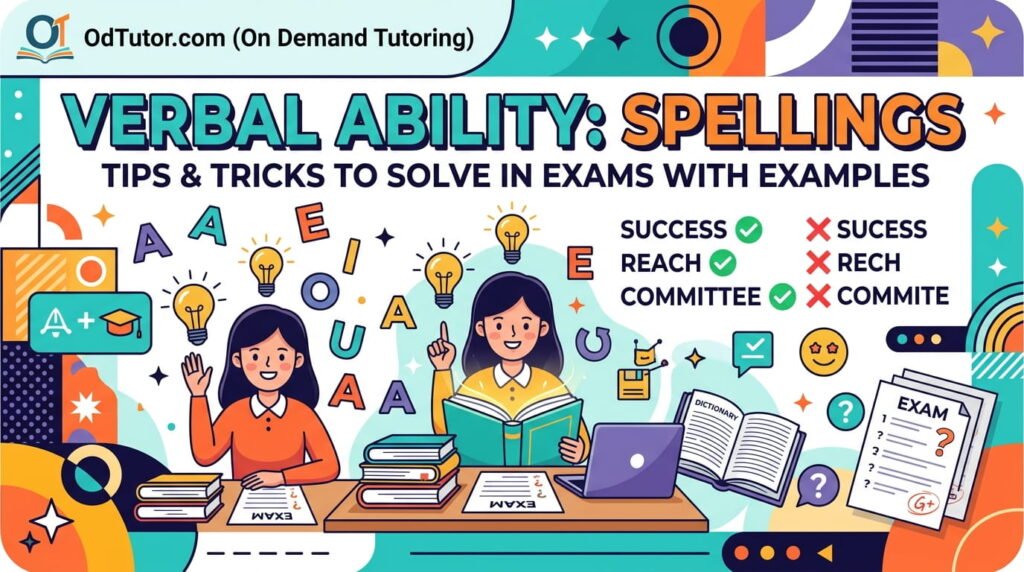
A student once told me, “Sir, I know grammar, I know vocabulary, but spellings still get me.” I hear some version of this almost every batch, and honestly, it makes sense. Spellings feel different from everything else we’ve covered so far in this series — Spotting Errors, Synonyms, Antonyms, and Selecting Words all reward understanding and logic, but spellings can feel like pure memory, and memory alone is unreliable under exam pressure. The good news, after years of coaching aspirants for IBPS, SBI, SSC, and Railway exams, is that spelling accuracy isn’t really about memorizing every word in the English language. It’s about recognizing patterns, knowing where English typically goes wrong, and training your eye to catch what looks “off.” Let’s get into how. 1. Understand How Spelling Questions Are Actually Asked Spelling questions in competitive exams usually take one of two forms. The first is a direct format, where you’re given four or five spellings of a word and asked to identify the correctly spelled one, or the one that’s misspelled. The second, increasingly common format, embeds a misspelled word within a full sentence or passage, asking you to spot it among several underlined words — a format that overlaps significantly with the Spotting Errors questions I discussed in my first article. The key skill in both formats is the same: training your eye to notice when a familiar-looking word has something subtly wrong with it, even when the overall shape of the word looks correct at a glance. This is harder than it sounds, because our brains are naturally good at “auto-correcting” text as we read, filling in gaps and skipping over small errors without consciously noticing them — which is exactly why students who read quickly often perform worse on this section than those who read a little more deliberately. My first piece of advice is always this: slow down slightly for spelling-focused questions specifically. The two-second habit of reading a word letter-by-letter, rather than as a whole shape, catches significantly more errors than a quick glance ever will. 2. Learn the Common Categories of Spelling Errors Over the years, I’ve noticed that most spelling mistakes tested in exams fall into a handful of recurring categories, and knowing these categories gives you a mental checklist to run through when you’re unsure about a word. The first category is doubled versus single consonants — words like “occurrence,” “embarrass,” “necessary,” and “recommend” are frequently misspelled because students aren’t sure whether to double a letter. The second is silent letters, as in “psychology,” “receipt,” “foreign,” and “conscience,” where a letter is present but unpronounced, making it easy to forget or misplace. The third category involves commonly confused letter pairs, particularly “ie” versus “ei” — the classic rule “i before e, except after c” helps with words like “believe” and “receive,” though exceptions like “weird” and “seize” exist and are worth memorizing separately. The fourth category is suffix-related errors, especially around words ending in “-able” versus “-ible,” or “-ance” versus “-ence,” which don’t follow a single reliable rule and require targeted memorization. Building awareness of these categories means that when you’re unsure about a word during the exam, you can quickly ask yourself, “Which category might this error fall into?” rather than trying to recall the word from a vague, general memory — a targeted question is always easier to answer than an open-ended one. 3. Maintain a Personal “Difficult Words” List Every student has their own individual set of words that consistently trip them up, and generic spelling lists rarely address this personalized weak spot effectively. I strongly recommend maintaining your own running list of words you’ve personally misspelled during practice tests, rather than relying solely on pre-made vocabulary books. Whenever you get a spelling question wrong during practice, don’t just note the correct spelling — write the word out five to six times by hand, say it aloud syllable by syllable, and if possible, note why you got it wrong (did you double a letter incorrectly, forget a silent letter, or confuse a suffix?). This active, reflective process builds much stronger retention than simply reading a correct spelling once and moving on. Over a few months of consistent exam practice, you’ll likely notice your personal list clustering around specific patterns — perhaps you consistently struggle with double consonants, or perhaps silent letters are your particular weak spot. Recognizing your own pattern lets you focus your remaining preparation time far more efficiently than spreading effort evenly across all possible spelling categories. I ask my students to review this personal list at least twice a week, and notably, to revisit it again a month later — spelling errors have a frustrating tendency to resurface if reviewed only once, so spaced repetition matters here just as much as it does for vocabulary building. 4. Break Words Into Syllables and Roots One of the most reliable techniques for spelling difficult words correctly is breaking them into smaller, manageable chunks rather than trying to memorize the whole word as a single unit. This mirrors the root-word approach I described in my synonyms and antonyms articles, and it applies just as usefully here. Take a commonly misspelled word like “accommodate.” Broken into parts — “ac-com-mo-date” — it becomes easier to remember that both the “c” and the “m” are doubled, since you’re processing the word in smaller, distinct sound units rather than as one long, unfamiliar string of letters. Similarly, “Wednesday” becomes far more memorable when you notice its root relationship to “Woden’s day” (from Old English), which explains that seemingly silent “d” in the middle. Understanding root words also helps with consistency across word families. If you know that “photo” relates to light, you’ll spell “photography,” “photosynthesis,” and “photogenic” more confidently, since the shared root anchors your spelling of that segment across multiple related words. I encourage students to pause on genuinely difficult words and actively look for a syllable breakdown or root explanation, rather than simply trying to memorize the letter sequence

Verbal Ability Selecting Words - Tips and Tricks to Solve in Exams with Examples

Verbal Ability: Selecting Words – Tips and Tricks to Solve in Exams with Examples

Four articles in, and I’m genuinely enjoying this series with you — Spotting Errors, Synonyms, Antonyms, and now we arrive at a topic that quietly trips up even well-prepared students: Selecting Words, often seen as fill-in-the-blank or word-choice questions. Here’s something I’ve noticed over the years of training aspirants for IBPS, SBI, SSC, and Railway exams: this section isn’t really about knowing more words than the next student. It’s about reading carefully and choosing the word that fits the sentence’s exact meaning, tone, and grammar — not just any word that sounds plausible. Let’s work through how to do that reliably. 1. Understand What “Selecting Words” Actually Tests This question type gives you a sentence with one or more blanks, along with word options for each blank, and asks you to pick the choice that best completes the sentence’s meaning. Sometimes it’s a single blank, sometimes two or more blanks in the same sentence, each needing options that work together logically. The key difference from synonyms is this: you’re not matching a given word’s meaning — you’re matching the sentence’s meaning. The blank has no fixed answer until you understand what the sentence as a whole is trying to say. This means your first job isn’t to scan the options at all; it’s to read the full sentence and predict, in your own words, what kind of word should logically go there before you even look at the choices. For example: “Despite the heavy rain, the farmers were _____ about this year’s harvest.” Before looking at options, you’d predict a positive word like “optimistic” or “hopeful,” since “despite” signals a contrast with something negative (heavy rain), meaning the blank must convey a favorable, unexpected outlook. Only after this mental prediction should you check which option matches best. 2. Use Contextual Signal Words as Your Compass Certain words within the sentence act as strong signals, or “compass words,” pointing you toward the tone and direction of the missing word. Learning to spot these quickly saves considerable time and prevents you from being misled by tempting but wrong options. Words like “although,” “despite,” “however,” “yet,” and “but” signal contrast — meaning the blank likely opposes something else stated in the sentence. Words like “because,” “since,” “therefore,” and “as a result” signal cause-and-effect, meaning the blank should logically follow from a stated reason. Consider: “The manager was known for his _____ approach; he never made a decision without consulting his entire team.” No contrast word appears here, but the explanation that follows (never deciding without consulting others) directly supports the blank — the missing word should mean something like “collaborative” or “consultative,” since the explanation reinforces rather than opposes it. Recognizing these compass words takes practice, but once internalized, it becomes almost automatic — your eyes catch “despite” or “because” and immediately orient your prediction in the right direction before you’ve even finished reading the sentence. 3. Check for Two-Blank Sentences and Internal Consistency Many exams include sentences with two blanks, and here, the two missing words must work together logically and grammatically, not just individually fit their local context. This is where students often get one blank right but overlook whether the second word actually complements the first in tone and meaning. Take this example: “The negotiations were _____, with both sides making _____ that ultimately led to a fair agreement.” The overall outcome (a fair agreement) tells you both blanks should carry a cooperative, positive tone — something like “constructive” and “concessions” work well together, since constructive negotiations naturally involve concessions leading to fairness. An option pairing a negative first word with a positive second word, or vice versa, would break this internal consistency even if each word looks fine in isolation. My tip here: read the full sentence with both blanks in mind before evaluating any option pair. Predict the overall tone of the sentence first — positive, negative, or neutral — and then check that both words in a given option share that same tone and logically connect to each other, not just to their immediate surrounding words. 4. Watch Out for “Almost Right” Distractor Options Selecting Words questions are notorious for including distractor options that are close in meaning to the correct answer but subtly wrong in tone, degree, or connotation — exactly the kind of trap I discussed in my synonyms and antonyms articles, but arguably even more common here since the sentence gives you a very specific meaning to match. For instance: “The critic’s review was _____, praising the film’s cinematography while pointing out its weak script.” A word like “balanced” fits perfectly, since the sentence describes both praise and criticism together. A tempting but wrong distractor might be “harsh” — related to criticism, but ignoring the praise entirely — or “glowing,” which ignores the criticism half of the sentence. Both distractors relate to part of the sentence but fail to capture the complete picture. This is why the prediction-first approach I mentioned earlier matters so much: if you form your own mental answer before scanning options, you’re far less likely to be pulled toward a word that only partially matches, since you’ll immediately notice it doesn’t fully align with your prediction. 5. Pay Attention to Formal Versus Informal Tone Competitive exams generally favor formal, standard written English, and the sentences in Selecting Words questions typically maintain a consistent register throughout. A word that’s technically correct in meaning but too casual, or too dramatic, for the sentence’s tone is often the wrong choice, even when its dictionary meaning fits. For example: “The committee’s decision was met with _____ from several stakeholders who felt excluded from the process.” A formal option like “resistance” or “opposition” fits the professional tone of the sentence far better than a more casual or exaggerated word like “outrage,” which overstates the intensity implied by the rest of the sentence, or “grumbling,” which feels too informal for a sentence about a professional committee. I always tell my students to read the entire

Verbal Ability Antonyms - Tips and Tricks to Solve in Exams with Examples

Verbal Ability: Antonyms – Tips and Tricks to Solve in Exams with Examples

Continuing from where we left off in my last two articles — Spotting Errors and Synonyms — let’s move to their close cousin: Antonyms. I say “cousin” because a lot of students assume that if they’re good at synonyms, antonyms will automatically follow. In my years of training aspirants for IBPS, SBI, SSC, and Railway exams, I’ve seen this assumption trip up otherwise strong students more often than you’d expect. Knowing what a word means and knowing its precise opposite are related but distinct skills, and exams are well aware of this gap — which is exactly why they test both separately. The good news is that many of the strategies I shared for synonyms carry over here with a slight twist. Let’s get into it. 1. Understanding How Antonym Questions Are Framed An antonym question typically gives you a word and asks you to choose the option that means the opposite, or is “most nearly opposite,” since exams rarely offer a perfect, textbook-exact opposite among the choices. This “most nearly opposite” framing is important — it means you’re often selecting the best available option rather than a flawless mirror-opposite, so process of elimination plays a bigger role here than students expect. Just like synonyms, antonyms are increasingly tested within a passage rather than as standalone words, particularly in exams that combine vocabulary testing with reading comprehension. When this happens, the surrounding sentence tells you exactly which sense of the word is being used, which matters a great deal for words with multiple meanings. Take the word “grave.” As an adjective, it means serious or solemn (a grave mistake), so its antonym would be something like “trivial” or “minor.” But as a noun, “grave” refers to a burial site, and has no meaningful antonym in that sense at all. If a question tests “grave” within a sentence like “The doctor’s grave expression worried the family,” the passage confirms you’re dealing with the adjective sense, not the noun. A common student error is picking an antonym for the wrong sense of a multi-meaning word, or worse, picking a word that’s actually unrelated in meaning rather than truly opposite. My advice: always identify the exact sense and part of speech of the word in context first, then look for its opposite — never the reverse order. 2. Learn to “Flip” Roots and Prefixes If you’ve been building your root-word vocabulary from my synonyms article, you already have a head start here, because antonyms often hide in plain sight through prefixes that negate or reverse a word’s core meaning. Recognizing this pattern can help you identify an opposite even for words you don’t fully know. Common negating prefixes include “un-,” “in-,” “im-,” “il-,” “ir-,” “dis-,” “non-,” and “anti-.” For example, “competent” becomes its opposite with “in-” (incompetent), “legal” becomes “illegal,” “responsible” becomes “irresponsible,” and “honest” becomes “dishonest.” Recognizing these prefix patterns means that if a question word already has a negating prefix, you can often find its opposite by simply looking for the root word alone, or vice versa. Beyond prefixes, certain root-based opposites recur often in exams. Roots like “bene” (good) and “mal” (bad) directly oppose each other, so “benevolent” (kindly disposed) opposes “malevolent” (having ill intentions). Similarly, “pro-” (in favor of) and “anti-” (against) create natural opposite pairs, as in “proponent” versus “opponent.” It’s worth noting a caution here, though: not every word with a negating prefix has a true “opposite” relationship with its root — some prefixed words have drifted into their own distinct meaning over time (for instance, “invaluable” doesn’t mean “not valuable”; it actually means extremely valuable). I always tell my students to verify a handful of these tricky exceptions specifically, since exams occasionally include them precisely to catch students who over-rely on the prefix trick alone. Used carefully, though, this root-and-prefix approach remains one of the fastest ways to work out an antonym for a word you only partially recognize. 3. Build Antonym Pairs Alongside Your Vocabulary, Not After One mistake I see often is students building a vocabulary list purely around meanings, and only later, separately, trying to memorize antonyms as an afterthought. This doubles your effort unnecessarily. Instead, I recommend learning new words in opposite-pairs right from the start, since this reinforces both the word and its opposite together, using each to sharpen your understanding of the other. For instance, when you learn “candid” (openly honest, straightforward), immediately pair it with “evasive” or “guarded” (reluctant to give direct information) as its opposite. When you learn “abundant” (existing in large quantities), pair it immediately with “scarce” or “meager.” This pairing method does double duty — it strengthens your synonym recognition and antonym recognition simultaneously, since you’re essentially learning two exam-relevant words in the time it typically takes to learn one. This approach is particularly powerful for adjectives describing personality, tone, or intensity — categories that competitive exams draw from heavily. Pairs like “meticulous” and “careless,” “assertive” and “timid,” “frugal” and “extravagant,” or “concise” and “verbose” are exactly the kind of vocabulary competitive exams favor, and learning them as connected pairs makes both far easier to recall under exam pressure. I recommend maintaining your vocabulary notebook with two columns side by side — the word and its most common opposite — rather than a single list. Reviewing pairs together, rather than words in isolation, has consistently helped my students recall antonyms faster and more accurately during timed practice tests. 4. Be Careful With Degree and Intensity One of the trickiest aspects of antonym questions is that many words exist on a scale of intensity, and exams often include multiple options that are technically “opposite-ish” but differ in how strongly they oppose the original word. Choosing the option with the closest degree of opposition, not just any vaguely opposite word, is key to getting these right. Consider the word “adore” (to love deeply). A mild antonym might be “dislike,” but a stronger, more precise opposite would be “detest” or “abhor” (to hate intensely). If the exam word

Verbal Ability Synonyms - Tips and Tricks to Solve in Exams with Examples

Verbal Ability: Synonyms – Tips and Tricks to Solve in Exams with Examples

If you’ve read my previous article on Spotting Errors, you already know a little about me and how I approach exam preparation — keeping things simple, practical, and rooted in real exam patterns rather than textbook theory. Today, I want to continue that same approach with another high-scoring but often underestimated topic: Synonyms. Most students treat this as a pure vocabulary game — either you know the word or you don’t. But over years of training aspirants for IBPS, SBI, SSC, and Railway exams, I’ve found that Synonyms questions actually reward strategy just as much as vocabulary. There are patterns, elimination techniques, and root-word tricks that can help you answer confidently even when a word feels unfamiliar at first glance. Let’s break it all down. 1. Understanding What Exams Actually Test Before diving into vocabulary-building techniques, it’s worth understanding exactly what a Synonyms question is asking. You’ll typically be given a word — sometimes standalone, sometimes underlined within a passage — and asked to choose the option closest in meaning from four or five choices. The word “closest” is key here; exams rarely offer an exact one-to-one match, so you’re really being tested on which option shares the most overlapping meaning and tone with the given word. Many exams now test synonyms in a contextual format, embedding the target word within a reading comprehension passage. This is actually a gift in disguise — the surrounding sentence often narrows down the intended meaning, especially for words that carry multiple senses. For instance, the word “sound” can mean “healthy” (a sound body), “reasonable” (a sound argument), or “a noise” (a loud sound) — and only the passage context tells you which meaning is being tested. A common mistake students make is picking the option that’s a synonym for the word in general usage, without checking whether it fits the specific sense used in that sentence. This single oversight costs more marks than not knowing the word at all. My advice: always read the sentence around the word first, identify which “version” of the word is being used, and only then scan the options. This context-first habit alone will improve your accuracy meaningfully, even on words you’re only partially familiar with. 2. Learn Word Roots, Prefixes, and Suffixes This is, in my experience, the single most powerful long-term strategy for synonym questions. English vocabulary is built largely from Latin and Greek roots, and once you recognize common ones, you can often deduce the meaning of a completely unfamiliar word just from its structure. Take the root “bene” (meaning good) — it appears in “benevolent” (kind, good-natured), “benefactor” (one who does good), and “beneficial” (helpful). Similarly, “mal” (meaning bad) gives us “malevolent” (having bad intentions), “malady” (an illness), and “malicious” (intending harm). If a question asks for the synonym of “malevolent,” even without knowing the exact word, recognizing “mal” tells you to look for a negative-meaning option. Prefixes are equally revealing. “Un-,” “in-,” “dis-,” and “im-” typically negate a word’s meaning (unhappy, inaccurate, dishonest, impossible), while “pro-” often suggests moving forward or in favor of something (progress, proponent), and “anti-” suggests opposition (antidote, antagonist). Suffixes also carry meaning. Words ending in “-ous” or “-ful” are usually adjectives describing a quality (courageous, joyful), while “-tion” or “-ment” often indicate a noun form of an action (creation, achievement). Recognizing these patterns helps you at least identify the part of speech, which narrows your options considerably. I encourage my students to maintain a small root-word notebook, adding five new roots a week along with two or three example words each. Over two to three months, this builds a vocabulary framework strong enough to tackle even unfamiliar words with reasonable confidence. 3. Read Widely and Actively, Not Just for Exams There’s no substitute for genuine reading when it comes to building real vocabulary depth — the kind that lets you recognize a word’s tone and usage instantly, rather than just its dictionary meaning. Editorial sections of good newspapers, opinion pieces, and well-written articles expose you to formal vocabulary in natural context, which is exactly how these words appear in exams. The key word here is “actively.” Passive reading — where you skim past unfamiliar words without pausing — builds almost no new vocabulary. Instead, whenever you encounter an unfamiliar word while reading, pause, guess its meaning from context, and then verify it. This habit of guessing before checking trains the same contextual-inference skill that synonym questions require. I recommend maintaining a reading journal where you jot down five new words a day from your reading, along with the sentence they appeared in and a simple, one-line meaning in your own words — not a copied dictionary definition. Writing meanings in your own words forces genuine understanding rather than memorization. It also helps to revisit these words periodically rather than just once. Spaced repetition — reviewing a word after one day, then after a week, then after a month — is far more effective for long-term retention than cramming a long list the night before an exam. Over a few months of consistent, active reading, you’ll notice something interesting: unfamiliar words start appearing less often, and your instinct for a word’s “feel” — even without formally knowing its meaning — starts becoming reliable enough to answer confidently in the exam. 4. Use Context Clues When the Word Appears in a Passage Many modern exams test synonyms within a comprehension passage rather than as standalone questions, and this format actually works in your favor if you know how to use it. The surrounding sentence almost always gives clues about the word’s tone, intensity, and specific meaning, even if you don’t know the word precisely. Look for structural clues first. If the sentence contains contrast words like “but,” “however,” or “although,” the unfamiliar word likely has an opposite meaning to something else in the sentence. For example: “Despite his reputation for being frugal, he made a lavish donation to the charity” — here, “frugal” is being contrasted with “lavish,” so

Verbal Ability Problems on Spotting Errors - Tips and Tricks to Solve in Exams with Examples

Verbal Ability: Problems on Spotting Errors – Tips and Tricks to Solve in Exams with Examples

About Me Hi, I’m Rachit Srivastava, and I’ve spent the better part of my career helping students crack the English, Aptitude, and Reasoning sections of competitive exams like IBPS PO, IBPS Clerk, SBI PO, SBI Clerk, SSC, and Railways. Alongside my MBA in Management Science, I’ve worked extensively in content writing, data analysis, and business intelligence consulting for live businesses — experience that has taught me one simple truth: precision with language and numbers matters everywhere, not just in exams. My teaching philosophy is built on simplicity. I don’t believe in overwhelming students with jargon or complicated grammar rules they’ll forget the next day. Instead, I focus on practical shortcuts, strong fundamentals, and plenty of real exam-style practice so that when you sit for your test, spotting an error feels like second nature rather than a guessing game. Today, I want to walk you through one of the most scoring — and most misunderstood — sections in the English paper: Spotting Errors. With the right approach, this section can become one of your fastest scoring areas rather than a time-consuming struggle. 1. Understanding the Question Pattern First Before jumping into grammar rules, it’s important to understand how Spotting Errors questions are actually structured. Most exams break a sentence into three or four parts (labelled A, B, C, D), and you’re asked to identify which part contains a grammatical error, or to mark “No Error” if the sentence is correct. Some exams present the full sentence with underlined segments instead of lettered parts, but the core skill being tested remains the same — your ability to notice when something in a sentence doesn’t sit right grammatically. The biggest mistake students make is trying to “translate” the sentence in their head or overanalyzing the meaning. Spotting Errors is not a vocabulary or comprehension test — it’s a structural test. Your job is to check whether each part of the sentence follows the rules of English grammar, not whether the sentence makes logical sense. I always tell my students to read the sentence twice: once for overall flow, and once part by part, specifically looking for the “usual suspects” — subject-verb agreement, tense consistency, articles, prepositions, and pronouns. Over time, this two-pass method becomes automatic, and you’ll start noticing errors within seconds. For example: “Each of the students / have submitted / their assignment / No Error.” Here, part B is wrong because “each” is singular and needs “has,” not “have.” Recognizing this instantly comes from knowing the pattern, not from re-reading the whole sentence five times. 2. Subject-Verb Agreement Errors This is, without exaggeration, the single most tested error type in every competitive exam I’ve prepared students for. The rule is simple in theory: singular subjects take singular verbs, and plural subjects take plural verbs. In practice, exams love to hide the real subject behind tricky phrases, collective nouns, or words like “each,” “every,” “either,” and “neither.” Consider this sentence: “The list of items / are / placed on the table / No Error.” Students often see “items” right before “are” and assume it’s correct. But the actual subject is “list,” which is singular — so it should be “is placed,” not “are placed.” This is called the “proximity trap,” and once you learn to spot it, entire categories of questions become easy. Collective nouns like “team,” “committee,” “family,” and “jury” are another common trap. These typically take a singular verb when acting as one unit: “The committee has decided” is correct, while “The committee have decided” is generally treated as an error in most exam patterns — unless members are acting individually. Words like “each,” “every,” “either,” “neither,” “none,” and “one of the” are almost always singular. So “Neither of the boys were present” should be “Neither of the boys was present.” My shortcut trick: mentally cross out prepositional phrases (like “of the students,” “along with his friends”) sitting between the subject and verb. What remains will usually reveal the true subject, making agreement errors far easier to catch under exam pressure. 3. Tense-Related Errors Tense errors test whether the verb forms used across a sentence are consistent with the time frame being described. These errors are sneaky because they often “sound fine” on a quick read, especially if you’re mentally rushing through the passage — which is exactly why exams include them. A classic example: “He has completed the project / yesterday / and submitted the report / No Error.” The word “yesterday” indicates a definite point in the past, so the present perfect tense (“has completed”) is incorrect — it should be “completed” in simple past. Present perfect tense is used for actions with no specific past time reference or those connected to the present, not for events tied to specific past markers like “yesterday,” “last year,” or “in 2020.” Another frequent trap involves “since” and “for.” “Since” is used with a specific point in time (since 2015, since Monday), while “for” is used with a duration (for five years, for two hours). Sentences often swap these incorrectly: “He is living here since five years” should be “He has been living here for five years.” Sequence of tense in reported speech and conditional sentences is another favorite. In “If I would have known, I would have come,” the first clause is wrong — it should be “If I had known,” since “would have” cannot appear in the “if” clause of a third conditional sentence. My advice: whenever you see time-indicating words like “yesterday,” “next week,” “since,” “ago,” or “by the time,” treat that sentence as a potential tense-trap and verify the verb form against that time marker specifically. 4. Errors with Articles (A, An, The) Articles seem like the smallest words in English, but they carry disproportionate weight in Spotting Errors questions. The three articles — “a,” “an,” and “the” — follow rules that are easy to learn but easy to overlook when you’re reading quickly under time pressure. The basic rule: use “a” before words starting with