
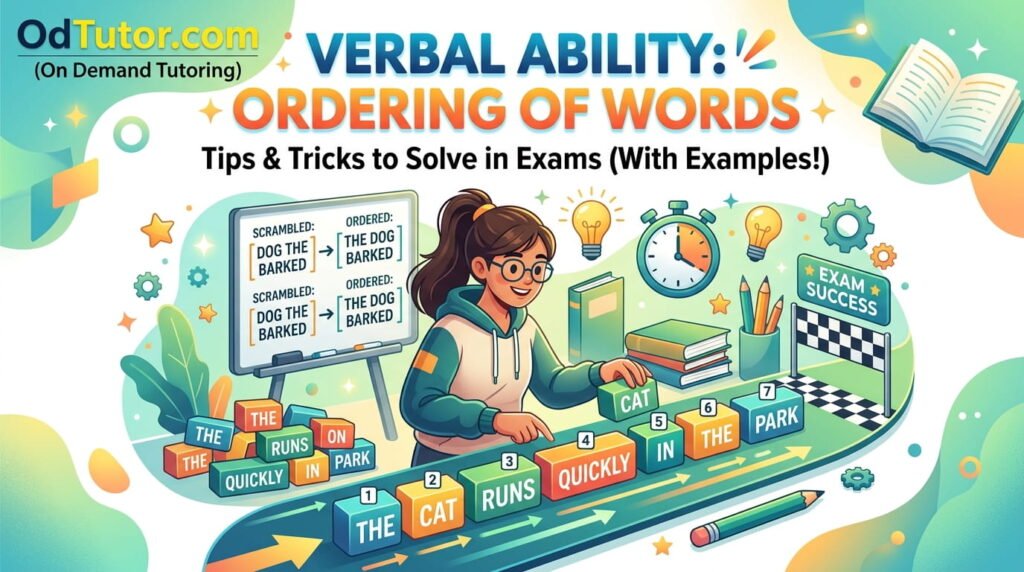
I remember a student once handing back a practice sheet and saying, “Sir, I got the meaning right, I got the grammar right, but I still lost marks because the words were in the wrong order.” That comment has stuck with me over the years, because it captures exactly what makes this topic so easy to underestimate. We’ve now covered Spotting Errors, Synonyms, Antonyms, Selecting Words, Spellings, and Sentence Formation in this series, and today we look at a close relative of that last one — Ordering of Words, where individual words within a single sentence are jumbled and need to be rearranged into a correct, meaningful order. It looks deceptively simple, but as I’ve seen with countless IBPS, SBI, SSC, and Railway aspirants, this section punishes students who rely on instinct alone rather than structured technique. Let’s fix that.
1. Understand How This Differs From Sentence and Para Rearrangement
Ordering of Words questions give you a set of individual words or short phrases, jumbled out of sequence, and ask you to arrange them into one grammatically correct and meaningful sentence — sometimes selecting the correct order from given options, sometimes identifying which segment comes first, second, or last.
This differs from para-jumbles, which I covered in my Sentence Formation article, because you’re working within a single sentence rather than sequencing multiple complete sentences into a paragraph. The logical connectors and pronoun-tracking techniques still matter, but here, grammatical structure plays an even bigger role, since you’re essentially rebuilding a sentence’s skeleton from scattered parts rather than sequencing already-complete units of thought.
The first step, before attempting any arrangement, is to read through all the given words or phrases once, without trying to arrange them yet, simply to get a general sense of the sentence’s likely topic and tone. This initial pass primes your brain to recognize a sensible arrangement more quickly once you start actively piecing the sentence together.
2. Identify the Subject and Main Verb First
Every correctly formed sentence needs a clear subject and a main verb, and identifying these two elements among your jumbled words or phrases gives you a strong anchor to build the rest of the sentence around. Once you know who or what the sentence is about, and what action or state is being described, the remaining words usually fall into place more naturally around that core.
For example, given jumbled segments like “the annual report,” “was submitted,” “by the finance team,” and “before the deadline,” start by identifying the main action: “was submitted” is your verb phrase. Then ask what was submitted — “the annual report” is your subject. From there, the remaining phrases logically attach: who submitted it (“by the finance team”) and when (“before the deadline”), giving you “The annual report was submitted by the finance team before the deadline.”
This subject-verb-first approach prevents you from getting distracted by smaller, modifying phrases before establishing the sentence’s core structure, which is a common mistake that leads students to build a technically fluent-sounding but structurally incorrect arrangement.
3. Use Articles and Prepositions as Positional Clues
Small words like articles (“a,” “an,” “the”) and prepositions (“in,” “on,” “at,” “by,” “with,” “of”) carry surprisingly strong positional information, since they almost always attach to a specific noun or noun phrase immediately following them. Spotting these small words among your jumbled segments helps you quickly identify which phrases must stay adjacent to each other.
For instance, if one jumbled segment is simply “the,” it must be immediately followed by a noun phrase, not a verb — so you can quickly eliminate pairing “the” with an action-based segment. Similarly, a segment ending in a preposition, like “responsible for,” clearly signals that whatever comes next must be the object of that preposition, such as “the project’s delay,” giving you “responsible for the project’s delay” as a fixed, connected unit.
I encourage students to treat these small grammatical words as glue, actively looking for which larger phrase each one connects to before worrying about the overall sentence order. Building these smaller, connected units first — essentially pre-assembling two or three-word clusters — makes the final full-sentence arrangement considerably easier, since you’re working with fewer, larger building blocks rather than many scattered individual words.
4. Watch for Correlative and Coordinating Structures
Certain word pairs and structures require specific companion words elsewhere in the sentence, and recognizing these pairs helps you lock two segments together immediately, regardless of where they initially appear among the jumbled options. Correlative conjunctions like “not only…but also,” “either…or,” “neither…nor,” and “both…and” are especially useful here, since spotting one half of the pair tells you exactly what kind of segment must appear with the other half.
For example, if one jumbled segment contains “not only did he apologize,” you know there must be a corresponding segment starting with “but also,” and the grammatical structure following each half must match — if the first half uses a verb phrase, the second half should as well, maintaining the parallelism I discussed in my Spotting Errors article.
Coordinating conjunctions like “and,” “but,” and “or” also give useful clues, since they typically join elements of the same grammatical type — two nouns, two verb phrases, or two complete clauses — rather than mismatched elements. If you see “and” attached to a segment, look specifically for another segment of the same grammatical form to logically pair with it.
Training yourself to notice these structural signals turns what feels like a purely trial-and-error puzzle into a more systematic process, considerably speeding up your accuracy during timed practice.
5. Build the Sentence in Logical Chunks, Not Word by Word
A common mistake I see is students trying to slot individual words into position one at a time, essentially guessing an overall order and then checking if it sounds right. This approach is slow and unreliable, especially under time pressure. Instead, I recommend grouping jumbled words into small, logical phrase-chunks first — as discussed in the articles-and-prepositions technique above — before worrying about the sentence’s complete order.
For example, given individual jumbled words like “quickly,” “the,” “team,” “responded,” “to,” “the,” “customer’s,” and “complaint,” first group obvious chunks: “the team,” “responded quickly,” and “to the customer’s complaint.” Once you have these three solid chunks, arranging them into a full sentence becomes far simpler: “The team responded quickly to the customer’s complaint,” rather than trying to place eight individual words correctly all at once.
This chunking approach mirrors how we naturally process language — we rarely think in single, isolated words, but rather in meaningful phrase units — so leaning into this natural tendency, rather than fighting it by treating every word as an independent puzzle piece, considerably speeds up your solving process.
6. Read Your Final Arrangement Aloud (Mentally) Before Finalizing
Once you’ve arrived at what seems like a correct arrangement, it’s worth taking a brief moment to mentally “read” the sentence aloud, checking whether it sounds natural and grammatically complete, rather than immediately moving to the next question. This final check catches errors that might not be obvious when you’re focused on individual chunks and connectors alone.
Pay particular attention to whether the sentence has a complete, sensible meaning from start to finish, not just grammatically correct individual segments. It’s entirely possible to arrange grammatically valid chunks in an order that technically follows connector-word rules but still produces an awkward or illogical overall sentence, particularly in longer, more complex sentences with multiple clauses.
This final read-through step takes only a few seconds but meaningfully reduces careless errors, especially in cases where two very similar arrangements might both seem grammatically plausible at first glance, but only one truly captures a natural, sensible meaning.
7. Practice With Increasingly Complex Sentence Structures
When building your preparation for this topic, start with simpler sentence structures — a single subject, verb, and object, with one or two modifying phrases — before progressing to more complex sentences involving multiple clauses, correlative conjunctions, or embedded phrases. This graduated approach builds your foundational chunking and connector-recognition skills before you’re asked to apply them to genuinely challenging, exam-level sentences.
As you progress, deliberately practice with sentences containing relative clauses (using “who,” “which,” “that”), since these require careful attention to ensure the clause correctly modifies the intended noun, and correlative structures, since these require the parallel matching discussed earlier. Complex sentences involving conditional clauses (“if…then” structures) or subordinate clauses with “although,” “because,” or “since” are also worth dedicated practice, since these introduce additional layers of logical dependency between sentence parts.
Working through previous years’ papers from your specific target exam remains valuable here too, since it exposes you to the actual complexity level and topic themes your exam typically favors, rather than generic textbook exercises that might not accurately reflect your exam’s real difficulty level.
8. Recognize Common Traps and Near-Miss Arrangements
Exams often include distractor options that rearrange the given segments into an order that’s grammatically plausible but subtly incorrect in meaning, word placement, or natural phrasing. Recognizing these traps requires the same careful, meaning-focused final check discussed earlier, rather than accepting the first grammatically valid-seeming arrangement you construct.
A common trap involves modifying phrases placed in a technically grammatical but awkward or ambiguous position — for instance, “The manager reviewed, carefully, the proposal” is grammatically unusual in its placement of “carefully” compared to the more natural “The manager carefully reviewed the proposal” or “The manager reviewed the proposal carefully.”
Another trap involves misplaced modifiers that create unintended meaning, similar to the dangling-modifier issue I discussed in my Sentence Formation article. If a modifying phrase ends up positioned closer to the wrong noun, the sentence’s meaning shifts in a way that a careless, quick arrangement might not catch.
Being aware that these traps exist encourages the habit of double-checking your final arrangement specifically for natural phrasing and clear, unambiguous meaning, not just technical grammatical validity.
9. Time Management and Exam-Day Strategy
Ordering of Words questions typically take a bit less time than full para-jumbles, since you’re working within a single sentence rather than multiple complete sentences, but they still require more careful thought than a straightforward vocabulary question. Budget around 30-40 seconds per question once you’ve built solid chunking and connector-recognition skills through practice.
If you’re genuinely stuck after identifying the subject, verb, and a couple of logical chunks, use elimination among the given answer options rather than trying to build the entire sentence from scratch under time pressure — often, comparing partial chunks against the given options directly reveals the correct choice faster than a full independent reconstruction.
As with every topic in this series, practice consistently within timed, full-length mock tests, and maintain an error log noting whether your specific mistakes came from missing a connector-word clue, misplacing a modifier, or overlooking the sentence’s overall logical meaning during your final check.
Sharpening This Skill With OdTutor
Ordering of Words rewards structured thinking over guesswork, and that structure is exactly what our teachers at OdTutor help you build. Through guided practice on real exam-style jumbled sentences, live demonstrations of the chunking technique, and personalized feedback on your specific recurring mistakes, our trainers help turn this often-underestimated topic into a genuinely fast and reliable scoring area for you.