
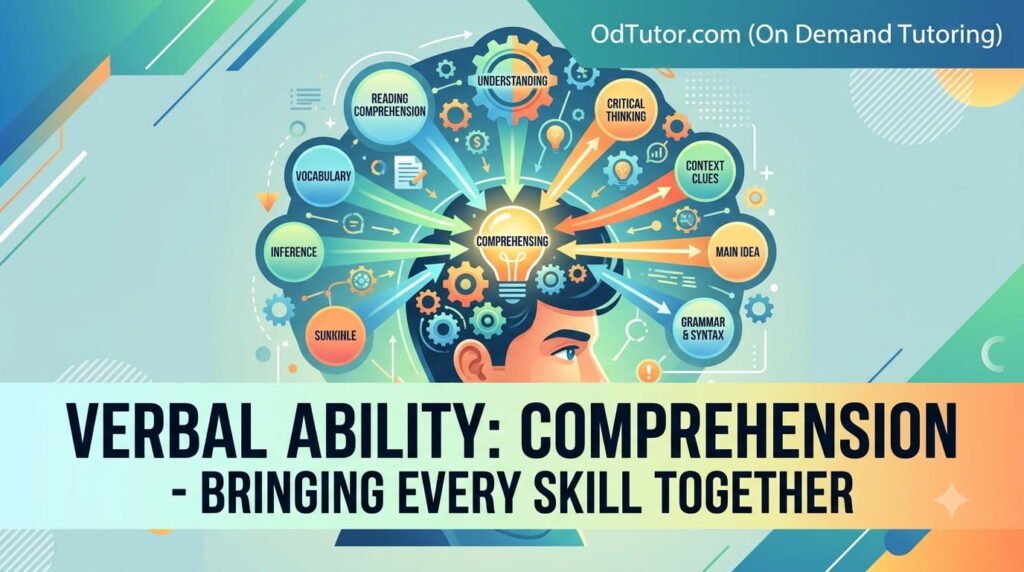
Thirteen articles in, and we’ve arrived at what feels like the natural culmination of this entire series. If Spotting Errors, Synonyms, Antonyms, Selecting Words, Spellings, Sentence Formation, Ordering of Words, Sentence Improvement, Completing Statements, Ordering of Sentences, Paragraph Formation, and Cloze Test have been individual instruments warming up, Reading Comprehension is where the full orchestra plays together. This isn’t a new skill separate from everything we’ve covered — it’s the ultimate application of all those skills combined, under realistic reading conditions, with complex passages and multi-layered questions that test everything from vocabulary to inference to critical analysis. After training thousands of IBPS, SBI, SSC, and Railway aspirants, I can tell you with certainty: students who excel at comprehension aren’t those with innate “reading ability” — they’re those who’ve deliberately practiced applying every single technique we’ve discussed so far, passage by passage, question by question. Let’s walk through how.
1. Comprehension Demands Every Skill We’ve Built So Far
Start by understanding what Reading Comprehension actually tests. Each passage is a miniature version of everything we’ve covered:
Spotting Errors foundation: You need to read grammatically and catch when something is phrased awkwardly or incorrectly, since this affects meaning.
Synonyms and Antonyms: Vocabulary precision matters enormously — not just knowing what words mean in isolation, but understanding shades of meaning and how word choice signals tone and emphasis.
Selecting Words and Cloze Test logic: You’re contextually inferring meaning from surrounding phrases and passages, not just looking up definitions.
Sentence Formation and Ordering: You track how sentences connect logically and sequentially, recognizing how ideas build across multiple sentences and paragraphs.
Sentence Improvement and Completing Statements: You distinguish between what’s explicitly stated and what’s implied, and you follow logical relationships between clauses and ideas.
Paragraph Formation: You recognize which details genuinely support a passage’s central idea versus which are tangential or contradictory.
Cloze Test skills: You read passages first for overall tone, theme, and flow before attempting detailed questions, rather than jumping to individual questions in isolation.
Reading Comprehension bundles all of this. A student weak in vocabulary will misunderstand word-choice questions. A student weak in logical inference will struggle with “which statement can be inferred?” questions. A student weak in distinguishing main idea from supporting detail will get author’s tone and purpose wrong. The good news: if you’ve been practicing this series thoroughly, you’ve been building comprehension skill all along.
2. The Three-Pass Reading Strategy: Bringing It All Together
Before answering any comprehension questions, I recommend a deliberate three-pass approach that synthesizes everything we’ve learned:
First Pass: Read for Overall Theme and Tone (Cloze Test + Paragraph Formation skill)
Read the entire passage without stopping to analyze individual sentences. Ask yourself: What’s the passage about? What’s the author’s overall stance — positive, negative, neutral, skeptical? What’s the main point? Is the passage explaining, arguing, narrating, or describing? This first pass should take you roughly 40-50 seconds for a 300-word passage.
Second Pass: Identify Structure and Key Support (Sentence Formation + Ordering of Sentences skill)
Go back through the passage and mentally note the structure — how many main ideas are presented? What’s the opening claim? What evidence or examples support it? Where do counterarguments or complications appear? How does it conclude? This pass isn’t about memorizing details, but recognizing the passage’s skeleton.
Third Pass: Note Vocabulary and Tone Markers (Synonyms + Sentence Improvement skill)
On your third pass, pay specific attention to vocabulary choices that signal the author’s tone or emphasis. Words like “merely,” “unfortunately,” “remarkably,” or “undeniably” carry loaded meaning. Phrases that repeat or echo across the passage reveal what the author considers central to the argument. This pass takes another 20-30 seconds and prepares you for vocabulary-specific and tone-specific questions.
Only after these three passes should you look at the specific questions. This read-first approach feels time-consuming initially, but it consistently saves time overall and prevents you from misunderstanding questions because you’ve missed the passage’s broader context.
3. Question Types and Which Skills Each Demands
Reading Comprehension questions typically fall into a handful of types, and each type directly maps to skills we’ve built:
Main Idea / Central Theme questions → Demands: Paragraph Formation skill (distinguishing main idea from supporting detail) → Approach: The answer should capture what the entire passage is fundamentally about, not just one example or supporting point.
Vocabulary / Word Meaning in Context questions → Demands: Synonyms + Antonyms + Selecting Words skill (contextual inference) → Approach: Look at how the word is used within its sentence, and check which option fits that specific context, not the word’s general dictionary meaning.
Inference / “Can Be Inferred” questions → Demands: Completing Statements skill (following logical connections) → Approach: The answer should follow logically from what’s stated, not require external knowledge. If the passage states “The budget was cut,” and you’re asked what happened to projects, an inference might be “Projects likely faced delays,” but not “The company immediately laid off staff” (which goes beyond what’s stated).
Author’s Tone / Purpose questions → Demands: Sentence Improvement skill (recognizing tone through word choice) → Approach: Look for words revealing the author’s attitude — “criticizes,” “argues,” “celebrates,” “questions.” Match the overall passage tone, not just isolated sentences.
Supporting Evidence / Detail questions → Demands: Spotting Errors skill (precise reading for accuracy) → Approach: Check that your answer actually appears in the passage, in the exact form asked. Don’t paraphrase or infer — verify the text explicitly supports your choice.
Logical Sequence / Ordering questions (less common in modern exams, but present in some) → Demands: Ordering of Sentences + Sentence Formation skill → Approach: Recognize transition words and pronouns that link sentences in sequence.
4. Common Trap Answers: Recognizing Distractor Patterns
Just as with every other topic in this series, comprehension questions include deliberate distractor patterns. Recognizing these patterns prevents you from being misled:
Distractor Pattern 1: Topically Related but Not Actually Stated An answer choice might describe something related to the passage’s topic, but that the passage never actually says. For example, if a passage discusses climate change impacts on agriculture, an answer about renewable energy might sound reasonable but goes beyond what the passage claims.
→ Defense: Verify each detail explicitly appears in the passage, particularly for “Supporting Detail” questions.
Distractor Pattern 2: True in General Knowledge but Not in This Passage An answer might be factually true in the real world, but the passage either doesn’t mention it or even contradicts it. Comprehension tests your understanding of this specific passage, not your general knowledge.
→ Defense: Always base answers on the passage content alone, regardless of what you know externally.
Distractor Pattern 3: Partially Correct but Incomplete or Reversed An answer might capture part of what the passage says, but miss a crucial qualifier or reversal. For instance, if the passage states “The study found no correlation between X and Y,” an answer saying “X causes Y” captures the variables but inverts the finding.
→ Defense: Read answer choices word-by-word carefully, checking for words like “not,” “no,” “unlike,” or “opposite.”
Distractor Pattern 4: Confusing Similar Concepts If the passage contrasts two ideas, a distractor might blend them together or swap them, requiring careful reading to distinguish.
→ Defense: When a passage sets up a contrast, actively track which idea is which, noting explicit language like “unlike,” “whereas,” or “however.”
5. Vocabulary in Context: Where Synonyms and Antonyms Meet Comprehension
One of the most common comprehension question types asks for the meaning of a word as used in the passage. This is where our entire Synonyms and Antonyms preparation directly applies, with one crucial addition: the meaning must fit the passage’s specific context, not just the word’s general dictionary sense.
For example, the word “sound” appears in “Her sound advice proved valuable” — here, “sound” means something like “well-reasoned” or “sensible.” But if the passage said “The sound of footsteps echoed,” “sound” means “noise.” The same word, completely different meanings based on context.
When answering vocabulary-in-context questions:
- Read the full sentence containing the word, not just the word in isolation
- Look for context clues — synonymous words nearby, contrasting words, examples, or explanations that hint at meaning
- Predict the meaning before looking at options, exactly as we discussed in the Selecting Words article
- Check that your prediction matches one of the given options and makes sense when substituted back into the sentence
This technique transforms a vocabulary guessing game into a reading-comprehension technique, where the passage itself teaches you the word’s meaning.
6. Inference: Following Logic Without Over-Reading
“Can be inferred” questions test whether you can follow logical implications without adding your own external knowledge. This is where our Completing Statements practice directly applies — you’re following a logical chain through the passage.
The key distinction: Inference ≠ Speculation
An inference is something that logically follows from what’s stated. A speculation is a guess beyond what the passage supports. For example:
Passage states: “The conference was cancelled due to lack of funding.”
Valid inference: “The conference organizers didn’t have sufficient resources.” (Logically follows from what’s stated.)
Invalid speculation: “The organizers were incompetent managers.” (Possible, but not logically required by what’s stated.)
When answering inference questions, ask yourself: “Does this answer have to be true based on what the passage says?” If the answer requires you to assume external knowledge or make an unjustified leap, it’s probably a distractor.
7. Author’s Tone and Purpose: Reading Between Lines Without Over-Interpreting
Author’s tone and purpose questions ask you to identify the author’s attitude or intended effect. This directly mirrors the Sentence Improvement work we did on distinguishing tone and connotation.
Key indicator words for tone:
Positive/Supportive: “celebrates,” “praises,” “advocates for,” “demonstrates the value of”
Negative/Critical: “criticizes,” “questions,” “exposes flaws in,” “undermines the claim that”
Neutral/Analytical: “examines,” “analyzes,” “investigates,” “explores the relationship between”
Concerned/Cautionary: “warns about,” “raises concerns,” “highlights the risk of”
The author’s tone typically colors vocabulary choice throughout the passage. If the author uses words like “struggled,” “battled,” and “overcome,” the tone is more dramatic and sympathetic than if they use “changed,” “shifted,” and “adapted.”
When answering tone questions, look for these vocabulary markers across the passage, not just one sentence, since tone is a passage-wide quality.
8. Putting It Together: A Worked Example
Let me walk through a short passage using all these skills integrated:
Passage: “The government’s renewable energy initiative, initially praised by environmental advocates, has faced unexpected criticism from rural communities. While solar and wind farms generate clean electricity, their development has disrupted agricultural land and displaced traditional livelihoods. This tension between environmental progress and local economic concerns remains largely unresolved, forcing policymakers to confront uncomfortable trade-offs.”
Three-Pass Reading:
- Pass 1 (Theme): The passage is about conflicts between renewable energy goals and rural community impacts.
- Pass 2 (Structure): Opening praise → complication (disruption/displacement) → unresolved tension → conclusion (policymakers facing trade-offs).
- Pass 3 (Tone/Vocabulary): Words like “tension,” “uncomfortable,” “displaced,” and “remains unresolved” signal the author views this as a complex problem without easy solutions.
Sample Question 1 (Main Idea): “What is the primary focus of the passage?”
- Answer should capture the conflict, not just praise or criticism alone.
Sample Question 2 (Vocabulary): “As used in the passage, ‘disrupted’ most likely means:”
- Context: “development has disrupted agricultural land” — disrupted = disturbed, interfered with, negatively affected
Sample Question 3 (Inference): “What can be inferred about policymakers’ position?”
- Valid: They face competing pressures and have no simple solution.
- Invalid: They don’t care about environmental concerns. (Passage doesn’t state this.)
Sample Question 4 (Author’s Tone): “The author’s tone is primarily:”
- Answer should reflect the “complex problem” view, not “environmental advocates were right” or “rural communities are wrong.”
This integrated approach — applying skills from every previous article — is what transforms scattered comprehension ability into systematic, reliable performance.
9. Practice Strategy: Building Endurance and Speed
Reading comprehension speed improves through consistent, timed practice with real exam passages. I recommend:
Weekly practice: Two full comprehension passages (2-3 passages × 4-5 questions each), timed at your target speed (typically 3-4 minutes per passage + 2-3 minutes for questions).
Error log analysis: For each question you miss, note whether it was a vocabulary-based misunderstanding, a logical inference error, a tone-reading mistake, or an over-reading/under-reading problem. This reveals your specific weak pattern across comprehension.
Passage variety: Practice with passages across different topics — science, history, economics, social issues — since the skills apply universally, but different subject matter can trip you up if you’re unfamiliar with the topic.
Resist the urge to skip ahead: Many students jump to questions before reading the passage, hoping to answer questions without full understanding. This actually costs time, since questions sent you back to re-read anyway. Read the passage first, answer questions second.
10. Exam-Day Management and Time Allocation
Reading Comprehension typically comprises 3-5 passages on competitive exams, totaling roughly 25-30% of the Verbal Ability section. Budget your time accordingly:
- 3-4 minutes per passage (read + answer questions)
- Adjust based on difficulty: Harder passages might take 4-5 minutes; simpler ones, 2-3 minutes
- Don’t abandon a passage halfway through if it feels difficult — you’ve already invested reading time, so finishing the questions is usually faster than restarting
If genuinely stuck on a specific question within a passage, make your best-reasoned choice using the skills from earlier articles (process of elimination, checking for distractor patterns) and move forward. Protecting overall completion matters more than perfecting one uncertain question.
The Full Circle: From Spotting Errors to Comprehension
Looking back at this entire thirteen-article series, the progression makes sense now:
We started with Spotting Errors, training you to read grammatically and notice what’s wrong. Then we built vocabulary through Synonyms, Antonyms, and Selecting Words. We learned how sentences connect through Sentence Formation, Ordering of Words, and Completing Statements. We mastered paragraph logic through Ordering of Sentences and Paragraph Formation. We practiced passage-level coherence through Cloze Test. And now, with Comprehension, we’re applying all of this simultaneously — reading carefully, understanding vocabulary precisely, following logic correctly, and identifying main ideas versus supporting details across realistic, exam-style passages.
Every skill you’ve built genuinely matters in comprehension. A student weak in Synonyms will misread vocabulary questions. A student weak in Completing Statements will struggle with inferences. A student weak in Paragraph Formation will miss main ideas buried in supporting details. But a student who’s genuinely practiced this full series? That student approaches comprehension with the systematic toolkit to handle whatever passage and whatever question type comes up.
How OdTutor Brings This All Together
Reading Comprehension is where the entire Verbal Ability journey converges, and that’s exactly where our most comprehensive guidance focuses. At OdTutor, our teachers guide you through real exam passages using the three-pass reading strategy, help you recognize question types and their corresponding skill-requirements, and train you to spot distractor patterns and avoid over-reading traps. With personalized feedback on your specific comprehension weaknesses — whether that’s vocabulary, inference, tone-reading, or main-idea identification — our trainers help you build genuine, lasting comprehension mastery that extends far beyond exam day.
Quick Practice Quiz
Here’s a short interactive quiz featuring three passages with mixed question types, bringing together everything from this entire series.
Reading Comprehension — Practice Sheet
Verbal Ability