
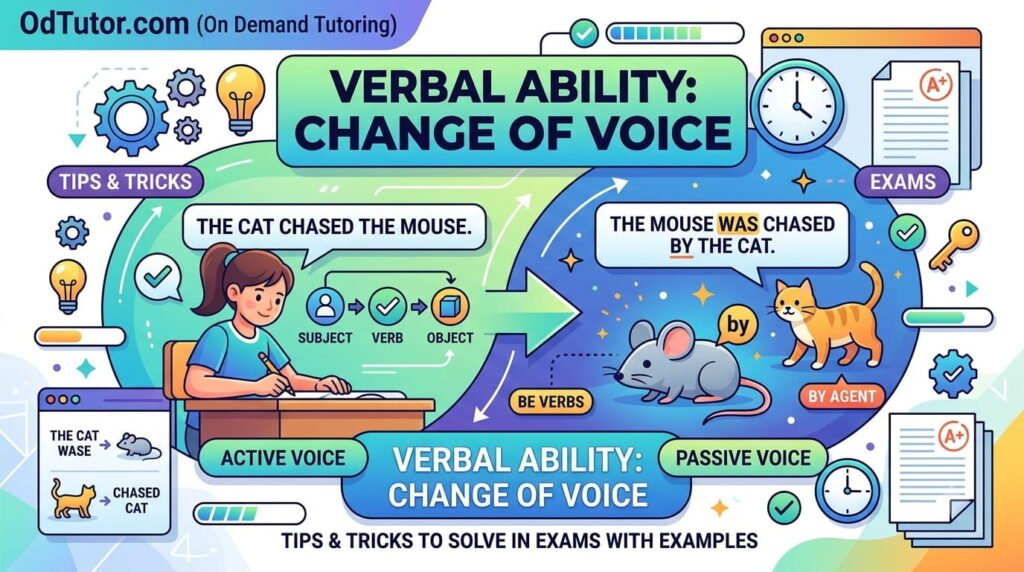
Sixteen articles into this series, and we’ve covered everything from basic grammar to advanced comprehension. Today’s topic Change of Voice brings us back to something foundational but genuinely important: understanding how to shift a sentence between active voice (the subject performs the action) and passive voice (the subject receives the action). After training IBPS, SBI, SSC, and Railway aspirants for years, I’ve noticed that students often treat voice change as a mechanical, rule-based task identify the subject, flip it with the object, change the verb form, add a “by” phrase. While that’s technically how voice change works, approaching it that way makes you slow and error-prone. The real skill, which I want to share today, is understanding voice choice conceptually why an author might use active or passive voice, when a conversion is correct, and how to convert quickly without mentally translating word by word. Let’s dive in.
1. Understand What Active and Passive Voice Actually Are
Before tackling conversion, let’s be precise about what active and passive voice represent. Active voice emphasizes the doer of an action: “The cat chased the mouse.” The subject (cat) performs the action (chased), and the object (mouse) receives it. Passive voice emphasizes what is done, or the receiver of the action: “The mouse was chased by the cat.” The subject (mouse) now receives the action, and the original doer appears in a “by” phrase.
The key insight: active and passive voice aren’t about grammar correctness both are grammatically valid. They’re about emphasis and focus. Active voice is typically clearer, more direct, and more concise. Passive voice is useful when the doer is unknown, unimportant, or you want to emphasize the receiver of the action.
Competitive exams test this by asking you to convert one to the other while maintaining the same meaning. This means understanding that a correct conversion isn’t about producing the “best” sentence it’s about producing a grammatically accurate passive or active alternative to what’s given, even if it sounds less natural.
2. Identify the Subject, Verb, and Object Clearly
Before attempting any conversion, identify three core elements: subject (who/what performs the action), verb (what action is taken), and object (who/what receives the action). This clarity prevents mistakes.
For example, in “The teacher explained the concept to the students,” the subject is “teacher,” the verb is “explained,” and the object is “concept.” Converting to passive: “The concept was explained to the students by the teacher.”
In “The government approved the new policy yesterday,” the subject is “government,” the verb is “approved,” and the object is “policy.” Converting to passive: “The new policy was approved by the government yesterday.”
Notice that the adverbial phrase (“to the students,” “yesterday”) remains largely unchanged, it’s not part of the core conversion, though its position might shift slightly.
A common mistake is misidentifying which noun is the object. In “She gave him a book,” the direct object is “book” and the indirect object is “him.” Converting to passive focusing on the direct object: “A book was given to him by her.” Or focusing on the indirect object: “He was given a book by her.” Both are correct, but exams usually expect the first pattern for this type of sentence.
3. Master the Mechanical Conversion Steps
Once you’ve identified subject -> verb -> object, the mechanical steps for converting active to passive are:
Step 1: The object becomes the new subject. Step 2: The verb becomes “to be” + past participle of the original verb. Step 3: The original subject becomes the object of the preposition “by.” Step 4: Tense and number agree with the new subject.
Example: “The scientists conducted extensive research.”
- Object (research) becomes subject
- Verb (conducted) becomes “was conducted”
- Subject (scientists) becomes “by the scientists”
- Result: “Extensive research was conducted by the scientists.”
Example: “They are building a new hospital.”
- Object (hospital) becomes subject
- Verb (are building) becomes “is being built”
- Subject (they) becomes “by them”
- Result: “A new hospital is being built by them.”
Notice that tense shifts matter: simple past “conducted” becomes “was conducted,” present continuous “are building” becomes “is being built.” These tense shifts are where most students make mistakes, so pay careful attention to preserving the original tense through the conversion.
4. Handle Different Tenses Carefully
Each tense has a specific passive form, and getting this right is critical. Here’s a quick reference:
Simple Present: “eat” → “is/are eaten” “She eats apples.” → “Apples are eaten by her.”
Simple Past: “ate” → “was/were eaten” “She ate apples.” → “Apples were eaten by her.”
Present Continuous: “is/are eating” → “is/are being eaten” “She is eating apples.” → “Apples are being eaten by her.”
Past Continuous: “was/were eating” → “was/were being eaten” “She was eating apples.” → “Apples were being eaten by her.”
Present Perfect: “has/have eaten” → “has/have been eaten” “She has eaten apples.” → “Apples have been eaten by her.”
Past Perfect: “had eaten” → “had been eaten” “She had eaten apples.” → “Apples had been eaten by her.”
Future Simple: “will eat” → “will be eaten” “She will eat apples.” → “Apples will be eaten by her.”
A common mistake is getting the auxiliary verb wrong. For past continuous, students sometimes write “was been eaten” instead of “was being eaten.” For present perfect, they might write “have eating been” instead of “have been eaten.” Memorizing these forms through repetition, rather than trying to reason them out, saves time and prevents errors.
5. Recognize When Passive Voice Is Impossible
Not every sentence can meaningfully convert to passive voice. Intransitive verbs (verbs that don’t take objects) cannot form passive voice because there’s no object to become the new subject.
For example: “The sun rose at 6 AM.” This can’t be converted to passive because “rose” is intransitive — there’s no object receiving an action. You can’t say “6 AM was risen at by the sun.”
Similarly, sentences with linking verbs (am, is, are, was, were, seem, appear, become) don’t convert to passive in the same way. “She is a teacher” can’t become “A teacher is been by her” — the structure breaks down because linking verbs don’t convey an action being done to an object.
Exams sometimes include such sentences specifically to test whether you understand this limitation. If a question asks you to convert a sentence with an intransitive verb or linking verb to passive, the correct answer might be “Cannot be converted” or “No passive form exists.”
6. Don’t Always Include the “By” Phrase
A key insight many students miss: passive sentences don’t require a “by” phrase. If the doer of the action is unknown, unimportant, or obvious from context, omitting it is not just acceptable — it’s often preferred.
For example: “The report was submitted on time.” We don’t need to say “by someone” or “by the team.” The passive form works perfectly without specifying who submitted it.
Competitive exams test this by offering options where some include a “by” phrase and others don’t. The correct answer often omits the “by” phrase if it adds no new information or seems redundant.
Example: “The government passed a new law.” Passive with “by”: “A new law was passed by the government.” Passive without “by”: “A new law was passed.” If the context already makes clear that the government passed the law, the second form is more concise and preferable.
7. Watch for Indirect Objects and Two-Object Verbs
Some verbs take both a direct object and an indirect object, complicating conversion. “She gave him a book” has both “him” (indirect) and “book” (direct) as objects.
When converting, exams typically expect you to make the direct object the new subject: “A book was given to him by her.” However, you could also make the indirect object the new subject: “He was given a book by her.” Both are grammatically correct, but exams usually test the first pattern.
Verbs that commonly have this dual-object structure include: give, send, show, teach, tell, offer, promise, write. Practice recognizing these verbs and knowing which object typically becomes the subject in passive form.
8. Preserve Meaning and Emphasis During Conversion
A technically correct conversion can still be wrong if it changes the emphasis or nuance of the original sentence. Exams sometimes test whether you understand this subtle distinction.
For example: “The principal praised the students enthusiastically.” A literal passive conversion: “The students were praised enthusiastically by the principal.” This is technically correct, but if you instead produce “The students were praised by the principal enthusiastically,” the emphasis shifts awkwardly.
The adverbial placement matters. “Enthusiastically” should stay close to the verb for emphasis. Similarly, negations must stay in the right position. “She didn’t write the letter” becomes “The letter was not written by her,” not “The letter was written not by her.”
When evaluating multiple choice options for a converted sentence, check whether the conversion not only changes voice correctly but also preserves the original sentence’s emphasis and natural flow.
9. Practice Reverse Conversions: Passive to Active
Competitive exams don’t just ask active-to-passive; they frequently ask passive-to-active conversions too. The reverse process is equally important.
Given passive: “The book was written by Austen in 1813.” Convert to active: “Austen wrote the book in 1813.”
Process for passive-to-active: Step 1: The subject of the passive sentence becomes the object. Step 2: The object of the “by” phrase becomes the new subject. Step 3: Recover the original verb form from the passive construction. Step 4: Adjust word order for natural active phrasing.
Example: “The bridge was being constructed by the engineers.”
- Subject (bridge) becomes object
- “By” phrase subject (engineers) becomes subject
- “was being constructed” becomes “were constructing”
- Result: “The engineers were constructing the bridge.”
Common mistakes in reverse conversion include: forgetting to change the “was/were being” back to the original verb form, or misplacing the recovered verb in the sentence. Practicing both directions equally prevents these errors.
10. Time Management and Exam Strategy
Change of Voice questions are typically quick to answer once you’ve practiced the conversions — aim for roughly 20-30 seconds per question. However, if you encounter an unusual tense or structure, don’t panic; apply the systematic steps from earlier sections and work through it carefully.
Many students rush these questions because they seem mechanical, leading to careless errors. Resist this temptation. Take the time to identify subject-verb-object clearly, match the correct auxiliary verb to the tense, and verify that meaning is preserved.
Practice with previous years’ papers, noting which tense forms your specific exam tests most frequently. Some exams heavily test present perfect passive or past continuous passive, while others focus on simple past. Prioritizing practice on your exam’s most-tested forms is an efficient use of study time.
Finally, maintain an error log for voice conversion questions, noting whether your mistakes came from tense mismatches, incorrect auxiliary verbs, or misidentified subjects/objects. This targeted reflection builds genuine skill rather than false confidence from passive review.
How OdTutor Strengthens This Skill
Change of Voice rewards systematic practice and careful attention to tense forms, and both develop fastest through guided, real-time feedback. At OdTutor, our teachers help you master the mechanical conversion steps, build fluency in passive forms across all tenses, and develop the careful reading habits that prevent careless errors. With personalized feedback on your specific tense-related weak points and regular practice with exam-style voice conversion questions, our trainers help you convert quickly and accurately under exam pressure.
Quick Practice Quiz
Here’s a short interactive quiz to test these techniques, five Change of Voice questions mixing different tenses and conversion directions.
Change of Voice — Practice Sheet
Verbal Ability