
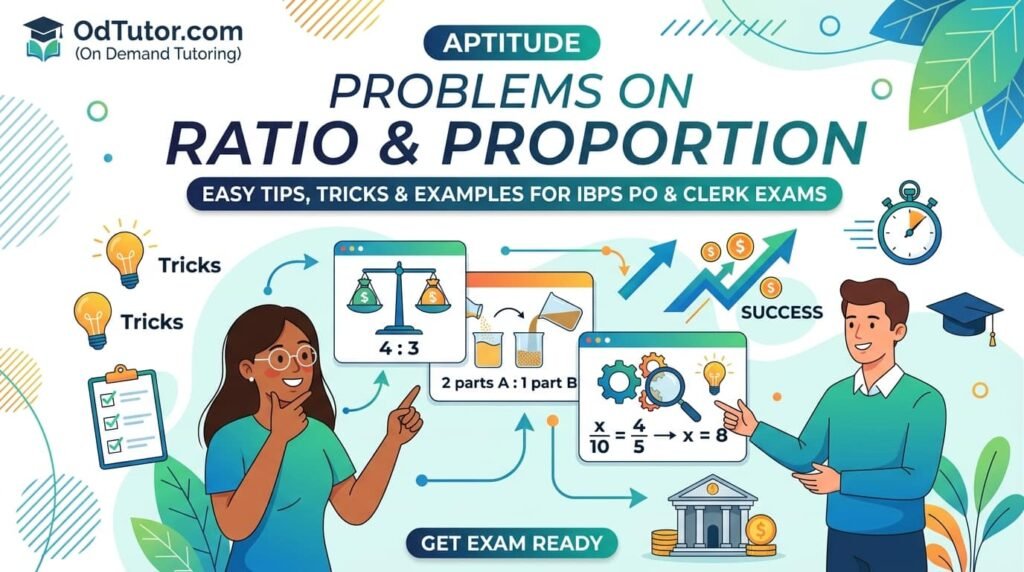
Hello Aspirants,
I am Rahul Sir, and over the years I have trained thousands of banking aspirants preparing for IBPS PO, IBPS Clerk, SBI PO, RBI Assistant, and other competitive examinations. Among all aptitude topics, Ratio and Proportion is one of the most scoring yet misunderstood chapters. Students often memorize formulas without understanding the relationships between quantities, leading to unnecessary mistakes in the examination.
Ratio and Proportion questions are frequently asked in IBPS exams directly and indirectly through topics like Partnership, Mixture & Allegation, Profit & Loss, Ages, Time & Work, and Data Interpretation. If your basics are clear, you can solve many questions mentally within seconds.
The secret is not learning dozens of formulas but understanding the concept behind ratios. Once you know how quantities compare, you can easily solve even lengthy-looking problems using smart tricks. In this guide, I will explain every important concept, shortcuts, and examination strategies with solved examples that will help you maximize your score.
Let’s master Ratio and Proportion the smart way.
1. Understanding Ratio and Proportion Basics
Ratio represents the comparison between two quantities of the same kind using division. If two quantities are A and B, their ratio is written as A or A/B.
Proportion states that two ratios are equal.
For example,
3:5 = 12:20
Since both represent the same relationship, they are said to be in proportion.
Important Formula
If
a = c
then
a × d = b × c
This is called cross multiplication.
Example
The ratio of boys to girls is 4:5.
If there are 36 girls, find the number of boys.
Solution
Girls = 5 parts
1 part = 36 ÷ 5 = 7.2
Boys = 4 × 7.2
= 28.8
Instead of decimals, use multiplication.
5 parts = 36
4 parts = (36 × 4)/5
= 144/5
= 28.8
In competitive exams, values are generally chosen to give whole numbers.
Suppose girls are 45.
Then
1 part = 9
Boys = 36
Shortcut
Always calculate one part first whenever total value of one side is given.
Common Mistakes
- Confusing ratio with difference.
- Ignoring simplification.
- Using addition instead of multiplication.
- Comparing different units.
2. Simplifying Ratios Quickly
One of the fastest ways to solve questions is learning to simplify ratios mentally.
Example
48:72
Find HCF
HCF = 24
Ratio
= 2:3
Shortcut
Always divide by highest common factor.
Decimal Ratio
0.8 : 1.2
Multiply by 10
8:12
Simplify
2:3
Fraction Ratio
1/2 : 3/4
Multiply both by LCM of denominators
LCM = 4
Ratio
2:3
Example
25 kg : 500 g
Convert units
25 kg = 25000 g
Ratio
25000:500
50:1
Exam Trick
Always convert units before taking ratio.
Practice
150:210
Answer
5:7
Speed Tips
- Remove common zeros.
- Divide by common factors.
- Convert fractions into integers.
- Convert kilograms into grams.
- Convert hours into minutes when required.
The faster you simplify, the faster every question becomes.
3. Finding Unknown Values Using Ratio
Many IBPS questions involve finding missing values.
Suppose
A = 7:9
If A = 56
Find B.
Solution
7 parts = 56
1 part = 8
9 parts = 72
Answer = 72
Shortcut Formula
Unknown = (Known × Required Ratio)/Known Ratio
Example
Ratio of pens and pencils = 5:8
Pens = 30
Pencils = ?
= (30 × 8)/5
= 48
Reverse Question
Ratio = 3:8
Second quantity = 80
First =
(80 × 3)/8
=30
Trick
Never calculate total unless asked.
Go directly using proportional multiplication.
Practice
Ratio
8:11
Second quantity = 44
First?
Answer
32
These direct questions should take less than 20 seconds.
4. Dividing Quantities According to Ratio
Sharing money or objects according to ratio is a favorite IBPS topic.
Example
Divide ₹1800 in ratio 4:5.
Solution
Total parts
4+5=9
One part
1800/9=200
Shares
4×200=800
5×200=1000
Shortcut Formula
Share
(Total × Individual Ratio)/(Sum of Ratios)
Example
Divide ₹3900 in ratio
2:3:8
Total parts
13
Shares
600
900
2400
Speed Trick
Always calculate one part first.
Then multiply.
Practice
₹960
Ratio
5:3
Shares
600
360
Common Mistake
Students divide using difference instead of total parts.
Always use addition of ratios.
5. Compound Ratio Made Easy
Compound ratio combines two or more ratios.
Example
2:3
and
4:5
Compound ratio
2×4 : 3×5
8:15
Example
3:7
5:9
Compound ratio
15:63
Simplify
5:21
Applications
Compound ratio appears in
- Partnership
- Successive comparisons
- Production
- Mixture
Shortcut
Multiply numerators together.
Multiply denominators together.
Simplify.
Practice
6:5
2:9
Compound ratio
12:45
4:15
Easy marks if practiced properly.
6. Proportion Tricks and Cross Multiplication
Cross multiplication saves enormous time.
If
x:15 = 12:20
Then
20x
=15×12
180
x=9
Example
5 =10:18
Cross multiply
90=10x
x=9
Direct Formula
a=c
Then
ad=bc
Practice
8:12 = x:18
8×18=12x
144=12x
x=12
Shortcut
Never expand ratios unnecessarily.
Use cross multiplication directly.
7. Ratio Changes After Increase or Decrease
These questions are very common.
Example
Ratio
3:5
Both increase by 6.
New ratio
?
Suppose original
3x and 5x
(3x+6)/(5x+6)
Use new condition if provided.
Example
Ratio
2:3
After adding 10 to each
3:4
Find original numbers.
Solution
2x+10
3x+10
Cross multiply
4(2x+10)
=
3(3x+10)
8x+40
9x+30
x=10
Numbers
20
30
Trick
Represent original values as multiples of x.
Never assume actual values.
8. Advanced Ratio Problems in IBPS
Example
Income ratio
5:7
Expenses ratio
4:5
Savings
₹2000 and ₹3000
Find incomes.
Represent incomes
5x
7x
Expenses
4y
5y
Use savings equations.
Solve simultaneously.
Another Example
Age ratio
3:5
After 10 years
5:7
Represent ages
3x
5x
Apply condition.
These questions appear difficult but become easy using variables.
Tips
- Use variables.
- Don’t substitute random values.
- Keep equations simple.
- Solve mentally whenever possible.
9. Ratio Questions in Data Interpretation
Pie charts, bar graphs and tables often require ratio calculations.
Example
Company A
120 employees
Company B
180 employees
Ratio
2:3
Percentage to Ratio
40%
60%
Ratio
2:3
Example
Male
240
Female
360
Ratio
2:3
Shortcut
Convert percentages into ratios.
25%
75%
1:3
20%
80%
1:4
30%
70%
3:7
These shortcuts save valuable seconds during DI.
10. Exam Strategies, Tricks and Practice Plan
To master Ratio and Proportion:
Daily Practice
Solve 20 questions daily.
Memorize Common Ratios
1:2
2:3
3:5
4:7
5:8
These appear repeatedly.
Learn Percentage-Ratio Conversion
20%=1:4
25%=1:3
40%=2:3
50%=1:1
60%=3:2
75%=3:1
Time Target
Easy Question
20 seconds
Moderate
40 seconds
Difficult
60 seconds
Avoid These Mistakes
- Wrong unit conversion
- Ignoring simplification
- Incorrect total parts
- Calculation mistakes
- Random assumptions
Final Advice
Concepts are more important than formulas. Practice enough questions so that identifying the method becomes automatic. With consistent revision, Ratio and Proportion can become one of your highest-scoring topics in the IBPS PO and Clerk examination.
How Teachers from OdTutor Can Help
At OdTutor, our experienced aptitude faculty provides structured preparation specifically designed for IBPS PO, Clerk, SBI, RBI, SSC, and other competitive examinations. Our teachers simplify Ratio and Proportion using conceptual explanations, shortcut techniques, live problem-solving sessions, and exam-oriented practice sets. Students receive chapter-wise notes, mock tests, previous year question discussions, and personalized doubt-clearing sessions. Regular speed tests help improve calculation accuracy and time management. Whether you are a beginner or an advanced learner, OdTutor’s expert guidance ensures you build strong fundamentals and develop the confidence to solve even the toughest aptitude questions accurately during the examination.