
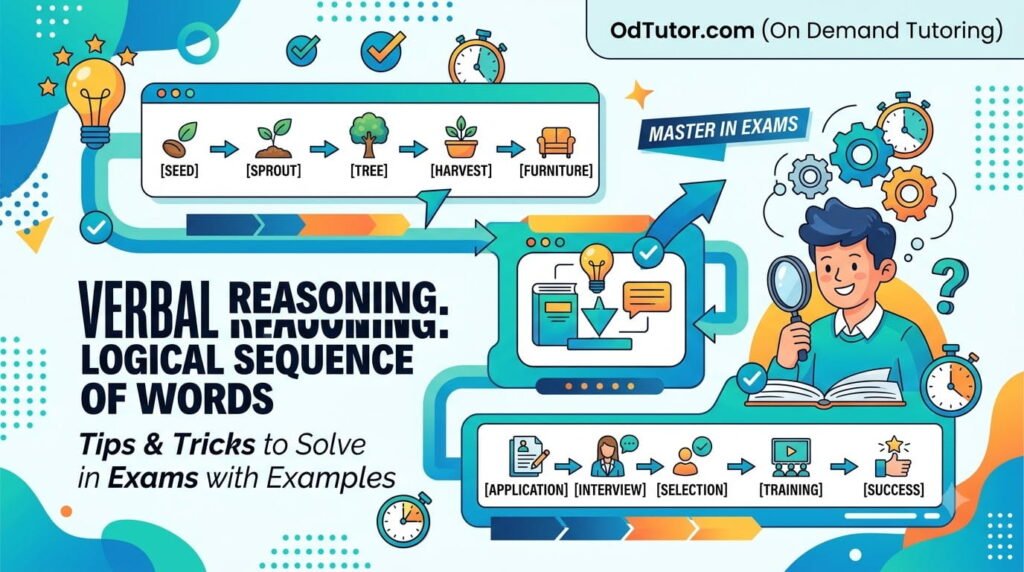
We’ve completed the full Verbal Ability series, from grammar fundamentals through advanced comprehension and analogies. Now we move into a new domain: Verbal Reasoning. While Verbal Ability tested your command of English language mechanics, Verbal Reasoning tests your logical thinking using words as the medium. This distinction matters profoundly. You could have perfect grammar but struggle with logical reasoning, or vice versa. Today’s topic, Logical Sequence of Words, is where that shift becomes real. You’ll encounter a jumbled list of words and need to arrange them in an order that makes logical sense according to a pattern. After training IBPS, SBI, SSC, and Railway aspirants for years, I’ve noticed that students approach this topic with confusion because they think there’s one “correct” order, but really, the order depends on identifying the underlying logic first. That’s the skill we’ll master today.
1. Understand That Sequence Logic Matters More Than Individual Words
The fundamental insight: a logical sequence of words isn’t about arranging words alphabetically or by length. It’s about identifying the pattern or principle that connects them, then arranging them according to that principle.
For example, consider: Dog, Puppy, Cat, Kitten. One student might arrange them alphabetically: Cat, Dog, Kitten, Puppy. Another might group by animal type: Cat, Kitten, Dog, Puppy. But the logical sequence recognizes a different pattern: adult animal, young animal, adult animal, young animal, which suggests the intended order is: Dog, Puppy, Cat, Kitten (pairs of adult-then-young).
The key skill: before arranging, identify what principle connects these words. Is it a lifecycle progression? A cause-and-effect chain? A conceptual hierarchy? A chronological order? A magnitude spectrum? Once you identify the principle, the correct sequence usually becomes obvious.
This principle-first thinking is what separates students who guess at sequences from students who solve them systematically. You’re not just rearranging, you’re reasoning about what the words represent and how they relate to each other.
2. Recognize Common Sequence Types
Competitive exams test specific types of sequences repeatedly. Recognizing which type you’re dealing with helps you identify the organizing principle faster.
Lifecycle/Development Sequences: Egg → Caterpillar → Chrysalis → Butterfly. Each stage represents a distinct phase in a transformation or growth process.
Cause-and-Effect Sequences: Rain → Flood → Evacuation → Relief. Each step triggers the next in a causal chain.
Magnitude/Intensity Sequences: Drizzle → Rain → Downpour → Deluge. These progress along a spectrum of intensity.
Profession-to-Object Sequences: Writer → Book → Reader → Audience. These show flow from producer through creation to consumer.
Conceptual Hierarchy Sequences: House → Room → Wall → Brick. These move from whole to progressively smaller parts, or vice versa.
Time-Based Sequences: Morning → Afternoon → Evening → Night. These follow chronological progression.
Problem-Solution Sequences: Disease → Diagnosis → Treatment → Recovery. These show steps in resolving an issue.
Tool-and-Purpose Sequences: Farmer → Seed → Field → Crop. These show how a tool, action, or input leads to output.
Recognizing these types during the exam helps you quickly identify which organizing principle applies to your particular sequence, speeding up solution significantly.
3. Look for Implicit Connections, Not Just Obvious Ones
Surface-level connections are easy to spot, but exam sequences often hide deeper logic that distinguishes correct answers from plausible-but-wrong ones.
For example, consider: Poverty, Hunger, Illness, Death. A surface-level connection is “all are negative conditions,” but the logical sequence is more specific: poverty is the root cause, which leads to hunger (lack of resources), which leads to illness (malnutrition), which can lead to death. The sequence represents causal progression from cause to consequence.
If instead you arranged them as: Hunger, Poverty, Illness, Death, you’d be grouping them by severity or negativity, not by logical progression. The original order captures the deeper relationship.
This is where skills from our Verbal Ability series matter, understanding connotation, implication, and subtle relationships helps you see the implicit connections that make a sequence truly logical rather than just grouped.
4. Eliminate Wrong Patterns Before Finalizing Your Sequence
A systematic approach: before committing to an answer, test whether your proposed sequence holds up under multiple interpretations.
Given sequence: Seed, Plant, Flower, Fruit
Your hypothesis: Lifecycle progression of plant growth.
Test: Does seed → plant work? Yes (seed grows into plant). Does plant → flower work? Yes (plant produces flower). Does flower → fruit work? Yes (flower develops into fruit).
All links are logical. The sequence holds.
Now test alternative arrangements to confirm this is the only logical one:
- Flower, Seed, Plant, Fruit? No, flower comes before seed, which breaks cause-effect.
- Plant, Seed, Flower, Fruit? No, you can’t have plant before seed logically.
By testing alternatives and eliminating those that break the logical chain, you confirm that your original sequence is correct, not just plausible.
5. Pay Attention to Direction of Progression
Some sequences progress forward (cause to effect, beginning to end, simple to complex). Others progress backward (effect to cause, end to beginning, complex to simple). Identifying the direction prevents reversing a correct sequence.
For example: Idea → Planning → Execution → Review. This progresses from conception to completion.
Reverse: Review → Execution → Planning → Idea. This is illogical, you can’t review before executing.
However, some sequences can logically work in either direction depending on context:
- Cause → Effect (forward causation)
- Effect → Cause (tracing back to root)
Both could be “logical,” but the exam expects you to recognize which direction makes more sense given the specific words and their relationships.
This is where context becomes crucial. If the words suggest a natural progression (like lifecycle, day progression, building a house), that’s your direction. If words suggest analysis or diagnosis, the reverse might be intended. Reading the words carefully to understand their implied directionality is essential.
6. Distinguish Between Sequences and Mere Groupings
A common trap: students arrange words into a group that “makes sense” without actually forming a logical sequence.
For example, given: Teacher, Student, Classroom, Lesson. A grouping might arrange them as: Classroom, Teacher, Student, Lesson (all related to education). But a logical sequence would be: Teacher → Lesson → Student → Classroom (the teacher prepares lesson, teaches student, in classroom). Or: Student → Classroom → Teacher → Lesson (student enters classroom, meets teacher, attends lesson).
The difference: a grouping just collects related items; a sequence orders them according to logical relationship or progression. Exam questions specifically ask for sequences, not groupings. You must identify the actual progression, not just arrange related words.
7. Use Process of Elimination Strategically
When you’re unsure of the exact sequence, eliminate options that clearly violate logic, then choose the most coherent remaining option.
Given: Food, Hunger, Eat, Satisfaction.
Option A: Hunger → Food → Eat → Satisfaction. Does this flow logically? You feel hungry, see food, eat it, become satisfied. Yes.
Option B: Food → Hunger → Eat → Satisfaction. Does this flow logically? Food exists, then hunger occurs, then eating, then satisfaction. This is possible but less intuitive.
Option C: Eat → Food → Hunger → Satisfaction. Does this flow logically? You eat before food exists? No, eliminate.
Option D: Satisfaction → Hunger → Food → Eat. Does this flow logically? This is the reverse progression, you’re satisfied, then hungry again, find food, eat. This also works but feels less natural as a sequence.
Between A and B, A is most intuitive. Choose A.
Strategic elimination of clearly illogical options narrows your choices, and then you select the most coherent remaining sequence.
8. Recognize When Multiple Sequences Could Be Valid
Sometimes, exam questions include sequences where multiple arrangements could theoretically be logical, but one is “more” logical or represents the intended progression.
For example: Writing, Reading, Thinking, Speaking.
Sequence A: Thinking → Writing → Reading → Speaking (thought precedes expression; writing is thought externalized; reading reverses the writing; speaking is final expression).
Sequence B: Reading → Thinking → Writing → Speaking (you read to learn, think about it, write your thoughts, speak about them).
Both have internal logic. However, if the exam is testing developmental progression or natural learning flow, Sequence B might be the expected answer. If testing expression progression, Sequence A might be correct.
In such cases, look for contextual clues: are the words ordered in a way that suggests cause-and-effect, or development, or problem-solution? That context usually indicates which interpretation the exam intends.
9. Practice With Real Exam Sequences to Build Pattern Recognition
Just as with Verbal Ability, building speed and accuracy in Logical Sequence of Words comes through consistent practice with real exam examples, not through memorizing “sequence types.”
Spend time with previous years’ papers from your target exam. Notice which sequence types recur, which progressions are most commonly tested, and which trap sequences appear (where multiple arrangements seem logical but only one is intended).
Over time, your brain develops automatic pattern recognition. You’ll see a sequence set and quickly identify the intended progression without consciously working through each step. This speed comes from exposure and repetition, not from studying principles in isolation.
10. Time Management and Exam Strategy
Logical Sequence of Words questions typically take 20-30 seconds once you’ve built pattern recognition. However, if you encounter an unfamiliar sequence type, don’t dwell excessively; identify the most obvious progression, verify it with one or two tests, then move forward.
The key habit: spend your time identifying the organizing principle, not in second-guessing your answer once you’ve identified it. Many students pick a correct sequence, then doubt themselves and switch, a costly mistake under exam pressure.
Build confidence in your pattern recognition by maintaining an error log. When you miss a sequence question, note what principle you missed and why. This targeted reflection builds genuine reasoning skill rather than false confidence from passive review.
How OdTutor Strengthens This Skill
Logical Sequence of Words rewards systematic pattern recognition and careful logical reasoning, both developing fastest through guided practice with real exam examples. At OdTutor, our teachers help you identify common sequence types, recognize the organizing principles that connect words, and build the speed that comes from deliberate exposure to diverse sequence patterns. With personalized feedback on whether your sequence misses stem from missing the organizing principle or from misunderstanding word relationships, our trainers help you develop genuine reasoning strength rather than lucky guessing.
Quick Practice Quiz
Here’s a short interactive quiz to test these techniques, five Logical Sequence of Words questions mixing different progression types and complexity levels.
Logical Sequence of Words — Practice Sheet
Verbal Reasoning