
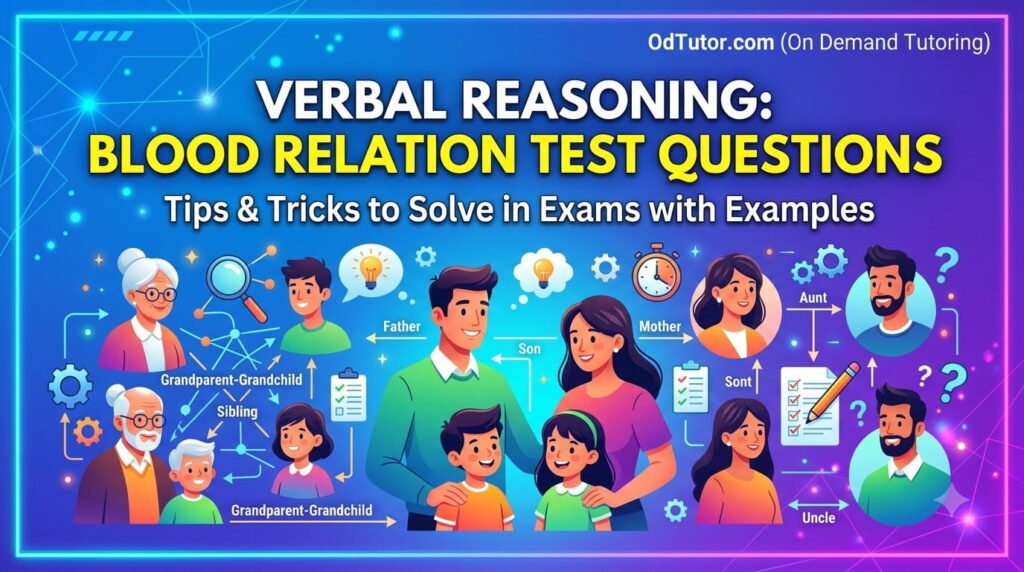
We’ve just completed Logical Sequence of Words, where you learned to identify patterns and progressions using reasoning skills. In this article, we shift our focus to Blood Relation Test Questions, a distinctly challenging area of Verbal Reasoning. Unlike sequential logic, this topic requires you to navigate intricate family ties across multiple generations and branches. Through years of coaching aspirants for IBPS, SBI, SSC, and Railway exams, I have observed that students often falter here not because the concepts are inherently difficult, but because they adopt a passive approach: reading the clues once and waiting for intuition to strike. The true differentiator and what I want to equip you with today is systematic relationship mapping. By learning to translate verbal descriptions into clear visual diagrams and tracing connections with a step-by-step methodology, you will be able to unravel even the most convoluted family trees with speed and accuracy. Let’s dive in and make you proficient in this skill.
1. Understand the Fundamental Relationship Categorie
Blood relation questions hinge on a few core relationship types. Mastering these prevents confusion later.
Direct Vertical Relationships (straight lineage):
- Grandfather/Grandmother (parent’s parent)
- Father/Mother (direct parent)
- Son/Daughter (direct child)
- Grandson/Granddaughter (child’s child)
Lateral Relationships (same generation):
- Brother/Sister (same parents)
- Cousin (parent’s sibling’s child)
- Aunt/Uncle (parent’s sibling)
In-laws (relationships through marriage):
- Husband/Wife
- Mother-in-law/Father-in-law
- Sister-in-law/Brother-in-law
- Son-in-law/Daughter-in-law
Extended Relationships (more distant):
- Nephew/Niece (sibling’s child)
- First cousin once removed (parent’s cousin)
- Second cousin (grandparent’s sibling’s grandchild)
Key insight: most exam questions don’t test exotic relationships like “first cousin twice removed.” They test core relationships — the tricky part is usually tracing through multiple steps, not understanding the basic category.
2. Create Visual Family Tree Diagrams as You Work
The most powerful technique for solving blood relation problems is converting the verbal description into a simple diagram. This transforms an abstract reasoning problem into something concrete you can trace visually.
For example, consider this problem: “X is the father of Y. Y is the sister of Z. Z is the father of W. How is W related to X?”
Rather than holding this in your head, draw it:
        X (grandfather)
        |
    Y (daughter)
    |       |
    |       Z (son)
    |       |
    |       W (grandson)

Answer: W is the grandson of X.
This diagram takes 10 seconds to sketch but eliminates confusion entirely. Under exam pressure, this visual clarity saves you from careless errors.
Practice drawing family trees for every blood relation problem during your study phase, even if you think you can solve it mentally. The habit of externalizing relationships builds the systematic thinking that makes you fast and accurate under pressure.
3. Decode Indirect Relationship Descriptions Carefully
Exam questions rarely say “X is the father of Y” directly. They embed relationships in complex descriptions, requiring you to decode them carefully.
For example: “A’s brother’s wife’s father’s son is B. How is A related to B?”
This requires careful unpacking:
- A’s brother’s wife = A’s sister-in-law
- Sister-in-law’s father = A’s brother-in-law’s father
- Father’s son = A’s brother-in-law (the original brother)
Wait — this becomes circular. Let me retrace:
- A’s brother’s wife’s father’s son could be the brother himself OR a brother of the wife
This ambiguity is exactly what exams test. The key: work step-by-step, explicitly stating each relationship as you decode.
A’s brother = X (let’s name him) X’s wife = Y Y’s father = Z Z’s son = could be X or could be Y’s brother
The exam expects you to recognize this ambiguity and work through the possibilities. This is where systematic decoding prevents errors.
4. Work Backward When Direct Analysis Stalls
Sometimes, working forward through a complex relationship creates confusion. When that happens, reverse direction — work backward from the final relationship to see what possibilities exist.
For example: “M is related to N in some way. M’s mother is N’s father’s sister. How is M related to N?”
Forward: M’s mother is N’s father’s sister. That means M’s mother is N’s aunt. So M is the child of N’s aunt. That makes M N’s first cousin.
But working backward is clearer: If M’s mother is N’s father’s sister, then:
- N’s father and M’s mother are siblings
- Therefore M and N are cousins
This backward approach often reveals the relationship more intuitively, especially for complex descriptions.
5. Master Cousin Classification — A Common Confusion Point
Cousins are among the most tested relationships, and students often confuse cousin types. Let’s be precise.
First Cousins: Your parents’ siblings’ children. You and your first cousin share the same grandparents.
Second Cousins: Your grandparents’ siblings’ grandchildren. You and your second cousin share the same great-grandparents.
First Cousin Once Removed: Your parent’s first cousin. You and this person are separated by one generation — your parent and this person are cousins, but you are one step away.
Cousin (without qualifier): Typically means first cousin in exam contexts. Any other type is usually specified.
A quick mental check: if the problem traces back to the same set of grandparents, they’re first cousins. If it goes back to great-grandparents, they’re second cousins. If generations differ, there’s a “removed” factor.
6. Pay Attention to Marriage and Adoption Distinctions
Most exams assume biological relationships unless explicitly stated otherwise. However, some questions include marriages or adoptions, changing relationship calculations.
For example: “X married Y. X is the father of Z. How is Z related to Y if Y is Z’s mother?”
This confirms they’re a typical family. But if the problem states: “X married Y. X is the father of Z from a previous relationship. How is Z related to Y?”
Now Z is X’s biological child but Y’s stepchild only (by marriage to X). This distinction matters because:
- Z’s sibling by X and Y = full sibling
- Z’s sibling by X and a different woman = half-sibling (but not related to Y)
- Y is stepmother, not mother
Exams test whether you understand these distinctions. Careful reading of whether relationships are biological or through marriage is essential.
7. Handle Multiple Generations with Letter Notation
For complex, multi-generational problems, using letter notation prevents you from losing track of who’s who.
For example: “A’s grandfather’s son’s daughter’s brother is B. How is A related to B?”
Let’s use notation:
- A’s grandfather = G1
- G1’s son = could be A’s father (F) or A’s uncle (U)
- That son’s daughter = A’s cousin (C) if son is uncle, OR A’s sister if son is father
- That daughter’s brother = C’s brother (A’s cousin) OR A’s brother
This ambiguity highlights why notation helps: you track all the steps explicitly, preventing confusion about which branch you’re following.
Alternate approach: assign names. “A’s grandfather is John. John’s son is Tom. Tom’s daughter is Sarah. Sarah’s brother is Mike.” Now the relationships are concrete, and you can trace: A is John’s grandchild. Mike is John’s grandchild (Sarah’s brother). So A and Mike are cousins.
8. Recognize Gender-Neutral Phrasing and Ambiguities
Exams sometimes use phrases that could apply to multiple genders, testing whether you think through all possibilities.
For example: “X is the child of Y” — X could be son or daughter. “A is B’s sibling” — A could be A’s brother or sister.
When a problem uses such phrasing, work through the possibilities. Often, the logic works out the same way regardless of gender (cousin is cousin whether male or female), but occasionally the answer changes.
If the problem says “X’s son’s daughter’s brother is Y,” the brother is definitely male, which matters if the final answer requires specifying gender.
Careful reading of who is explicitly male, female, or ambiguous helps you avoid careless errors.
9. Practice With Real Exam Problems to Build Pattern Intuition
Blood relation problems follow recurring patterns. After solving 30-40 real exam problems, you start recognizing these patterns instantly:
- “A’s mother’s father” = A’s maternal grandfather
- “A’s father’s sister” = A’s aunt
- “A’s brother’s son” = A’s nephew
- “A’s sister’s daughter” = A’s niece
Pattern recognition built through repetition is what makes you fast. You’ll see a problem, recognize the pattern from previous practice, and trace the relationship almost automatically.
This intuition doesn’t come from studying the patterns in isolation — it comes from exposure to real exam problems. Spend time with previous years’ papers from your target exam, noticing which relationship combinations recur most frequently.
10. Time Management and Exam Strategy
Blood relation questions typically take 20-30 seconds once you’ve built pattern recognition. However, complex multi-generational problems might take 45-60 seconds, and that’s normal.
Key strategy: if a problem seems hopelessly tangled, sketch a quick diagram (takes 15 seconds), then trace the relationship (another 15 seconds). This systematic approach almost always solves the problem, even if you feel lost initially.
Don’t spend more than 60 seconds on any single blood relation question. If you’re stuck after sketching a diagram and tracing twice, make your best-reasoned guess and move forward. Under exam pressure, sometimes one relationship seems more logical than others even if you can’t trace it perfectly.
Maintain an error log for blood relation questions, noting whether your mistakes stem from misunderstanding terminology, losing track of generations, or misreading the problem. This targeted reflection builds genuine skill rather than false confidence.
How OdTutor Strengthens This Skill
Blood Relation Test Questions reward systematic relationship mapping and careful decoding of complex descriptions, both developing fastest through guided practice with real exam examples. At OdTutor, our teachers help you master fundamental relationship categories, build the diagramming habit that converts confusion into clarity, and develop the pattern recognition that makes you fast. With personalized feedback on whether your relation mistakes stem from terminology confusion, multi-generation errors, or reading comprehension gaps, our trainers help you solve blood relations with confidence under exam pressure.
Quick Practice Quiz
Here’s a short interactive quiz to test these techniques — five Blood Relation Test Questions mixing different complexity levels and relationship types.
Blood Relation Test Questions — Practice Sheet
Verbal Reasoning