
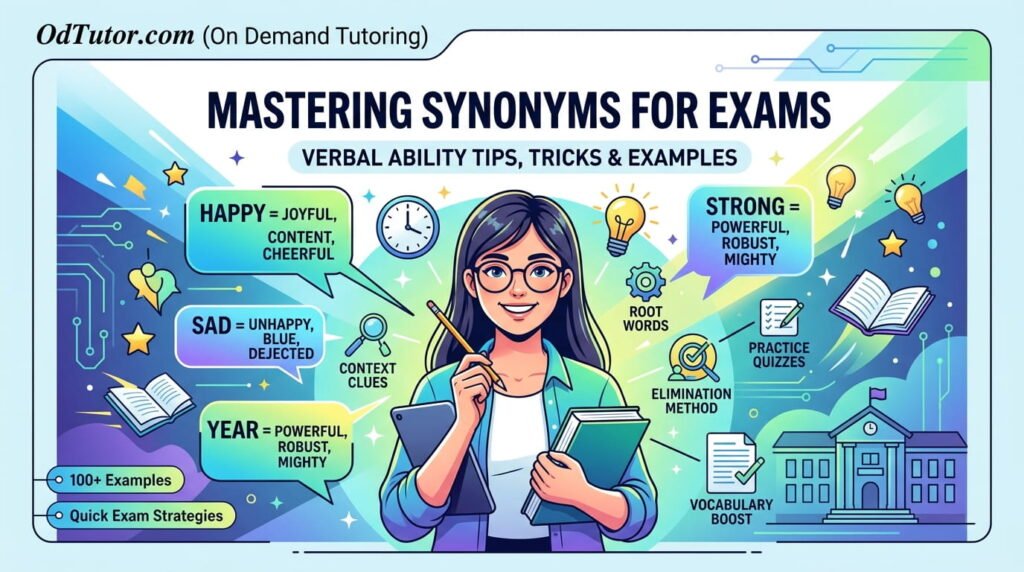
If you’ve read my previous article on Spotting Errors, you already know a little about me and how I approach exam preparation — keeping things simple, practical, and rooted in real exam patterns rather than textbook theory. Today, I want to continue that same approach with another high-scoring but often underestimated topic: Synonyms. Most students treat this as a pure vocabulary game — either you know the word or you don’t. But over years of training aspirants for IBPS, SBI, SSC, and Railway exams, I’ve found that Synonyms questions actually reward strategy just as much as vocabulary. There are patterns, elimination techniques, and root-word tricks that can help you answer confidently even when a word feels unfamiliar at first glance. Let’s break it all down.
1. Understanding What Exams Actually Test
Before diving into vocabulary-building techniques, it’s worth understanding exactly what a Synonyms question is asking. You’ll typically be given a word — sometimes standalone, sometimes underlined within a passage — and asked to choose the option closest in meaning from four or five choices. The word “closest” is key here; exams rarely offer an exact one-to-one match, so you’re really being tested on which option shares the most overlapping meaning and tone with the given word.
Many exams now test synonyms in a contextual format, embedding the target word within a reading comprehension passage. This is actually a gift in disguise — the surrounding sentence often narrows down the intended meaning, especially for words that carry multiple senses. For instance, the word “sound” can mean “healthy” (a sound body), “reasonable” (a sound argument), or “a noise” (a loud sound) — and only the passage context tells you which meaning is being tested.
A common mistake students make is picking the option that’s a synonym for the word in general usage, without checking whether it fits the specific sense used in that sentence. This single oversight costs more marks than not knowing the word at all.
My advice: always read the sentence around the word first, identify which “version” of the word is being used, and only then scan the options. This context-first habit alone will improve your accuracy meaningfully, even on words you’re only partially familiar with.
2. Learn Word Roots, Prefixes, and Suffixes
This is, in my experience, the single most powerful long-term strategy for synonym questions. English vocabulary is built largely from Latin and Greek roots, and once you recognize common ones, you can often deduce the meaning of a completely unfamiliar word just from its structure.
Take the root “bene” (meaning good) — it appears in “benevolent” (kind, good-natured), “benefactor” (one who does good), and “beneficial” (helpful). Similarly, “mal” (meaning bad) gives us “malevolent” (having bad intentions), “malady” (an illness), and “malicious” (intending harm). If a question asks for the synonym of “malevolent,” even without knowing the exact word, recognizing “mal” tells you to look for a negative-meaning option.
Prefixes are equally revealing. “Un-,” “in-,” “dis-,” and “im-” typically negate a word’s meaning (unhappy, inaccurate, dishonest, impossible), while “pro-” often suggests moving forward or in favor of something (progress, proponent), and “anti-” suggests opposition (antidote, antagonist).
Suffixes also carry meaning. Words ending in “-ous” or “-ful” are usually adjectives describing a quality (courageous, joyful), while “-tion” or “-ment” often indicate a noun form of an action (creation, achievement). Recognizing these patterns helps you at least identify the part of speech, which narrows your options considerably.
I encourage my students to maintain a small root-word notebook, adding five new roots a week along with two or three example words each. Over two to three months, this builds a vocabulary framework strong enough to tackle even unfamiliar words with reasonable confidence.
3. Read Widely and Actively, Not Just for Exams
There’s no substitute for genuine reading when it comes to building real vocabulary depth — the kind that lets you recognize a word’s tone and usage instantly, rather than just its dictionary meaning. Editorial sections of good newspapers, opinion pieces, and well-written articles expose you to formal vocabulary in natural context, which is exactly how these words appear in exams.
The key word here is “actively.” Passive reading — where you skim past unfamiliar words without pausing — builds almost no new vocabulary. Instead, whenever you encounter an unfamiliar word while reading, pause, guess its meaning from context, and then verify it. This habit of guessing before checking trains the same contextual-inference skill that synonym questions require.
I recommend maintaining a reading journal where you jot down five new words a day from your reading, along with the sentence they appeared in and a simple, one-line meaning in your own words — not a copied dictionary definition. Writing meanings in your own words forces genuine understanding rather than memorization.
It also helps to revisit these words periodically rather than just once. Spaced repetition — reviewing a word after one day, then after a week, then after a month — is far more effective for long-term retention than cramming a long list the night before an exam.
Over a few months of consistent, active reading, you’ll notice something interesting: unfamiliar words start appearing less often, and your instinct for a word’s “feel” — even without formally knowing its meaning — starts becoming reliable enough to answer confidently in the exam.
4. Use Context Clues When the Word Appears in a Passage
Many modern exams test synonyms within a comprehension passage rather than as standalone questions, and this format actually works in your favor if you know how to use it. The surrounding sentence almost always gives clues about the word’s tone, intensity, and specific meaning, even if you don’t know the word precisely.
Look for structural clues first. If the sentence contains contrast words like “but,” “however,” or “although,” the unfamiliar word likely has an opposite meaning to something else in the sentence. For example: “Despite his reputation for being frugal, he made a lavish donation to the charity” — here, “frugal” is being contrasted with “lavish,” so you can infer that “frugal” means something like careful with money or not extravagant.
Cause-and-effect clues also help. In “Her meticulous planning ensured the event ran smoothly without a single hitch,” the effect (smooth, hitch-free event) tells you “meticulous” likely means careful and detail-oriented, since only thorough planning produces that outcome.
Sometimes, the sentence provides a direct definition or example right after the word, often set off by commas or a dash: “His gregarious nature — always chatting, always making new friends — made him popular at every gathering.” Here, the descriptive clause directly explains what “gregarious” means: sociable and outgoing.
Practicing with passage-based synonym questions specifically, rather than isolated word lists, trains your brain to actively hunt for these contextual signals, which is a skill that pays off significantly during the actual exam when you encounter genuinely unfamiliar words.
5. Watch Out for Near-Synonyms With Different Connotations
One of the most common exam traps involves words that are technically synonyms in a dictionary sense but carry different emotional shades or connotations — positive, negative, or neutral. Choosing the “textbook correct” synonym without checking connotation is a frequent source of avoidable mistakes.
Take the words “thrifty” and “stingy.” Both relate to careful spending, but “thrifty” carries a positive connotation (wisely economical), while “stingy” carries a negative one (unwilling to spend, even when appropriate). If the original word used in the exam is “frugal” (generally neutral-to-positive), and the options include both “thrifty” and “stingy,” the correct choice depends on which connotation matches the word being tested.
Similarly, “assertive” and “aggressive” both describe someone who is forceful, but “assertive” has a more positive, confident connotation, while “aggressive” leans negative, suggesting hostility. Exams frequently place both as options for a word like “confident” or “forceful,” expecting you to distinguish based on tone rather than surface meaning alone.
Another common pair is “curious” (positive, showing healthy interest) versus “nosy” (negative, prying into others’ business) — both relate to wanting information, but their connotations differ sharply.
My tip: whenever you’re choosing between two options that both seem to technically fit, ask yourself whether the original word carries a positive, negative, or neutral tone, and match that tone in your answer rather than just the dictionary definition. This connotation-matching approach resolves a surprising number of “trick” options that would otherwise seem equally correct.
6. Match the Part of Speech First
A simple but often overlooked strategy is checking the part of speech of the given word before evaluating the answer options. Since a synonym must match the grammatical function of the original word, this step alone can eliminate one or two options instantly, even before you’ve fully worked out the meaning.
For example, if the question word is “abandon” used as a verb (to abandon a plan), the correct synonym must also be a verb — such as “forsake” or “relinquish” — not a noun form like “abandonment,” even if it appears as a distractor option.
This becomes especially useful with words that can function as multiple parts of speech depending on context. The word “object,” for instance, functions as a noun (a physical object) or a verb (to object to a proposal), and these two forms have completely different sets of synonyms. Checking the sentence’s grammatical structure tells you immediately which form is being tested.
Suffixes are a quick giveaway for part of speech: words ending in “-ly” are typically adverbs, “-ness” or “-tion” typically indicate nouns, “-ify” or “-ize” often indicate verbs, and “-ous,” “-ful,” or “-ive” typically indicate adjectives. Scanning both the question word and the answer options for these suffix patterns lets you quickly filter out mismatched parts of speech.
I encourage students to make this a genuine first step, before even thinking about meaning — it takes only a few seconds, but it meaningfully narrows your options and reduces the chance of being misled by a distractor that “sounds right” but is grammatically mismatched.
7. Practice Elimination When You’re Unsure of the Exact Word
Even with strong vocabulary preparation, you will occasionally encounter a word you simply don’t know well during the actual exam. In these situations, the elimination technique becomes your most valuable tool, and it’s a skill worth practicing deliberately rather than relying on only during the exam itself.
Start by eliminating any option whose part of speech clearly doesn’t match the question word, as covered in the previous section. Next, eliminate options that you recognize as antonyms or clearly unrelated in meaning — these are usually easier to identify than the correct answer itself, even if you’re unsure of the target word’s exact meaning.
If you can identify any root, prefix, or suffix in the unfamiliar word, use that to eliminate options that clearly don’t match that directional meaning (positive/negative, for/against, before/after, and so on). Even partial root recognition — knowing that a word starts with a negative prefix like “in-” or “dis-,” for example — can help you eliminate one or two options confidently.
Finally, if you’re down to two options and genuinely unsure, consider the connotation-matching approach from earlier — pick the option whose emotional tone feels closer to how the original word is typically used, based on any partial familiarity you have with it.
This structured elimination process, rather than a random guess, significantly improves your odds compared to blind guessing, and over enough questions across an exam, this improved probability translates into real additional marks.
8. Build Word Groups Instead of Isolated Lists
Many students prepare vocabulary using long, alphabetically arranged word lists, memorizing definitions in isolation. In my experience, this method has weak retention because your brain has no meaningful structure to hang the information on. A far more effective approach is grouping words by theme or shared meaning family.
For instance, instead of memorizing “verbose,” “loquacious,” “garrulous,” and “taciturn” separately, group them under the theme of “talkativeness,” noting that the first three mean overly talkative (with “loquacious” being slightly more formal and “garrulous” often implying rambling), while “taciturn” is the odd one out, meaning the opposite — reserved and quiet. Learning them together, with their contrast, makes each word’s specific shade of meaning far more memorable.
Similarly, group words related to “anger” (irate, indignant, incensed), “happiness” (elated, jubilant, content), or “criticism” (reprimand, admonish, castigate) together, paying attention to intensity differences within each group — “content” is mild happiness, while “elated” and “jubilant” indicate much stronger joy.
This thematic approach mirrors how synonym questions are actually constructed, since exam options often include words from the same meaning family with subtle differences in intensity or connotation — exactly the kind of distinction thematic grouping trains you to notice quickly.
I recommend building ten to fifteen such thematic groups over your preparation period, revisiting them regularly. This approach builds a genuinely usable vocabulary rather than a memorized list that fades soon after the exam.
9. Don’t Neglect Commonly Repeated Exam Words
While building broad vocabulary is valuable, it’s equally important to be strategic about your preparation time, and one very practical shortcut is studying words that have historically appeared frequently in your target exam’s previous papers. Every competitive exam tends to have certain vocabulary “favorites” that reappear across years, sometimes with only slight variation in options.
I recommend going through the last five to seven years of previous papers specifically for your exam and compiling a list of every synonym-based question word that appeared. You’ll often notice recurring words like “ambiguous,” “meticulous,” “candid,” “austere,” “pragmatic,” and similar moderately advanced vocabulary that competitive exams seem to favor repeatedly.
This isn’t about spotting a pattern to game the system — it’s simply an efficient use of limited preparation time, since these words have a demonstrated history of being tested and are statistically more likely to reappear in some form, whether as the question word itself or as one of the answer choices.
Alongside this, pay attention to any word list or vocabulary resource provided specifically by your coaching institute or mock test series, since these are often curated based on genuine exam trends rather than generic vocabulary books.
Combining this targeted, exam-specific vocabulary with the broader root-word and thematic-grouping strategies from earlier gives you a well-rounded preparation — broad enough to handle unexpected words, but also sharply focused on what’s most likely to actually appear on your exam day.
10. Practice Strategy and Time Management
Knowing vocabulary techniques is only useful if you can apply them quickly and accurately under real exam conditions, so let’s talk about how to actually approach this section on exam day.
First, attempt Synonym questions relatively early if your exam structure allows choosing question order, since these are typically quicker to answer than reading comprehension or para-jumbles once you’ve built reasonable vocabulary familiarity. Aim to spend no more than 15-20 seconds on straightforward questions, reserving slightly more time only for words you genuinely need to work through using elimination.
Second, don’t get stuck on a single difficult word for too long. If a word feels completely unfamiliar even after applying root-word and context clues, make your best elimination-based guess and move on — dwelling too long on one question eats into time you could use to secure marks elsewhere.
Third, take full-length mock tests regularly, not just vocabulary quizzes in isolation. This helps you get accustomed to seeing synonym questions embedded within the pressure of a timed, mixed-question environment, which behaves quite differently from relaxed vocabulary practice.
Fourth, maintain an error log specifically for synonym mistakes, noting not just the correct answer but why you got it wrong — was it a connotation mismatch, an unfamiliar root, or a part-of-speech error? Reviewing this log weekly helps you identify your specific weak patterns rather than just generally “needing more vocabulary.”
Finally, be patient with this process. Vocabulary genuinely builds over months, not days, so consistent daily effort — even just fifteen to twenty minutes — will serve you far better in the long run than last-minute cramming before the exam.
The OdTutor Advantage in Vocabulary Preparation
Vocabulary can feel overwhelming when you’re studying alone, but with the right guidance, it becomes far more manageable and even enjoyable. At OdTutor, our teachers curate exam-specific word lists based on real previous-year trends, conduct regular vocabulary tests to track your retention, and help you apply root-word and context-clue techniques through live practice sessions. Beyond just teaching words, our trainers focus on building the elimination and connotation-matching instincts that make the real difference on exam day, with personalized feedback on your specific weak areas along the way.