
About Me
Hi, I’m Rachit Srivastava, and I’ve spent the better part of my career helping students crack the English, Aptitude, and Reasoning sections of competitive exams like IBPS PO, IBPS Clerk, SBI PO, SBI Clerk, SSC, and Railways. Alongside my MBA in Management Science, I’ve worked extensively in content writing, data analysis, and business intelligence consulting for live businesses — experience that has taught me one simple truth: precision with language and numbers matters everywhere, not just in exams. My teaching philosophy is built on simplicity. I don’t believe in overwhelming students with jargon or complicated grammar rules they’ll forget the next day. Instead, I focus on practical shortcuts, strong fundamentals, and plenty of real exam-style practice so that when you sit for your test, spotting an error feels like second nature rather than a guessing game. Today, I want to walk you through one of the most scoring — and most misunderstood — sections in the English paper: Spotting Errors. With the right approach, this section can become one of your fastest scoring areas rather than a time-consuming struggle.
1. Understanding the Question Pattern First
Before jumping into grammar rules, it’s important to understand how Spotting Errors questions are actually structured. Most exams break a sentence into three or four parts (labelled A, B, C, D), and you’re asked to identify which part contains a grammatical error, or to mark “No Error” if the sentence is correct. Some exams present the full sentence with underlined segments instead of lettered parts, but the core skill being tested remains the same — your ability to notice when something in a sentence doesn’t sit right grammatically.
The biggest mistake students make is trying to “translate” the sentence in their head or overanalyzing the meaning. Spotting Errors is not a vocabulary or comprehension test — it’s a structural test. Your job is to check whether each part of the sentence follows the rules of English grammar, not whether the sentence makes logical sense.
I always tell my students to read the sentence twice: once for overall flow, and once part by part, specifically looking for the “usual suspects” — subject-verb agreement, tense consistency, articles, prepositions, and pronouns. Over time, this two-pass method becomes automatic, and you’ll start noticing errors within seconds.
For example: “Each of the students / have submitted / their assignment / No Error.” Here, part B is wrong because “each” is singular and needs “has,” not “have.” Recognizing this instantly comes from knowing the pattern, not from re-reading the whole sentence five times.
2. Subject-Verb Agreement Errors
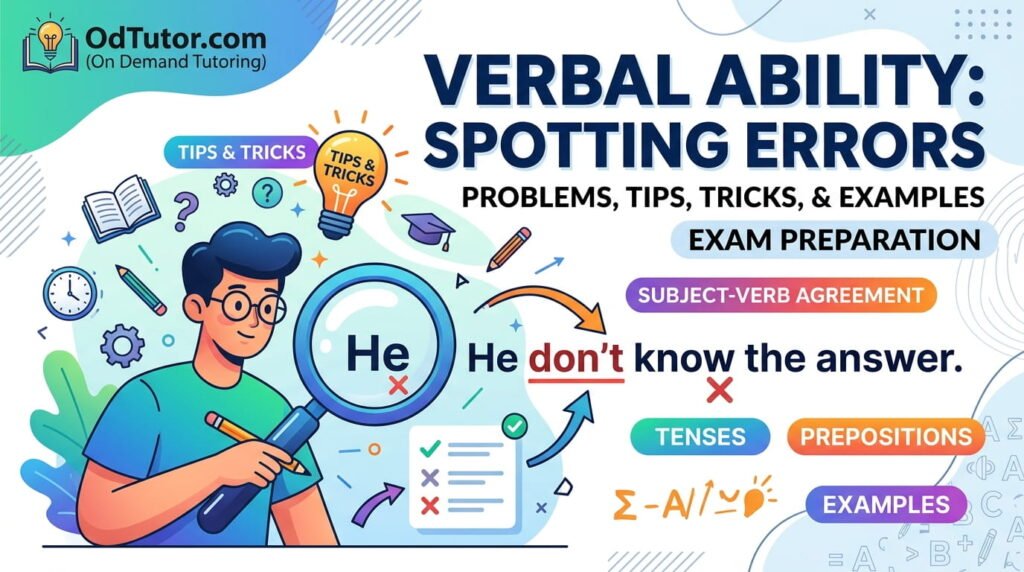
This is, without exaggeration, the single most tested error type in every competitive exam I’ve prepared students for. The rule is simple in theory: singular subjects take singular verbs, and plural subjects take plural verbs. In practice, exams love to hide the real subject behind tricky phrases, collective nouns, or words like “each,” “every,” “either,” and “neither.”
Consider this sentence: “The list of items / are / placed on the table / No Error.” Students often see “items” right before “are” and assume it’s correct. But the actual subject is “list,” which is singular — so it should be “is placed,” not “are placed.” This is called the “proximity trap,” and once you learn to spot it, entire categories of questions become easy.
Collective nouns like “team,” “committee,” “family,” and “jury” are another common trap. These typically take a singular verb when acting as one unit: “The committee has decided” is correct, while “The committee have decided” is generally treated as an error in most exam patterns — unless members are acting individually.
Words like “each,” “every,” “either,” “neither,” “none,” and “one of the” are almost always singular. So “Neither of the boys were present” should be “Neither of the boys was present.”
My shortcut trick: mentally cross out prepositional phrases (like “of the students,” “along with his friends”) sitting between the subject and verb. What remains will usually reveal the true subject, making agreement errors far easier to catch under exam pressure.
3. Tense-Related Errors
Tense errors test whether the verb forms used across a sentence are consistent with the time frame being described. These errors are sneaky because they often “sound fine” on a quick read, especially if you’re mentally rushing through the passage — which is exactly why exams include them.
A classic example: “He has completed the project / yesterday / and submitted the report / No Error.” The word “yesterday” indicates a definite point in the past, so the present perfect tense (“has completed”) is incorrect — it should be “completed” in simple past. Present perfect tense is used for actions with no specific past time reference or those connected to the present, not for events tied to specific past markers like “yesterday,” “last year,” or “in 2020.”
Another frequent trap involves “since” and “for.” “Since” is used with a specific point in time (since 2015, since Monday), while “for” is used with a duration (for five years, for two hours). Sentences often swap these incorrectly: “He is living here since five years” should be “He has been living here for five years.”
Sequence of tense in reported speech and conditional sentences is another favorite. In “If I would have known, I would have come,” the first clause is wrong — it should be “If I had known,” since “would have” cannot appear in the “if” clause of a third conditional sentence.
My advice: whenever you see time-indicating words like “yesterday,” “next week,” “since,” “ago,” or “by the time,” treat that sentence as a potential tense-trap and verify the verb form against that time marker specifically.
4. Errors with Articles (A, An, The)
Articles seem like the smallest words in English, but they carry disproportionate weight in Spotting Errors questions. The three articles — “a,” “an,” and “the” — follow rules that are easy to learn but easy to overlook when you’re reading quickly under time pressure.
The basic rule: use “a” before words starting with a consonant sound, and “an” before words starting with a vowel sound. Note that this is about sound, not spelling — “an hour” is correct because “hour” starts with a vowel sound (the h is silent), while “a university” is correct because “university” starts with a “yoo” consonant sound despite starting with the letter u.
“The” is used for specific, particular nouns — things already known to the reader, unique objects, or superlatives. Missing or misplaced “the” is a very common exam trap: “He is best student in the class” is incorrect; it should be “He is the best student in the class,” since superlative adjectives almost always require “the.”
Another frequent error is unnecessary use of an article before uncountable or abstract nouns: “She gave me an advice” is wrong because “advice” is uncountable — it should simply be “She gave me advice” or “a piece of advice.”
Proper nouns generally don’t take articles (“the India” is wrong; just “India”), except in specific cases like names of rivers, oceans, mountain ranges, or countries with plural-sounding names (the Ganges, the Himalayas, the United States).
My shortcut: whenever an underlined part contains “a,” “an,” or “the” — or conspicuously lacks one where you’d expect it — slow down slightly and check it against these rules before moving on.
5. Preposition Errors
Prepositions are one of the trickiest areas of English because their usage often depends on fixed collocations rather than logical rules — meaning you largely need to build familiarity through exposure and practice rather than memorizing formulas alone.
That said, there are patterns worth knowing. Certain verbs and adjectives are conventionally paired with specific prepositions: “married to” (not “married with”), “different from” (not “different than,” in most formal exam contexts), “consist of” (not “consist in”), “depend on,” “capable of,” and “interested in.” Exams frequently swap these fixed pairings to test whether you’ve internalized correct usage.
For example: “He is married with a doctor / and lives in Delhi / with his family / No Error.” Part A is incorrect — it should be “married to a doctor.”
Prepositions of time also cause confusion: “in” is used for months, years, and longer periods (in July, in 2024); “on” is used for specific days and dates (on Monday, on 15th August); and “at” is used for precise times (at 5 o’clock, at noon). A sentence like “The meeting will be held in Monday” should read “on Monday.”
Another common issue is redundant prepositions — adding one where none is needed, such as “discuss about the matter” instead of the correct “discuss the matter,” since “discuss” is already a transitive verb that doesn’t require “about.”
My practical tip: keep a running list of verb-preposition and adjective-preposition combinations as you encounter them in practice tests. Spaced repetition of these fixed pairs, even just ten minutes a day, builds the intuition needed to catch preposition errors instantly during the actual exam.
6. Pronoun Errors
Pronoun errors test whether a pronoun correctly agrees with its antecedent (the noun it refers to) in number, gender, and case. These errors are common because a sentence can have multiple nouns, and it’s easy to lose track of which one the pronoun is actually replacing.
A frequent example: “Every student must submit their assignment before the deadline.” Traditionally, in formal exam grammar, “every student” is treated as singular, so the pronoun should technically be “his or her” rather than “their” — though it’s worth noting that many modern style guides now accept singular “they.” For competitive exams, however, it’s safer to follow the traditional formal rule unless the exam’s answer key indicates otherwise.
Case errors are another category — mixing up subject pronouns (I, he, she, they) with object pronouns (me, him, her, them). For instance: “Between you and I, this deal seems risky” is incorrect; since “between” is a preposition, it should take the object case: “Between you and me.”
Reflexive pronoun misuse is also tested: “Myself and my colleague will attend the meeting” is wrong. “Myself” should only be used when the subject and object refer to the same person (“I hurt myself”), not as a substitute for “I.”
Finally, ambiguous pronoun reference — where it’s unclear which noun a pronoun refers to — can also appear, especially in fill-in-the-blank or sentence improvement formats tied to this section.
My tip: whenever you see a pronoun in an underlined segment, physically trace it back to the noun it replaces, and check that they match in number and person before deciding the sentence is correct.
7. Parallelism and Conjunction Errors
Parallelism means that items joined in a list, or clauses connected by conjunctions, should follow the same grammatical structure. When this structure breaks, sentences sound clumsy and are flagged as errors even if the meaning is technically understandable.
Example: “She likes reading, writing, and to paint.” This is incorrect because two items are in gerund form (“reading, writing”) while the third switches to infinitive form (“to paint”). The correct version is “She likes reading, writing, and painting.”
Correlative conjunctions — pairs like “not only…but also,” “either…or,” “neither…nor,” and “both…and” — are a major focus area. Each element following these pairs must match structurally: “He is not only intelligent but also he is hardworking” is wrong; the correct form is “He is not only intelligent but also hardworking,” keeping both sides as adjectives.
Another common trap is using “and” to join a main and dependent clause incorrectly, or misusing “although” and “but” together in the same sentence, since they serve the same contrasting function: “Although he was tired, but he continued working” is incorrect — you should drop either “although” or “but,” not use both.
Comparisons are also tested under this category: “My salary is higher than my brother” is technically wrong, since it compares “salary” to “brother” rather than “brother’s salary.” It should read “higher than my brother’s” or “higher than that of my brother.”
My advice here is to read list items and clauses on either side of a conjunction and mentally check whether they “match” in form — verb form, tense, or part of speech — before deciding the sentence is grammatically sound.
8. Confusing Word Pairs and Usage Errors
Some of the trickiest Spotting Errors questions don’t involve grammar rules at all — they involve commonly confused word pairs that sound or look similar but have different meanings and usages. Exams love these because they test genuine vocabulary precision rather than rote rule application.
Common pairs include “affect” (verb, to influence) versus “effect” (usually a noun, a result); “fewer” (used for countable nouns) versus “less” (used for uncountable nouns) — so “fewer people” is correct, not “less people”; and “lay” (to place something) versus “lie” (to recline), which are frequently mixed up even by advanced speakers.
Another frequent pair is “compare to” versus “compare with” — “compare to” is used when highlighting similarity between different things (life compared to a journey), while “compare with” is used when examining similarities and differences between similar things (comparing two companies’ financial results).
“Uninterested” (not caring about something) versus “disinterested” (impartial, having no personal stake) is a classic exam favorite: “The judge should be uninterested in the case” is actually incorrect if the intended meaning is impartiality — it should be “disinterested.”
Words like “principal” (head of an institution, or main/primary) versus “principle” (a fundamental rule) also appear often in written exams, particularly in sentence correction formats.
My suggestion is to build a small personal glossary of these confusing pairs as you come across them in your practice sets, along with one memorable example sentence for each. Reviewing this list regularly, even for five minutes a day, pays off significantly on exam day.
9. Punctuation and Sentence Structure Errors
While less frequently tested than grammar-based errors, punctuation and structural issues do appear, especially in exams that use sentence-improvement or paragraph-based error formats rather than simple lettered segments.
Comma splices — joining two independent clauses with just a comma instead of a conjunction or semicolon — are a common issue: “The exam was difficult, many students struggled” should either use a semicolon (“difficult; many students struggled”) or add a conjunction (“difficult, so many students struggled”).
Run-on sentences, where multiple independent clauses are strung together without appropriate punctuation or connecting words, are also tested, particularly in exams with paragraph-length error-spotting questions.
Apostrophe errors for possessives versus contractions are another area: “Its” (possessive, no apostrophe) is often confused with “it’s” (contraction of “it is”). “The company announced it’s new policy” is incorrect; it should be “its new policy.”
Misplaced modifiers — where a descriptive phrase is positioned so it appears to modify the wrong word — can also create structural errors: “Walking to the station, the rain started falling” incorrectly implies the rain was walking. It should be restructured as “While he was walking to the station, the rain started falling.”
Since these errors are less frequent, I recommend prioritizing your revision time toward subject-verb agreement, tense, and prepositions first, and treating punctuation and structural rules as a secondary layer once your fundamentals are solid.
10. Time Management and Practice Strategy for the Exam
Knowing the rules is only half the battle — applying them accurately within seconds, under exam pressure, is the real challenge. Here’s the strategy I recommend to every student I train.
First, attempt Spotting Errors questions early in the section if your exam allows choosing question order, since these tend to be quicker to solve than reading comprehension or para-jumbles once you’re fluent in the patterns. Aim to spend no more than 20-25 seconds per question once you’re well-practiced.
Second, build a mental checklist you run through automatically: subject-verb agreement, tense consistency, articles, prepositions, pronouns, and parallelism — in that order of exam frequency. This ordered scanning prevents you from getting stuck overanalyzing a sentence for an error type that’s statistically less likely to be there.
Third, don’t ignore “No Error” as an option out of suspicion. Many students psychologically resist selecting “No Error” even when a sentence is genuinely correct, second-guessing themselves into picking a wrong option. Trust your analysis if you’ve methodically checked the sentence.
Fourth, practice with previous years’ papers and full-length mock tests rather than isolated grammar exercises alone. Real exam sentences have a particular “flavor” and level of subtlety that generic textbook exercises often don’t replicate.
Finally, maintain an error log of questions you get wrong during practice, noting the specific rule you missed. Reviewing this log weekly is, in my experience, one of the fastest ways students improve their accuracy in this section — often within just a few weeks of consistent practice.
Why Learning With OdTutor Makes the Difference
Grammar rules are easy to read but hard to apply instinctively under exam pressure — that’s where structured mentorship changes the game. At OdTutor, our teachers don’t just explain rules; they walk you through hundreds of real exam-style sentences, helping you build the pattern-recognition speed that Spotting Errors truly demands. With personalized doubt-clearing sessions, regular mock tests, and error-log reviews tailored to your specific weak areas, our trainers help you convert theoretical knowledge into exam-day accuracy. Whether you’re just starting out or fine-tuning your final revision, OdTutor’s teachers are there to guide every step of your preparation journey.