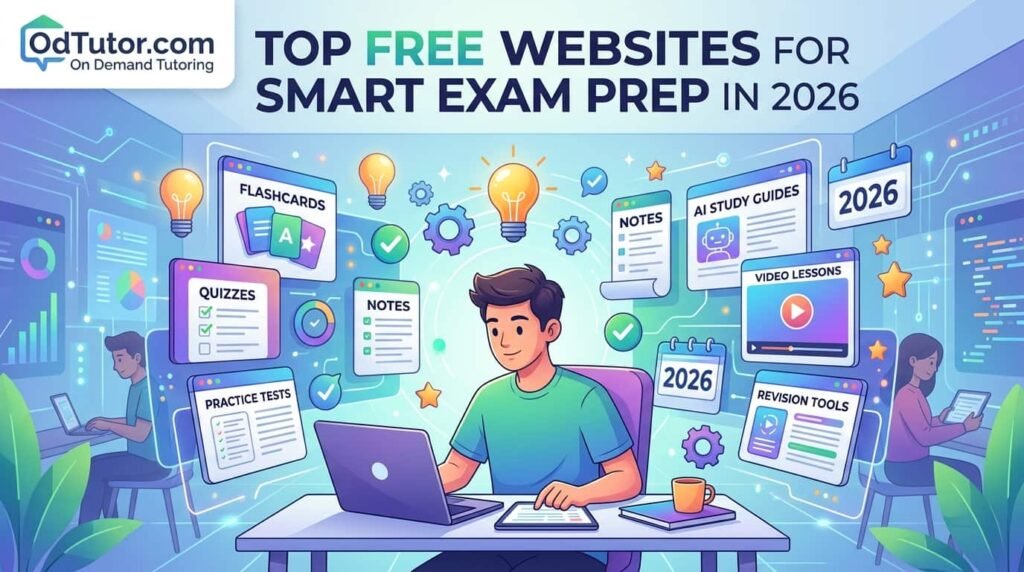
Top Free Websites Every Student Must Use for Smart Exam Preparation in 2026
Hello students, I’m Rahul, and over the years I have noticed one major difference between average students and top scorers — smart resource usage. Many students think success only comes from studying for long hours, but the reality is that using the right learning platforms can save time, improve understanding, and increase marks significantly. Today’s students have access to amazing free websites that can help with notes, mock tests, doubt solving, revision, concept visualization, time management, and exam strategies. Whether you are preparing for CBSE board exams, ISC, JEE, NEET, CUET, Olympiads, or competitive examinations, free educational websites can become your biggest support system. The internet is no longer only for entertainment. It has evolved into a powerful digital classroom where students can learn from expert teachers, solve practice papers, watch concept videos, attempt quizzes, and track progress without spending large amounts of money. However, many students waste time on random websites that provide incomplete or confusing information. That is why I have created this detailed guide to help students discover the best free educational platforms that genuinely improve preparation quality. These websites are useful for school students, college students, competitive exam aspirants, and even self-learners. If you use these platforms consistently with proper discipline and revision strategies, your exam preparation can become faster, smarter, and more effective than ever before. Khan Academy for Strong Concept Clarity One of the best free educational platforms available for students worldwide is Khan Academy. This website is extremely useful for Mathematics, Physics, Chemistry, Biology, Economics, and several other subjects. The biggest advantage of Khan Academy is its concept-focused teaching style. Instead of simply memorizing formulas, students learn the logic behind every topic. Many students struggle because their basics are weak. For example, if a student does not properly understand algebra or trigonometry, advanced Mathematics becomes difficult. Khan Academy solves this problem by offering step-by-step lessons from beginner to advanced level. The explanations are simple, visual, and beginner-friendly. Another major benefit is the practice system. After watching lessons, students can solve quizzes and assignments to test understanding instantly. This improves retention and helps students identify weak areas quickly. The platform also tracks progress, which motivates students to continue learning consistently. For competitive exam aspirants preparing for JEE and NEET, Khan Academy provides valuable support for strengthening NCERT-level fundamentals. Students can revise topics repeatedly without paying coaching fees. The website works effectively on mobile devices as well, making it useful for students who prefer learning through smartphones. With regular practice and disciplined learning, Khan Academy can become a complete self-study companion for students aiming for higher marks. NCERT Official Website for Authentic Study Material Students preparing for CBSE and many state board examinations should regularly use the official NCERT website. This platform provides free access to all NCERT textbooks in PDF format. Since many competitive exams are based heavily on NCERT concepts, this website becomes extremely important for serious students. A common mistake students make is depending entirely on guidebooks while ignoring NCERT textbooks. In reality, direct questions and conceptual foundations often come from NCERT itself. Subjects like Biology, Chemistry, and Social Science become much easier when students study directly from authentic NCERT resources. The website allows students to download books chapter-wise, making revision more organized and convenient. Even if a student loses a physical textbook, digital versions remain available anytime. This helps during travel, coaching classes, and quick revision sessions. Students preparing for NEET especially benefit from NCERT Biology and Chemistry books. JEE aspirants can also strengthen theory and examples using NCERT Mathematics and Physics content. Board exam students should carefully solve all textbook examples and exercises. Another advantage is that the website provides updated editions whenever syllabus changes occur. This ensures students always study the latest content instead of outdated material. Using the official NCERT platform regularly improves conceptual understanding, reduces confusion caused by unofficial notes, and helps students focus on the exact syllabus required for examinations. YouTube Educational Channels for Visual Learning YouTube has become one of the largest free educational resources for students. Thousands of teachers upload high-quality educational videos covering school academics, competitive exams, coding, spoken English, reasoning, and more. When used correctly, YouTube can significantly improve learning speed and concept clarity. Many students understand topics better visually rather than through textbook reading alone. Animated explanations, diagrams, graphs, and live problem solving make difficult concepts easier to remember. Subjects like Physics and Mathematics become more interesting when teachers explain them using practical examples and visual demonstrations. Students should follow trusted educational channels instead of randomly watching low-quality content. Good channels provide structured playlists, chapter-wise explanations, mock tests, revision strategies, and important questions. This organized approach helps students study systematically. Another benefit is flexible learning. Students can pause videos, replay difficult sections, and study at their own pace. Slow learners especially benefit because they can revise concepts multiple times without hesitation. YouTube is also useful for motivation and exam strategy guidance. Many experienced educators share time management techniques, revision plans, topper strategies, and productivity methods that help students improve overall performance. However, discipline is important. Students must avoid distractions like entertainment recommendations and focus only on educational playlists. Creating a dedicated study account can help maintain concentration. When used wisely, YouTube becomes a powerful digital classroom that provides access to quality education from experienced teachers completely free of cost. Wikipedia for Quick Topic Understanding and Research Wikipedia is often underestimated by students, but it can be extremely useful for quick learning and basic understanding of topics. While it should not replace textbooks entirely, it serves as an excellent starting point for research and concept exploration. Students frequently encounter unfamiliar terms during studies. Instead of wasting time searching through multiple websites, Wikipedia provides summarized explanations in simple language. Topics related to history, science, geography, technology, literature, and current affairs can be understood quickly using this platform. One major advantage is interconnected learning. Wikipedia articles contain links to related concepts, allowing students to explore subjects deeply and develop broader understanding. This improves