
Hello Students,
I am Rahul Sir, and today we will discuss one of the most important topics in the Quantitative Aptitude section of IBPS PO and Clerk examinations – Permutation and Combination. Many banking aspirants find this topic difficult because it involves counting arrangements and selections without actually listing all possibilities. However, once you understand the basic concepts and formulas, these questions become among the easiest scoring areas in competitive exams.
Permutation and Combination questions test your logical thinking, counting ability, and understanding of arrangements. They are frequently asked in IBPS PO, IBPS Clerk, SBI PO, SBI Clerk, RRB PO, and other banking examinations. Usually, 1-3 questions appear directly or indirectly from this topic.
In this article, I will explain important concepts, formulas, shortcuts, and exam-oriented tricks with examples. By mastering these techniques, you can solve questions quickly and accurately during the exam.
1. Understanding Permutation and Combination Basics
Before learning shortcuts, it is important to understand the difference between permutation and combination.
Permutation
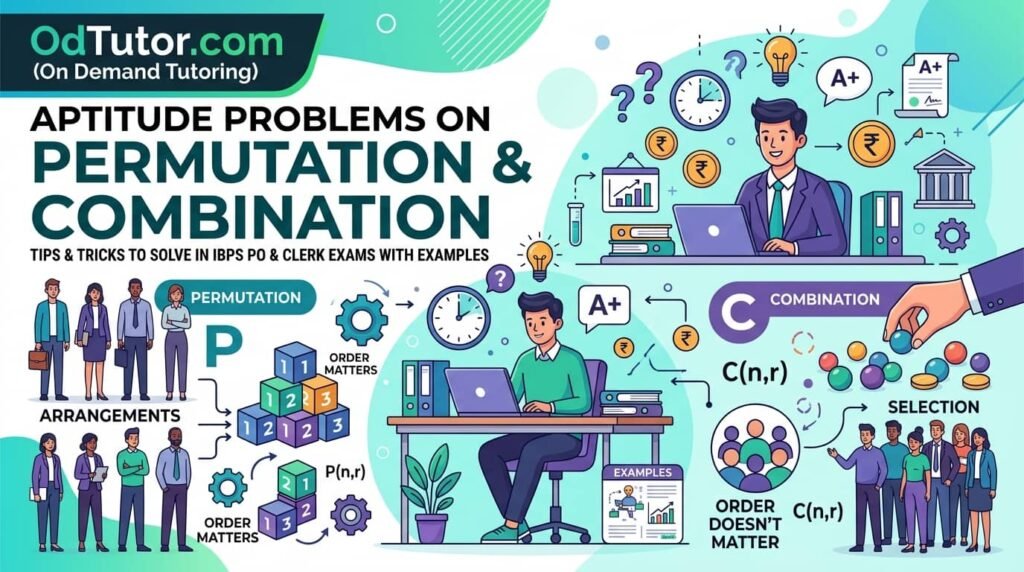
Permutation refers to arrangements where order matters.
Formula:
nPr = n! / (n-r)!
Combination
Combination refers to selections where order does not matter.
Formula:
nCr = n! / [r!(n-r)!]
Example
How many ways can 3 students be selected from 5 students?
Combination:
5C3 = 5! / (3! × 2!)
= 10
How many ways can President, Vice President, and Secretary be selected from 5 students?
Permutation:
5P3 = 5! / 2!
= 60
Exam Tip
Whenever positions are different, use permutation.
Whenever only selection is required, use combination.
Quick Memory Trick
- Selection → Combination
- Arrangement → Permutation
Most exam mistakes happen because students confuse these two concepts.
2. Mastering Factorials Quickly
Factorials are the foundation of permutation and combination.
Formula
n! = n × (n-1) × (n-2) …
Examples
5! = 120
6! = 720
7! = 5040
Important Values
| Number | Factorial |
|---|---|
| 1 | 1 |
| 2 | 2 |
| 3 | 6 |
| 4 | 24 |
| 5 | 120 |
| 6 | 720 |
| 7 | 5040 |
Shortcut
Instead of calculating complete factorials, cancel terms.
Example:
8! / 6!
= (8×7×6!)/6!
= 56
Example Question
Find 10P2.
10P2
= 10!/8!
= 10 × 9
= 90
Exam Strategy
Memorize factorial values up to 10!.
This saves significant time during calculations.
3. Circular Arrangement Questions
Questions involving people sitting around a table are common.
Formula
For n persons sitting in a circle:
Arrangement = (n-1)!
Example
How many ways can 6 persons sit around a round table?
=(6−1)!
=5!
=120
Why?
In circular arrangements, rotations are considered identical.
Example
A B C D and B C D A are same arrangements in a circle.
Quick Tip
| Situation | Formula |
|---|---|
| Straight Line | n! |
| Circle | (n-1)! |
Example
8 persons around a table:
(8−1)!
=7!
=5040
This shortcut frequently appears in banking and insurance exams.
4. Arrangements with Repeated Letters
Many questions involve words containing repeated letters.
Formula
n! / (p! × q! × r!)
Where p, q, r are repeated letters.
Example
Find arrangements of “LEVEL”
Letters = 5
Repeated:
L = 2
E = 2
Answer:
5!/(2!×2!)
=120/4
=30
Example
Find arrangements of “BANANA”
Total letters = 6
A = 3
N = 2
Answer:
6!/(3!×2!)
=720/12
=60
Shortcut
Always identify repeated letters before applying factorial.
Ignoring repetitions leads to incorrect answers.
5. Selection of Committees
Committee questions are pure combination-based problems.
Example
A committee of 4 members is to be formed from 10 people.
10C4
=210
Example
Choose 2 boys from 5 and 3 girls from 7.
Required:
5C2 × 7C3
=10 × 35
=350
Shortcut
When separate groups exist:
Use multiplication.
Formula
Total Ways
= Ways from Group A × Ways from Group B
Committee questions are among the easiest permutation-combination questions in IBPS exams.
6. Arrangements with Restrictions
Many questions contain conditions.
Example
How many ways can 5 persons sit if A and B sit together?
Treat A and B as one unit.
Units become:
AB, C, D, E
Total units = 4
Arrangement:
4!
Internal arrangement of AB:
2!
Answer:
4! × 2!
=24 × 2
=48
Shortcut
When people stay together:
- Treat them as one object.
- Arrange units.
- Multiply internal arrangements.
This method solves most restriction-based questions quickly.
7. Arrangements Where Persons Cannot Sit Together
Opposite of the previous concept.
Example
Arrange A, B, C, D, E where A and B cannot sit together.
Method
Total arrangements
=5!
=120
Arrangements where A and B sit together
=4! × 2!
=48
Required
=120−48
=72
Shortcut Formula
Required
= Total Arrangements − Restricted Arrangements
This method saves time compared to direct counting.
8. Formation of Numbers Using Digits
Questions often involve forming numbers from digits.
Example
How many 3-digit numbers can be formed using digits 1,2,3,4,5?
Use permutation.
5P3
=5×4×3
=60
Example
How many 4-digit numbers can be formed using 0,1,2,3,4?
First digit cannot be zero.
Choose first digit:
4 ways
Remaining:
4P3
=24
Total
=4×24
=96
Shortcut
Whenever zero exists:
Handle first digit separately.
This avoids common mistakes.
9. Shortcut Techniques for IBPS Exams
Important Results
nC0 = 1
nCn = 1
nC1 = n
nCn−1 = n
Symmetry Property
nCr = nCn−r
Example:
10C8 = 10C2
=45
Benefit
Always choose the smaller value of r.
Example:
15C13
Instead solve
15C2
=105
Much faster.
Exam Trick
Reduce calculations by applying symmetry before solving.
This saves valuable exam time.
10. Previous Year IBPS Style Questions
Question 1
Select 3 members from 8 persons.
8C3
=56
Question 2
Arrange 5 books on a shelf.
5!
=120
Question 3
How many ways can 7 students stand in a row?
7!
=5040
Question 4
How many ways can 2 boys and 3 girls be selected from 5 boys and 6 girls?
5C2 × 6C3
=10 × 20
=200
Question 5
Arrange the letters of “BOOK”.
4! / 2!
=12
Exam Advice
Practice at least 50 mixed-level questions before the exam.
The more patterns you solve, the faster you identify the correct approach.
How Teachers from OdTutor Can Help
At OdTutor, experienced aptitude faculty help students master Permutation and Combination through concept-based learning, shortcut techniques, and extensive practice sessions. Our teachers explain difficult concepts using simple real-life examples and exam-oriented methods. Students receive topic-wise worksheets, doubt-solving sessions, mock tests, and previous year question discussions. Whether you are preparing for IBPS PO, IBPS Clerk, SBI, RRB, SSC, or other competitive exams, OdTutor provides personalized guidance to improve speed and accuracy. With regular practice and expert mentorship, students can confidently solve permutation and combination questions in the actual examination.