
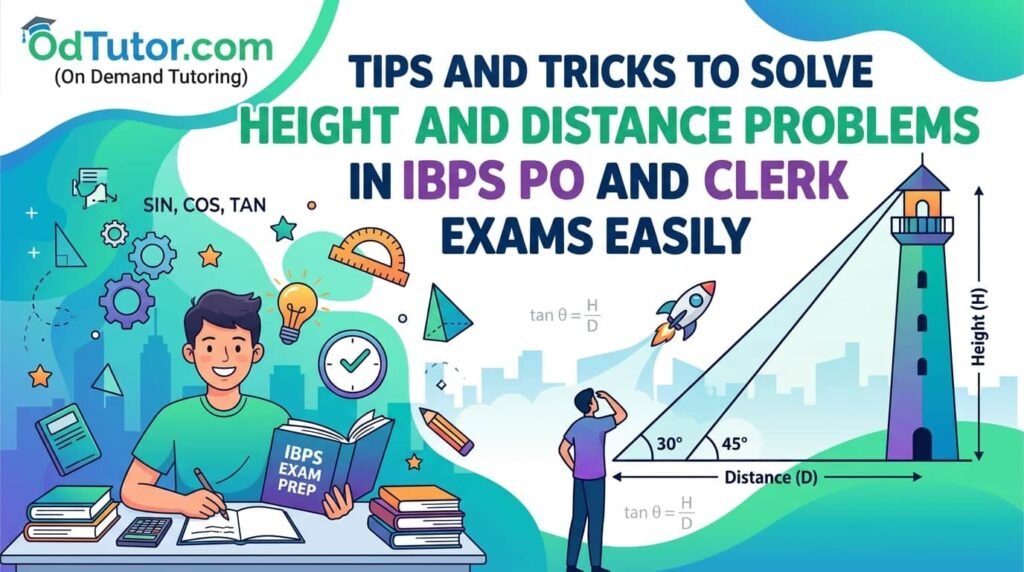
Hi Students, I’m Rahul Sir, and today we are going to master one of the most scoring and interesting topics asked in IBPS PO and Clerk exams — Height and Distance. Many students fear trigonometry-based questions because they think calculations are difficult or formulas are confusing. But the truth is, Height and Distance questions become extremely easy once you understand the logic behind angles, triangles, and observation techniques.
In banking examinations like IBPS PO and IBPS Clerk, questions from Height and Distance are generally direct and formula-based. They test your speed, observation power, and ability to apply basic trigonometric ratios. Most problems involve finding the height of buildings, towers, trees, poles, or distances using angles of elevation and depression.
The biggest mistake students make is memorizing formulas without understanding concepts. In this article, I will explain practical tricks, shortcuts, visualization techniques, and solved examples that will help you solve questions faster during the exam. We will cover angle-based shortcuts, common triangle values, diagram techniques, and smart elimination methods that save precious time in competitive exams.
If practiced regularly, Height and Distance can become one of your strongest topics in quantitative aptitude. So let’s begin learning these powerful methods step-by-step and improve your IBPS exam score with confidence.
Understanding the Basic Concept of Height and Distance
Height and Distance is based on the application of trigonometry. Before solving questions, students must understand three important terms: line of sight, angle of elevation, and angle of depression. Without clarity in these concepts, even easy questions appear confusing.
The line of sight refers to the straight line drawn from the observer’s eye to the object. When the observer looks upward towards an object, the angle formed is called the angle of elevation. When the observer looks downward, it becomes the angle of depression.
Most IBPS questions involve right-angled triangles. Therefore, knowing the relationship between sides and angles is extremely important. The three primary trigonometric ratios are:
Among these, tangent ratio is used most frequently in banking exams. Students should focus heavily on tan values because they simplify calculations in height-distance problems.
For example, if the angle of elevation is 45° and the distance from the tower is 20 meters:
So, the height becomes 20 meters.
The easiest trick is to always draw a diagram before solving. Even rough diagrams improve understanding and reduce mistakes. Students who skip diagrams often confuse height and base values. Practice visualization because IBPS questions become easier when converted into figures mentally.
Mastering these fundamentals forms the foundation for solving advanced Height and Distance questions quickly and accurately.
Learn Standard Trigonometric Values for Fast Calculations
One of the biggest time-saving tricks in IBPS exams is memorizing standard trigonometric values. Many students waste time calculating ratios during exams, while toppers instantly recall them and solve questions within seconds.
The most important angles are 0°, 30°, 45°, 60°, and 90°. Questions in IBPS generally revolve around these standard angles. Memorizing tangent values is especially important.
Similarly, students should remember sine and cosine values because some questions use them indirectly.
A smart memory trick for sine values is:
0, 1/2, 1/√2, √3/2, 1
And cosine values are simply the reverse order.
Example:
A tower casts a shadow of 10√3 meters when the angle of elevation of the sun is 30°. Find the height.
Using:
After simplification:
h = 10 meters.
Students who know standard values solve such questions mentally without lengthy calculations. Another important shortcut is recognizing special triangles:
- 45°-45°-90° triangle → sides are equal
- 30°-60°-90° triangle → ratio is 1 : √3 : 2
These triangle properties appear repeatedly in competitive exams.
Daily revision of trig values for just 10 minutes can significantly improve exam speed. Create flashcards or write values repeatedly until they become automatic in your mind.
Master Diagram Drawing Techniques
A simple diagram can turn a difficult Height and Distance problem into an easy one. Many students lose marks not because concepts are difficult, but because they fail to visualize the situation properly.
Whenever you read a question, immediately identify:
- Observer
- Object
- Angle
- Distance
- Height
After identifying these elements, draw a right triangle. Do not worry about artistic perfection. A rough sketch is enough to understand relationships.
For example:
“A man standing 30 meters away from a tower observes the top at an angle of 60°.”
Immediately draw:
- Vertical tower
- Horizontal ground
- Observer at one end
- Angle at observer point
Then apply:
Since:
Height = 30√3 meters.
Students often confuse angle placement. Remember:
- Angle of elevation is always measured upward from the horizontal line.
- Angle of depression is always measured downward.
Another useful trick is labeling all known values directly on the figure. This avoids confusion during calculations.
For multi-step questions involving two observations, use separate triangles carefully. Mark distances clearly. Sometimes questions involve moving towards or away from an object. In such cases, write old and new distances separately.
Diagram practice improves problem-solving speed dramatically. During exams, visualization saves time and reduces silly mistakes. The more figures you draw during practice sessions, the easier actual exam questions become.
Shortcut Tricks for 45 Degree Questions
Questions involving 45° are among the easiest in Height and Distance because tangent of 45° equals 1.
This means:
Height = Base
Whenever you see a 45° angle, instantly understand that the perpendicular side and base side are equal.
Example:
The angle of elevation of a tower from a point on the ground is 45°. If the distance from the tower is 25 meters, find the height.
Solution:
Therefore:
h = 25 meters.
No complicated calculation is needed.
Another common IBPS trick involves two observations:
- First angle = 45°
- Second angle = 60°
- Observer moves closer
These questions become simple when you first use the 45° property to establish equality between height and distance.
Students should also remember:
- If angle = 45°, shadow length equals object height.
- If angle increases beyond 45°, height becomes greater than distance.
- If angle is below 45°, distance becomes greater than height.
These observations help eliminate wrong options quickly in multiple-choice exams.
Practice mental calculations for 45° problems because they are highly scoring and frequently repeated in banking examinations. Examiners love such questions because they test conceptual clarity more than difficult mathematics.
Mastering 45° shortcuts can help you solve certain questions in less than 20 seconds during IBPS exams.
Solving Questions Using the Shadow Concept
Shadow-based problems are common in Height and Distance chapters. These questions mainly involve sunlight, poles, buildings, trees, and towers.
The concept is simple:
- Height = perpendicular
- Shadow = base
- Sunlight forms hypotenuse
Example:
A pole casts a shadow of 15 meters when the angle of elevation of the sun is 60°. Find the height.
Using:
Therefore:
The biggest shortcut here is understanding the relationship between angle and shadow length:
- Larger angle → smaller shadow
- Smaller angle → larger shadow
For example:
- At 45°, height and shadow are equal
- At 60°, shadow becomes shorter
- At 30°, shadow becomes longer
This helps estimate answers quickly.
Students should also practice unit consistency. Sometimes questions use centimeters, meters, or kilometers together. Convert all units before calculation.
Another trick is identifying whether the question requires exact value or approximate value. If approximation is allowed, use:
- √3 ≈ 1.732
- √2 ≈ 1.414
This speeds up calculations during IBPS exams.
Shadow questions are generally direct and scoring. Students who memorize tan values and understand shadow-angle relationships can solve them rapidly with high accuracy.
Handling Two Observation Point Questions
Two observation point questions are slightly advanced but highly predictable. These problems involve observing the same object from two different distances or positions.
Example structure:
- Observer first sees top at angle 30°
- Moves closer by 20 meters
- New angle becomes 60°
- Find height
The key trick is creating two equations using tangent formulas.
Suppose original distance = x
Then new distance = x − 20
Now apply:
And:
After solving equations simultaneously, height can be calculated easily.
Students often panic seeing two angles, but the logic remains the same. Simply write equations carefully and solve step-by-step.
Another shortcut is noticing standard angle combinations:
- 30° and 60°
- 45° and 60°
- 30° and 45°
These combinations appear frequently because calculations become manageable.
Always write distance variables clearly. Many students make sign mistakes while subtracting or adding movement distances.
Practice equation formation more than calculations because the real challenge lies in converting language into mathematical equations.
Once mastered, two-observation questions become highly scoring and can even help improve confidence during quantitative aptitude sections.
Understanding Angle of Depression Questions
Angle of depression questions confuse many students initially, but they are extremely simple once understood properly.
Angle of depression occurs when the observer is at a higher position and looks downward. Examples include:
- Person standing on building
- Observer on lighthouse
- Person on hilltop
Important rule:
Angle of depression equals angle of elevation because they are alternate interior angles.
This single concept solves most problems.
Example:
A person standing atop a 50-meter building observes a car on the ground at an angle of depression of 45°. Find the distance of the car from the building.
Since angle of depression = angle of elevation:
Thus:
x = 50 meters.
The main trick is drawing parallel horizontal lines. Once you mark alternate angles correctly, the problem becomes a regular trigonometry question.
Students should carefully read whether the question mentions:
- angle of elevation
- angle of depression
Wrong interpretation leads to incorrect diagrams.
Another shortcut:
- From top to ground → depression
- From ground to top → elevation
Conceptually both are connected through geometry.
These questions are usually easy scoring opportunities in IBPS exams because they rely more on understanding than heavy calculations.
Speed Calculation Tricks for Competitive Exams
In banking exams, speed matters as much as accuracy. Even if you know concepts well, slow solving can reduce overall score.
The first speed trick is avoiding unnecessary calculations. Use direct standard values whenever possible instead of decimal expansions.
Example:
Instead of calculating:
√3 = 1.732 repeatedly,
keep expressions in surd form until the final answer.
Second trick:
Memorize square roots up to at least 25. This improves calculation speed tremendously.
Third trick:
Use option elimination.
Suppose angle is 60° and base is 10 meters. Since tan60° is greater than 1, height must be greater than 10. Eliminate smaller options instantly.
Fourth trick:
Use approximation in lengthy calculations when options are far apart.
Fifth trick:
Identify repetitive patterns. Many Height and Distance questions are modified versions of previous exam questions.
Students should also develop mental math skills:
- Multiplication tables
- Fraction simplifications
- Square root approximations
Another powerful technique is solving from options backward. Sometimes plugging answer choices is faster than solving equations traditionally.
Timed practice is essential. Solve 20–30 questions daily with a stopwatch. Initially focus on accuracy, then gradually improve speed.
Competitive exams reward efficient thinking. The goal is not just solving correctly, but solving quickly with confidence.
Common Mistakes Students Must Avoid
Even strong students lose marks due to avoidable mistakes in Height and Distance questions. Understanding these common errors can significantly improve accuracy.
The first mistake is drawing incorrect diagrams. Wrong placement of angles leads to incorrect equations. Always read the question twice before sketching.
The second mistake is confusing sine, cosine, and tangent formulas. In most IBPS problems, tangent is sufficient because height and distance are generally given directly.
Students also forget unit conversions. If height is in meters and distance is in kilometers, calculations become wrong unless converted properly.
Another common error occurs while simplifying surds like √3 or √2. Practice simplification techniques regularly.
Students also panic when questions appear lengthy. Remember:
Long language does not mean difficult mathematics.
Break the question into smaller parts and identify:
- Known values
- Unknown values
- Required formula
One major mistake is skipping standard trigonometric value memorization. Without these values, students waste time repeatedly calculating.
Another issue is careless algebra while solving simultaneous equations in two-observation questions.
The best prevention method is consistent practice. Analyze every mistake carefully after mock tests. Maintain an error notebook and revise incorrect questions weekly.
Avoiding common errors can improve marks more effectively than learning complicated shortcuts.
Best Practice Strategy for IBPS PO and Clerk Exams
Consistent practice is the real secret behind mastering Height and Distance. Students who practice regularly develop faster visualization and better accuracy.
Start with concept-building:
- Learn diagrams
- Memorize trig values
- Understand angle concepts
After basics, solve topic-wise questions from previous IBPS papers. Banking exams often repeat similar patterns.
A highly effective strategy is:
- Day 1: Basic concepts
- Day 2: Standard angle problems
- Day 3: Shadow questions
- Day 4: Two-observation problems
- Day 5: Mixed practice
- Day 6: Mock test
- Day 7: Error analysis
This structured approach improves retention.
Students should also maintain a formula notebook containing:
- Trigonometric values
- Important shortcuts
- Common patterns
Revision is crucial. Many students learn concepts once and forget them later due to lack of revision.
Online quizzes and sectional mock tests help improve speed under pressure. Try solving questions within one minute each.
Another useful method is teaching concepts to friends. Explaining problems improves conceptual clarity and memory retention.
Do not fear difficult questions initially. With repeated exposure, even advanced problems become manageable.
Most importantly, stay calm during the exam. Height and Distance questions are generally easier than they appear. Confidence and visualization are the real keys to success.
How Teachers from OdTutor Can Help
Expert mentors from Odtutor.com help students master quantitative aptitude topics like Height and Distance through live classes, doubt-solving sessions, shortcuts, mock tests, and personalized guidance. Experienced teachers like Rahul C Sir simplify complex trigonometry concepts using practical examples and exam-oriented techniques. Students receive structured preparation strategies for IBPS PO, Clerk, SSC, Railway, and other competitive exams. OdTutor also provides online learning flexibility, practice worksheets, previous year questions, and one-on-one support to improve both speed and accuracy in mathematics.