
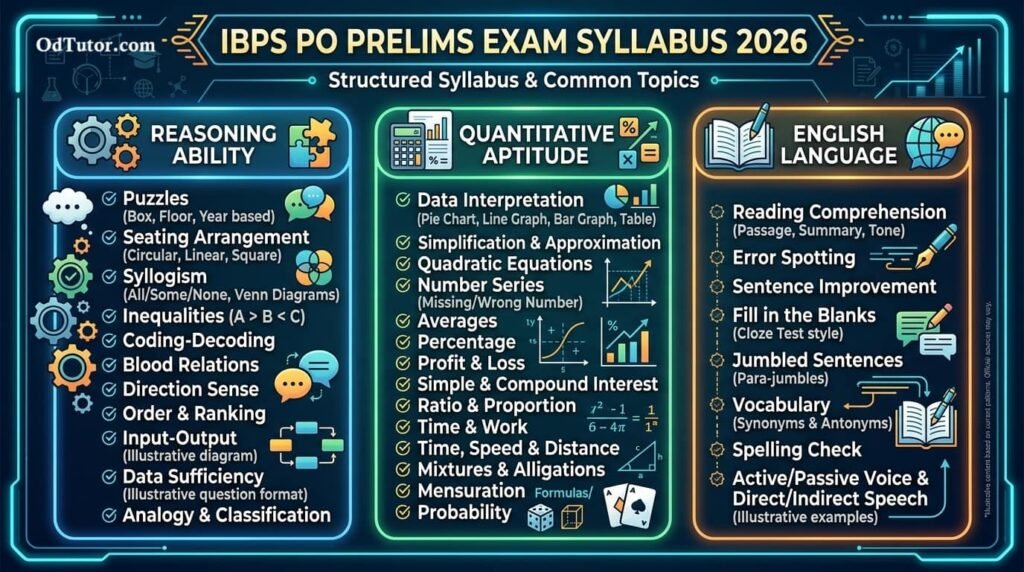
This comprises of Reasoning Ability, Quantitative Aptitude and English Language.
IBPS PO PRELIMS EXAM 2026
Complete Syllabus & Preparation Guide
Overview of IBPS PO Prelims 2026
The Institute of Banking Personnel Selection (IBPS) conducts the Probationary Officer (PO) examination every year to recruit officers for public sector banks across India. The IBPS PO selection process follows a three-tier structure: Preliminary Examination, Main Examination, and an Interview round. The Prelims is the first and most competitive stage, acting as a qualifying filter that determines which candidates proceed to the Main Examination.
The IBPS PO Prelims 2026 is a one-hour online objective-type examination consisting of 100 questions spread across three sections. Understanding the syllabus thoroughly is the first and most essential step towards effective preparation. This guide provides a detailed breakdown of all three sections — Reasoning Ability, Quantitative Aptitude, and English Language — along with key preparation tips.
| Conducting Body | Institute of Banking Personnel Selection (IBPS) |
| Exam Name | IBPS PO Preliminary Examination 2026 |
| Total Questions | 100 Questions |
| Total Marks | 100 Marks |
| Duration | 60 Minutes (20 minutes per section) |
| Mode | Online (Computer-Based Test) |
| Negative Marking | 0.25 marks deducted per wrong answer |
| Sections | Reasoning Ability | Quantitative Aptitude | English Language |
SECTION 1: REASONING ABILITY
About This Section
Reasoning Ability tests a candidate’s logical thinking, pattern recognition, and analytical skills. With 35 questions carrying 35 marks and a time limit of 20 minutes, this is the most intellectually demanding section of the IBPS PO Prelims. Aspirants must develop strong problem-solving speed to handle this section effectively.
| REASONING ABILITY — TOPIC-WISE BREAKDOWN |
| 1. Logical Reasoning |
| 2. Alphanumeric Series |
| 3. Ranking / Direction / Alphabet Test |
| 4. Data Sufficiency |
| 5. Coded Inequalities |
| 6. Seating Arrangement |
| 7. Puzzle |
| 8. Tabulation |
| 9. Syllogism |
| 10. Blood Relations |
| 11. Input-Output |
| 12. Coding-Decoding |
Topic-Wise Explanation
Logical Reasoning forms the backbone of this section, testing a candidate’s ability to identify relationships, draw inferences, and evaluate arguments using structured information. Questions may appear as cause-effect, conclusion-based, or statement-assumption formats.
Alphanumeric Series involves sequences composed of letters, numbers, or a mix of both, requiring candidates to find the missing term or identify the pattern. Ranking, Direction, and Alphabet Tests check spatial awareness, positional reasoning, and alphabetical order logic.
Data Sufficiency questions present a problem followed by two or three statements; the candidate must determine whether the data given is sufficient to answer the question. Coded Inequalities use symbolic representations (>, <, =) in place of letters to form inequality chains.
Seating Arrangement and Puzzle are the most heavily weighted topics in this section, frequently appearing as sets of 4–5 questions. They test the ability to organize given conditions logically — linear, circular, or floor-based arrangements. Tabulation questions present data in grid form requiring careful reading and deduction.
Syllogism tests deductive reasoning through Venn diagram-based logic. Blood Relations map family trees to find relationships. Input-Output involves machine-based word or number rearrangements. Coding-Decoding requires identifying a system of letter or number substitution.
SECTION 2: QUANTITATIVE APTITUDE
About This Section
Quantitative Aptitude assesses a candidate’s mathematical proficiency, speed, and accuracy. This section carries 35 marks with 35 questions to be solved in 20 minutes. It demands both conceptual clarity and quick calculation ability. Topics range from fundamental arithmetic to advanced mathematical concepts and data analysis.
| QUANTITATIVE APTITUDE — TOPIC-WISE BREAKDOWN |
| 1. Simplification |
| 2. Profit & Loss |
| 3. Mixtures & Allegations |
| 4. Simple Interest, Compound Interest, Surds & Indices |
| 5. Work & Time |
| 6. Time & Distance |
| 7. Mensuration — Cylinder, Cone, Sphere |
| 8. Data Interpretation |
| 9. Ratio & Proportion, Percentage |
| 10. Number Systems |
| 11. Sequence & Series |
| 12. Permutation, Combination & Probability |
Topic-Wise Explanation
Simplification is a foundational topic that tests the application of BODMAS rules, fractions, decimals, and approximations. Aspirants should aim to solve these quickly, as they offer straightforward marks. Profit & Loss questions cover concepts of cost price, selling price, discount, and percentage profit, often in the context of commercial transactions.
Mixtures & Allegations involves combining two or more substances at different rates or concentrations, using the allegation formula to find ratios. Simple Interest and Compound Interest are key topics, with questions frequently combining both. Surds and Indices test simplification of irrational numbers and exponential expressions.
Work & Time problems involve shared work rates, pipes and cisterns, and efficiency calculations. Time & Distance covers speed-time relationships, relative motion, trains, and boats. Mensuration focuses on surface area and volume of three-dimensional figures such as cylinders, cones, and spheres — these require formula memorization and application.
Data Interpretation is a critical and high-weight topic. It appears in sets of 5 questions each, using tables, bar graphs, pie charts, and line graphs. Candidates must quickly extract, compute, and compare data. Ratio & Proportion and Percentage are foundational skills embedded across all other topics. Number Systems covers HCF, LCM, divisibility rules, and properties of integers.
Sequence & Series tests number patterns, arithmetic progressions, geometric progressions, and wrong number identification. Permutation, Combination, and Probability are advanced topics often appearing in 1–2 questions, requiring clarity of fundamental counting principles, arrangement logic, and probability theory.
SECTION 3: ENGLISH LANGUAGE
About This Section
The English Language section evaluates a candidate’s comprehension, vocabulary, grammar, and verbal reasoning skills. It carries 30 marks with 30 questions in 20 minutes. This section rewards candidates who read regularly and have built a strong command over written English. It is also the section most amenable to quick score improvement through targeted practice.
| ENGLISH LANGUAGE — TOPIC-WISE BREAKDOWN |
| 1. Reading Comprehension |
| 2. Cloze Test |
| 3. Para Jumbles |
| 4. Multiple Meaning / Error Spotting |
| 5. Fill in the Blanks |
| 6. Miscellaneous (Grammar, Vocabulary) |
| 7. Paragraph Completion |
Topic-Wise Explanation
Reading Comprehension is the most prominent topic in this section, typically appearing as a passage followed by 5–10 questions. Passages are drawn from economics, banking, social affairs, or general interest topics. Questions test vocabulary in context, inferential meaning, main idea identification, and tone of the author.
Cloze Test presents a passage with blanks that must be filled with the most contextually and grammatically appropriate words from given options. It tests both vocabulary range and reading comprehension simultaneously. Para Jumbles require rearranging a set of sentences to form a coherent, logically sequenced paragraph — a skill that tests reading flow and discourse awareness.
Error Spotting questions present sentences divided into segments; the candidate must identify which portion contains a grammatical or usage error. Multiple Meaning questions test knowledge of words that can have different meanings depending on context, often called homonyms or polysemous words.
Fill in the Blanks questions assess vocabulary and grammatical understanding, sometimes presenting double blanks requiring two contextually compatible words. Paragraph Completion asks candidates to select the most suitable sentence to conclude or logically complete a given paragraph.
Section-Wise Marks Distribution
| Section | No. of Questions | Maximum Marks |
| Reasoning Ability | 35 | 35 |
| Quantitative Aptitude | 35 | 35 |
| English Language | 30 | 30 |
| TOTAL | 100 | 100 |
PREPARATION STRATEGY
Key Tips for IBPS PO Prelims 2026
• Master the basics first — a strong foundation in arithmetic, grammar rules, and logical reasoning principles is essential before attempting complex problems.
• Practice daily with time-bound mock tests to develop speed and accuracy. Aim for at least one full-length mock test per week as the exam approaches.
• Focus heavily on Seating Arrangement, Puzzles, and Data Interpretation — these topics contribute the maximum marks and often decide sectional cutoffs.
• Read English newspapers daily (The Hindu, Indian Express) to improve Reading Comprehension speed, vocabulary, and general awareness simultaneously.
• Be mindful of negative marking — do not guess randomly. Prioritize accuracy over attempting all 100 questions.
• Revise short tricks for Simplification, Percentage, and SI/CI to save valuable time during the actual examination.
• Analyze your mock test performance after each attempt to identify weak areas and refine your time allocation strategy accordingly.
Best of luck for IBPS PO Prelims 2026!