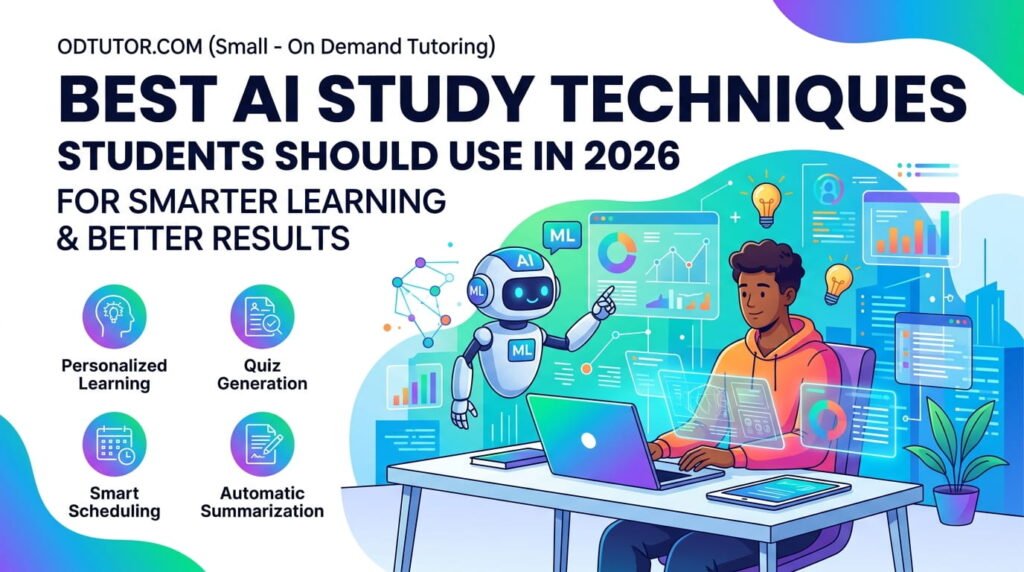
Hello students, I am Rahul C Sir, and one thing I have noticed over the years is that students are studying harder than ever, but many are still struggling with focus, retention, and time management. In 2026, the competition for exams like JEE, NEET, CUET, Boards, SSC, Banking, and other entrance exams has become extremely intense. Traditional study methods alone are no longer enough. Students now need smart learning strategies powered by Artificial Intelligence to improve productivity and learning efficiency.
AI is not here to replace teachers or books. Instead, it acts as a powerful assistant that helps students learn faster, revise better, identify weak areas, and practice in a more personalized way. Today’s students have access to AI-powered apps, adaptive learning platforms, intelligent flashcards, AI doubt-solving tools, automated note generators, personalized mock tests, and even AI tutors that explain difficult concepts instantly.
However, using AI without proper strategy can also waste time. Many students get distracted or become dependent on shortcuts. That is why understanding the best AI study techniques is very important. When used correctly, AI can help students build discipline, consistency, confidence, and deeper understanding.
In this article, I will explain the best AI study techniques students should use in 2026 to improve academic performance, prepare effectively for competitive exams, and study smarter instead of simply studying longer.
Using AI-Powered Personalized Learning Platforms
One of the biggest advantages students have in 2026 is access to personalized AI learning platforms. Unlike traditional classroom systems where every student follows the same pace, AI-powered learning systems analyze a student’s strengths, weaknesses, accuracy levels, speed, and understanding patterns to create customized study plans.
For example, if a student is weak in Algebra but strong in Geometry, the AI system automatically increases practice questions for Algebra while maintaining revision sessions for Geometry. This targeted approach saves time and improves learning efficiency. Students preparing for IIT JEE or NEET can especially benefit because competitive exams require strategic preparation rather than random studying.
These platforms also use adaptive learning methods. If a student answers questions incorrectly repeatedly, the AI changes the difficulty level and offers simpler explanations before gradually increasing complexity. This prevents frustration and helps students build confidence step by step.
Another major benefit is performance analytics. Students receive detailed reports showing time spent on chapters, error patterns, weak concepts, and predicted scores. Such insights help students focus their energy where improvement is most needed.
However, students must avoid blindly following AI suggestions. Human understanding and self-discipline are still important. AI should guide the learning process, not control it entirely. Combining personalized AI tools with proper teacher guidance creates the most effective study system for modern students.
Smart Revision Through AI Flashcards and Memory Systems
Revision is one of the most important parts of successful learning, but many students forget concepts because they revise randomly. AI-powered flashcard systems in 2026 use advanced memory science techniques like spaced repetition and active recall to improve long-term retention.
Traditional revision often involves rereading notes multiple times, which is less effective. AI flashcard tools instead test students repeatedly at scientifically optimized intervals. Concepts that students remember well appear less frequently, while weak concepts appear more often until mastery is achieved.
This method significantly improves memory retention for subjects like Biology terminology, Chemistry reactions, Physics formulas, Mathematics identities, historical dates, and vocabulary-based subjects. Students can create custom flashcards or use AI-generated sets based on textbooks and class notes.
Many modern platforms now automatically generate flashcards from PDFs, lecture notes, or recorded classes. AI identifies key points, formulas, definitions, and important concepts, reducing manual work for students. Some tools even include voice-based revision and interactive quizzes.
Another advantage is portability. Students can revise anytime using mobile devices during travel, breaks, or free time. Short daily revision sessions become more effective than long stressful revision marathons before exams.
The best strategy is to combine AI flashcards with handwritten notes. Writing improves conceptual understanding, while AI-based revision improves retention. Students who consistently use active recall systems usually perform better in exams because they train their brain to retrieve information quickly under pressure.
AI Doubt Solving for Faster Concept Clarity
Many students lose valuable study time because doubts remain unresolved for days. In 2026, AI-powered doubt-solving systems have become highly advanced and can instantly explain concepts, solve numerical problems, and provide step-by-step solutions.
These systems are especially useful during self-study hours when teachers or tutors may not be immediately available. Students can upload images of questions, type equations, or ask conceptual doubts using voice commands. The AI then provides explanations in multiple formats including text, diagrams, videos, and simplified breakdowns.
For Mathematics and Physics, AI tools can show complete step-by-step solving methods instead of only giving final answers. This helps students understand the logic behind the solution. In Chemistry, AI can explain reaction mechanisms, balancing methods, and conceptual theories. For Biology students, AI can simplify complex processes and generate memory tricks.
However, students must avoid overdependence. Simply copying AI solutions without attempting questions independently reduces critical thinking ability. The correct approach is to first attempt problems on your own, identify confusion points, and then use AI for clarification.
Another smart strategy is cross-verification. Students should compare AI explanations with textbooks and teacher guidance because not every AI-generated answer is perfectly accurate. Learning improves most when students actively analyze solutions rather than passively reading them.
Used wisely, AI doubt-solving tools can dramatically reduce frustration, improve conceptual understanding, and maintain study momentum during preparation.
Creating AI-Based Study Timetables for Maximum Productivity
One of the biggest reasons students fail to complete their syllabus is poor planning. AI-powered timetable systems in 2026 help students create realistic and optimized study schedules based on learning capacity, exam deadlines, strengths, weaknesses, and daily routines.
Unlike traditional timetables that students often abandon after a few days, AI systems continuously adapt based on progress. If a student misses study sessions or performs poorly in certain topics, the schedule automatically adjusts revision time and practice sessions accordingly.
AI scheduling systems also reduce mental fatigue by balancing difficult and easy subjects intelligently. For example, highly analytical subjects like Mathematics and Physics may be scheduled during peak concentration hours, while lighter revision tasks are placed during low-energy periods.
Another useful feature is productivity tracking. AI tools monitor consistency, focus duration, break patterns, and completion rates. Students receive reminders, motivational alerts, and daily progress summaries that help maintain discipline.
Students preparing for competitive exams can also use AI-generated milestone planning. These systems divide large syllabi into achievable weekly and monthly goals, preventing last-minute stress.
However, no timetable works unless students maintain consistency. AI can design excellent schedules, but execution still depends on student discipline. A realistic timetable followed consistently is far better than an overly ambitious schedule that becomes impossible to maintain.
Students should also include proper sleep, exercise, and relaxation in AI-generated schedules because mental performance directly depends on physical health and emotional balance.
Using AI Note-Making Tools for Faster Learning
Modern students spend a huge amount of time making notes manually. In 2026, AI-powered note-making systems have transformed how students organize study material. These tools can summarize lectures, convert videos into notes, generate mind maps, extract important points from PDFs, and organize topics automatically.
AI note-making tools are especially useful for lengthy theoretical subjects where students struggle to identify key concepts. Instead of writing everything, students can focus more on understanding while AI assists in organizing content efficiently.
Some AI platforms can even create chapter summaries in simple language, helping students revise quickly before exams. Students preparing for Boards, NEET, UPSC, or university exams benefit greatly because large volumes of information become easier to manage.
Mind mapping is another powerful AI feature. AI tools visually connect related concepts, formulas, definitions, and processes. This improves conceptual linking and memory retention, especially for interdisciplinary subjects.
Voice-to-note conversion has also become highly popular. Students can record lectures, and AI automatically converts them into structured notes with headings and bullet points. This saves considerable time during classroom learning.
Still, students should not completely stop making handwritten notes. Writing manually improves comprehension and recall ability. The best method is to combine AI-generated summaries with personal handwritten key points and annotations.
AI note systems should support learning efficiency, not replace active engagement. Students who actively review, modify, and personalize AI-generated notes generally gain deeper understanding and better exam performance.
AI Mock Tests and Predictive Exam Analysis
Practice testing is one of the strongest predictors of exam success. AI-based mock testing systems in 2026 have become extremely advanced and provide students with intelligent performance analysis instead of just scores.
Modern AI mock tests simulate real exam environments including timing pressure, difficulty patterns, adaptive questioning, and performance tracking. These systems identify weak chapters, recurring mistakes, time management issues, and conceptual gaps.
For competitive exams like JEE and NEET, predictive analytics is especially valuable. AI systems compare student performance with large datasets and estimate probable score ranges, rank predictions, and qualifying chances. This helps students understand where they stand in competition.
Another advantage is targeted improvement plans. After each test, AI generates personalized recommendations such as increasing revision frequency for certain topics, improving calculation speed, or practicing specific question types.
AI systems can also identify behavioral patterns. For example, they may detect that a student performs poorly in lengthy numerical sections due to anxiety or time pressure. Such insights help students improve strategically rather than studying blindly.
However, students should avoid becoming emotionally dependent on predicted scores. Mock test analysis should guide preparation, not create fear or overconfidence. Consistency and continuous improvement matter more than temporary performance fluctuations.
The best strategy is to take regular AI mock tests, analyze mistakes honestly, revise weak concepts immediately, and maintain a balanced mindset throughout preparation.
Improving Focus Using AI Productivity Tools
Distractions are one of the biggest challenges students face today. Social media, gaming, notifications, and entertainment platforms continuously reduce concentration levels. AI productivity tools in 2026 help students improve focus and maintain disciplined study sessions.
AI-based focus systems monitor screen usage, study duration, distraction patterns, and concentration levels. Some tools temporarily block distracting apps and websites during study hours. Others use smart timers based on techniques like Pomodoro to optimize attention spans.
Advanced AI productivity apps now even analyze behavioral patterns. For instance, if a student usually loses concentration after 40 minutes, the system recommends short breaks before mental fatigue begins. This improves efficiency and reduces burnout.
Many AI systems also include ambient sounds, concentration music, breathing exercises, and guided focus sessions. These features help students create productive study environments at home.
Another useful feature is habit tracking. Students can monitor daily study hours, completed tasks, consistency streaks, and productivity trends over weeks and months. Visual progress tracking increases motivation and accountability.
However, students should remember that productivity tools alone cannot create discipline. Real focus comes from clear goals, self-control, and strong motivation. AI tools only support these habits.
Students should also avoid spending excessive time customizing productivity apps instead of actually studying. Simplicity often works best. The goal is efficient learning, not perfect digital organization.
Learning Difficult Concepts Through AI Visualizations
Many students struggle because they try to memorize concepts without truly understanding them. AI visualization tools in 2026 make learning more interactive and concept-oriented through animations, simulations, 3D models, and intelligent diagrams.
Subjects like Physics, Chemistry, Biology, Mathematics, and Engineering become easier when students can visually observe processes and relationships. For example, AI simulations can demonstrate electric fields, molecular structures, projectile motion, calculus graphs, or biological systems dynamically.
Visual learning significantly improves conceptual clarity because the human brain processes images faster than plain text. Students who understand visually often retain information longer and solve application-based questions more effectively.
AI platforms now also allow interactive learning. Students can manipulate variables in simulations and instantly observe results. This creates deeper understanding compared to passive textbook reading.
For Mathematics students, graph visualization tools help explain functions, transformations, trigonometry, and coordinate geometry.
Similarly, Physics concepts like wave motion and projectile trajectories become more intuitive when visualized dynamically.
Still, visualization should support conceptual thinking rather than replace problem-solving practice. Students must balance visual learning with numerical practice, derivations, and written explanations to build complete mastery.
The combination of AI visualization and traditional analytical practice creates stronger conceptual foundations for advanced examinations and real-world applications.
AI Language Tools for Better Communication and Writing Skills
In 2026, communication skills are becoming increasingly important for academic and professional success. AI language tools help students improve grammar, writing clarity, vocabulary, pronunciation, comprehension, and speaking confidence.
Students preparing essays, reports, assignments, presentations, and interviews can use AI writing assistants to identify grammar errors, sentence improvements, and structural weaknesses. These tools also help students write more clearly and professionally.
For students learning English or other languages, AI conversation systems provide interactive speaking practice without fear of judgment. Pronunciation analysis, vocabulary suggestions, and real-time corrections improve language fluency significantly.
AI summarization tools are also valuable for academic reading. Long research articles and textbook chapters can be summarized into simpler formats for faster understanding. This is particularly useful for higher education students managing heavy reading loads.
Another growing trend is AI-based debate and communication practice. Students can simulate interview situations, group discussions, and public speaking exercises using conversational AI platforms.
However, students must avoid copying AI-generated writing directly into assignments. Academic honesty and original thinking remain extremely important. AI should help improve writing quality, not replace creativity and personal effort.
The best approach is to use AI suggestions for refinement while maintaining your own voice, ideas, and analytical thinking. Strong communication skills combined with subject expertise create major advantages in both academics and future careers.
Balancing AI Learning with Human Guidance
While AI has transformed education in 2026, students must understand an important truth: technology cannot fully replace human teachers, mentors, and self-effort. The most successful students use AI as a support system while still relying on structured guidance from experienced educators.
Teachers provide emotional support, motivation, strategic planning, real-life experience, and personalized mentoring that AI cannot fully replicate. Human educators understand student psychology, exam stress, confidence issues, and learning behavior more deeply.
Students should use AI for revision, practice, organization, and quick clarification, but complex conceptual discussions and long-term academic strategy still benefit greatly from experienced teachers and tutors.
Another important factor is discipline. AI tools can provide reminders and analytics, but they cannot force consistency. Success still depends on regular practice, focused effort, and mental resilience.
Students must also learn digital responsibility. Spending excessive time experimenting with tools, watching random AI-generated content, or relying completely on shortcuts can reduce actual learning quality. Smart usage matters more than excessive usage.
The future belongs to students who combine technology with strong fundamentals, critical thinking, creativity, and guidance from skilled mentors. AI is a powerful educational partner, but real growth still comes through dedication, curiosity, and continuous learning.
How Tutors from Odtutor.com Can Help Students Succeed in 2026
The right mentorship can completely transform a student’s academic journey. Tutors from Odtutor.com help students combine modern AI learning techniques with expert human guidance for maximum academic improvement.
Experienced tutors provide personalized support for subjects like Mathematics, Physics, Chemistry, Biology, Coding, English, and competitive exam preparation. Instead of following generic study patterns, students receive customized learning strategies based on their individual strengths and weaknesses.
One major advantage of Odtutor tutors is concept-focused teaching. Students are guided step by step through difficult topics while also learning how to use AI tools effectively for revision, doubt solving, note-making, and productivity improvement.
Tutors also help students avoid common AI learning mistakes such as overdependence, passive studying, and poor time management. They create structured learning routines that combine technology with strong academic fundamentals.
For competitive exams like IIT JEE, NEET, CUET, SSC, Banking, and Boards, Odtutor mentors provide targeted preparation plans, mock test guidance, performance analysis, and motivational support. Students gain both technical knowledge and confidence.
Another important benefit is flexibility. Students can access online learning support from skilled tutors while using modern digital learning systems from home. This creates a balanced and efficient learning ecosystem designed for the demands of modern education.
Conclusion
The education system in 2026 is evolving rapidly, and students who learn how to use AI intelligently will have a major advantage. AI-powered learning techniques can improve productivity, memory retention, focus, revision quality, conceptual understanding, and exam preparation efficiency.
However, students must remember that AI is a tool, not a shortcut to success. Real achievement still depends on consistency, discipline, critical thinking, curiosity, and regular practice. The best results come when students combine AI technology with proper mentorship, self-effort, and strategic study habits.
From personalized learning systems and AI mock tests to intelligent revision tools and productivity management, modern students now have access to resources that previous generations could only imagine. Those who use these tools wisely can reduce stress, study more efficiently, and perform better academically.
As a teacher, my advice is simple: do not fear AI, and do not misuse it. Learn how to use it as a smart assistant that strengthens your preparation while you continue building strong fundamentals and independent thinking skills.
The future of education belongs to students who can balance technology with human intelligence, discipline, and creativity.