Hello Students,
I am Rahul Sir, and over the years, I have trained thousands of students preparing for academic success, competitive examinations, and professional careers. One thing has become very clear in recent years—the world is changing faster than ever before because of Artificial Intelligence (AI).
AI is transforming every industry, from healthcare and banking to education, manufacturing, marketing, and software development. Many routine jobs are becoming automated, while entirely new career opportunities are emerging. This means students can no longer rely only on traditional academic knowledge. Employers are now looking for candidates who combine technical knowledge with creativity, communication, critical thinking, and adaptability.
The good news is that AI is not replacing talented people—it is replacing repetitive work. Students who learn the right skills today will become tomorrow’s innovators, entrepreneurs, managers, engineers, analysts, educators, and leaders.
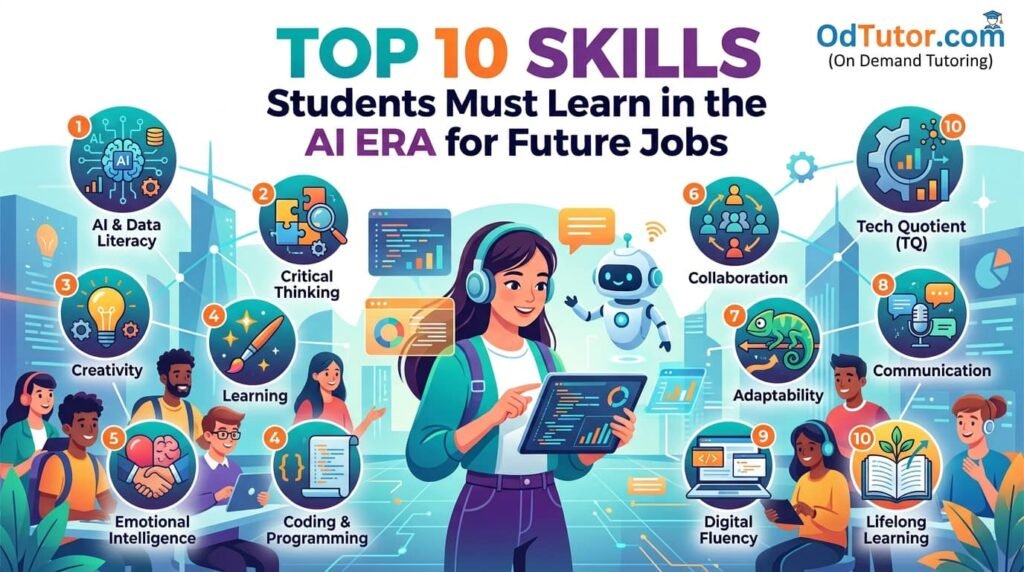
In this article, I will explain the Top 10 future-ready skills every student should develop in the AI era. These skills are relevant whether you are in school, college, preparing for competitive exams, or planning your first job. Start developing these abilities today, and you’ll build a career that remains valuable even as technology continues to evolve.
Let’s explore the skills that will define the future workforce.
1. Artificial Intelligence & AI Literacy
Students don’t need to become AI researchers, but everyone should understand how AI works. AI literacy means understanding machine learning, generative AI, automation, prompts, ethics, and practical applications.
Today’s professionals use AI tools for writing reports, coding, creating presentations, designing graphics, analyzing data, and solving business problems. Students who understand AI can complete tasks faster while improving productivity.
Start by learning:
- Basics of Artificial Intelligence
- Machine Learning concepts
- Generative AI
- Prompt Engineering
- Responsible AI usage
- AI ethics and privacy
Students should experiment with AI tools for learning mathematics, programming, writing, presentations, and research rather than simply copying answers. The goal is to become someone who knows how to work with AI instead of competing against it.
Every profession—from doctors and lawyers to accountants and teachers—will increasingly use AI. Therefore, AI literacy is becoming as essential as computer literacy once was.
Learning AI today gives students a competitive advantage in internships, higher education, entrepreneurship, and future employment.
2. Digital Communication Skills
Communication has become one of the most valuable professional skills.
In an AI-powered workplace, professionals communicate with clients, remote teams, international organizations, and AI systems every day.
Students should improve:
- English communication
- Professional email writing
- Presentation skills
- Public speaking
- Video communication
- Business writing
Good communication also includes listening carefully, asking meaningful questions, and explaining complex ideas in simple language.
Even the most technically skilled employee may struggle without effective communication. Employers consistently rank communication among the top hiring criteria.
Practice by:
- Participating in debates
- Creating presentations
- Recording yourself speaking
- Writing blogs
- Explaining concepts to friends
Communication improves confidence, leadership, teamwork, and interview performance.
In the AI era, people who communicate clearly will always remain valuable because AI cannot fully replace empathy, persuasion, and human connection.
3. Critical Thinking & Problem Solving
AI can provide information, but humans still make decisions.
Critical thinking means analyzing situations carefully before accepting information. Students should question assumptions, compare alternatives, identify risks, and choose the best solutions.
Problem-solving involves:
- Understanding the issue
- Gathering information
- Breaking problems into smaller parts
- Testing different solutions
- Evaluating outcomes
Competitive exams, engineering, management, medicine, law, and entrepreneurship all require analytical thinking.
Develop this skill by solving:
- Logical reasoning questions
- Case studies
- Real-life business problems
- Coding challenges
- Mathematical puzzles
Students who think independently become innovators rather than followers.
Employers increasingly seek candidates who can solve unfamiliar problems instead of simply memorizing facts.
Critical thinking helps students use AI responsibly rather than depending on it blindly.
4. Data Literacy & Analytical Skills
Data is often called the new oil.
Every organization collects enormous amounts of information. Businesses need professionals who can understand and analyze this data to make informed decisions.
Students should learn:
- Microsoft Excel
- Google Sheets
- Data visualization
- Basic statistics
- Charts and dashboards
- Data interpretation
Understanding data helps in finance, healthcare, sports, marketing, government, research, and education.
Students can begin by analyzing survey results, school projects, or publicly available datasets.
Even non-technical careers increasingly require analytical thinking.
When combined with AI tools, data literacy enables faster decision-making and better business insights.
Learning to read and interpret data is becoming a universal workplace skill.
5. Coding & Computational Thinking
Not everyone needs to become a software engineer, but basic programming skills provide a tremendous advantage.
Students should start with beginner-friendly languages like:
- Python
- JavaScript
- HTML
- CSS
Coding teaches logical thinking, creativity, debugging, automation, and structured problem-solving.
Computational thinking means breaking large problems into manageable steps.
AI tools can help students write code faster, but understanding programming concepts remains essential.
Programming is useful in:
- Artificial Intelligence
- Robotics
- Finance
- Research
- Web Development
- Data Science
Even professionals in non-technical industries benefit from automation and scripting knowledge.
Students who understand programming adapt more easily to technological changes.
6. Creativity & Innovation
AI can generate content, but original ideas still come from human creativity.
Creative thinking involves:
- Generating new ideas
- Finding unique solutions
- Designing innovative products
- Thinking beyond conventional methods
Students should explore:
- Graphic design
- Storytelling
- Video editing
- Music
- Entrepreneurship
- Product design
Creativity drives innovation across industries.
Future companies will value employees who combine AI tools with original thinking.
Students should work on personal projects, participate in competitions, and build portfolios demonstrating creative abilities.
Innovation happens when imagination meets execution.
7. Emotional Intelligence & Leadership
Emotional Intelligence (EQ) is becoming increasingly important because AI cannot replace genuine human relationships.
EQ includes:
- Self-awareness
- Empathy
- Conflict resolution
- Motivation
- Team collaboration
- Stress management
Leadership means inspiring others, making responsible decisions, and creating positive work environments.
Students can improve EQ by:
- Participating in group projects
- Volunteering
- Managing events
- Practicing active listening
Companies increasingly promote leaders who understand people rather than simply managing tasks.
Human-centered leadership will remain one of the most valuable skills in the AI era.
8. Adaptability & Continuous Learning
Technology changes rapidly.
Skills that are valuable today may become outdated within a few years.
Students should develop a habit of lifelong learning.
Ways to stay updated include:
- Online courses
- Industry certifications
- Reading books
- Watching educational videos
- Following technology trends
- Learning from mentors
Adaptable students embrace change instead of fearing it.
Future employers will value learning ability more than static knowledge.
Continuous improvement ensures long-term career success.
9. Financial Literacy & Entrepreneurship
Students should understand money before entering professional life.
Important topics include:
- Budgeting
- Saving
- Investing
- Taxes
- Personal finance
- Business planning
Entrepreneurship teaches opportunity recognition, innovation, customer understanding, and calculated risk-taking.
Even employees benefit from entrepreneurial thinking because organizations appreciate proactive problem solvers.
Students should consider freelance work, internships, or small business ideas while studying.
Financial literacy creates independence and smarter career decisions.
10. Cybersecurity & Digital Responsibility
As digital usage increases, cybersecurity awareness becomes essential.
Students should understand:
- Strong passwords
- Two-factor authentication
- Online privacy
- Digital scams
- Phishing attacks
- Responsible social media usage
Cybersecurity awareness protects personal information and professional data.
Every industry now depends on secure digital systems.
Responsible digital behavior also includes respecting copyrights, protecting confidential information, and maintaining professional online conduct.
Students who understand cybersecurity become safer internet users and more responsible professionals.
Digital responsibility is now a core employability skill.
How OdTutor.com Can Help You Build Future-Ready Skills
Learning future-ready skills becomes much easier with proper guidance, structured learning, and experienced mentors. OdTutor.com connects students with qualified tutors across various academic and professional subjects, enabling personalized learning that goes beyond classroom education.
Whether you want to strengthen mathematics, science, English communication, programming, aptitude, competitive exam preparation, digital skills, or AI fundamentals, OdTutor provides one-on-one and interactive learning experiences designed around individual goals. Students receive personalized attention, practical guidance, doubt-solving sessions, and mentorship that helps them build confidence for higher education and future careers.
If you are an experienced educator, subject expert, industry professional, or trainer, OdTutor also offers an excellent opportunity to become a tutor. By joining the platform, you can share your knowledge with learners across India, build your personal teaching brand, earn flexible income, and contribute to shaping the next generation of professionals. Whether you teach school subjects, competitive exams, coding, digital marketing, languages, or emerging technologies, OdTutor welcomes passionate educators to become part of its growing learning community.
The future belongs to learners—and great teachers make that future possible.
Conclusion
Artificial Intelligence is transforming industries, but it is also creating incredible opportunities for students who are prepared. Success in the coming decade will not depend solely on academic marks but on the ability to learn continuously, solve problems, communicate effectively, think creatively, analyze data, understand technology, and work collaboratively with AI.
The ten skills discussed in this guide form the foundation of future-ready careers. Students who begin developing these competencies today will be better equipped for higher education, competitive examinations, entrepreneurship, and global employment opportunities.
Remember, AI is a powerful tool—but human intelligence, creativity, ethics, empathy, and leadership will always remain the driving forces behind innovation. Invest in your skills today, embrace lifelong learning, and prepare yourself for a future where technology and human potential work together to create extraordinary opportunities.