
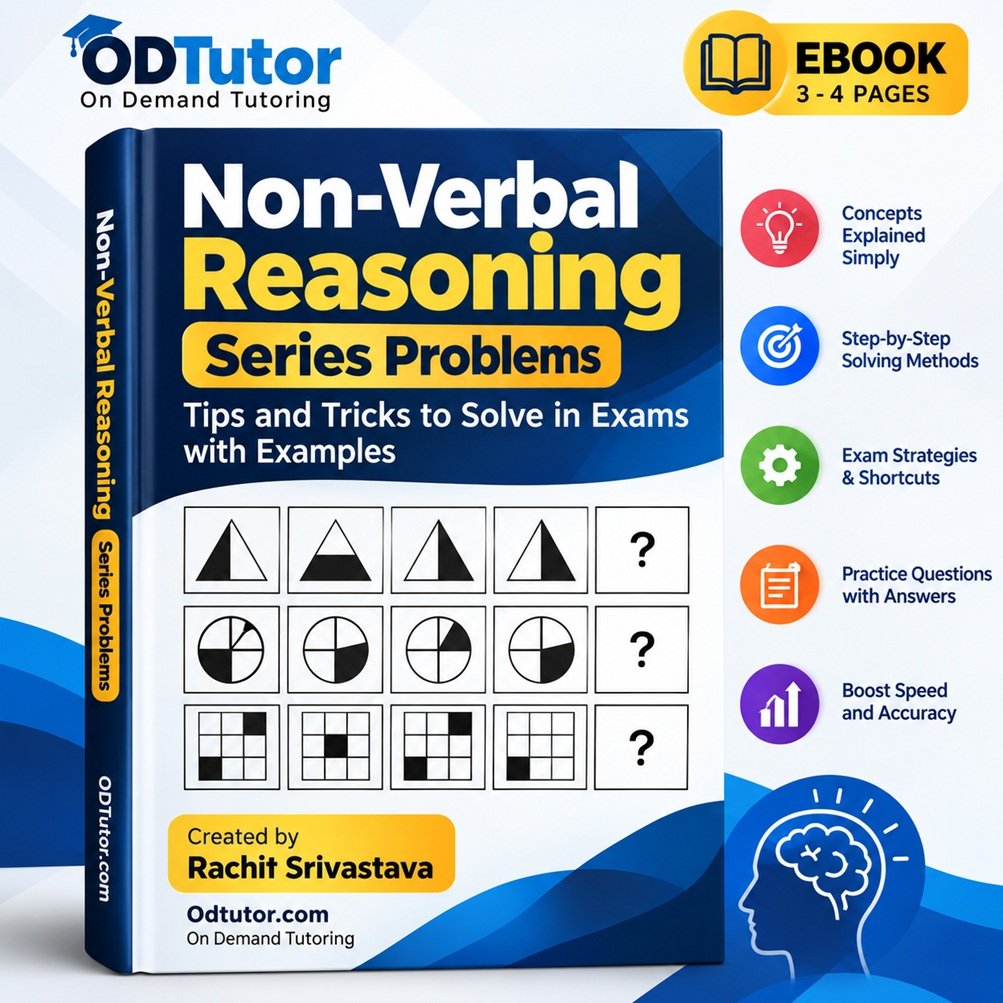
Non-Verbal Reasoning Series Problems: Tips & Tricks to Solve in Exams with Examples is a practical, exam-focused ebook designed to help competitive exam aspirants understand and solve Non-Verbal Reasoning Series questions with greater speed and accuracy.
Non-Verbal Reasoning questions may look like simple pictures, but solving them correctly requires systematic observation. A small change in rotation, position, shading, size, direction or the number of elements can completely change the answer. Many students lose valuable marks because they try to guess the next figure instead of identifying the underlying pattern.
This ebook teaches you to approach these questions like a reasoning problem—not a picture-guessing exercise.
What You Will Learn
The ebook begins with the fundamentals of Non-Verbal Reasoning Series questions and explains exactly what you should observe when a sequence of figures is presented. You will learn how to compare consecutive figures, identify the changing property and verify whether the same rule continues throughout the series.
The guide covers the most common patterns, including:
- Rotation and directional movement
- Addition and subtraction of elements
- Shading and fill patterns
- Changes in size
- Position and movement of objects
- Shape transformation
- Mirror and symmetry-based patterns
- Series involving multiple rules
A major focus of the ebook is exam-solving technique. Instead of simply explaining what a pattern is, the guide shows you what to actually do when you encounter a series question in the examination.
You will learn how to break a complicated figure into individual properties and analyse them separately. For example, if a figure is rotating while its internal shading is also changing, you will learn to track both rules independently before combining them.
Avoid Common Traps
The ebook also highlights common mistakes made by students, such as following the rotation correctly but ignoring shading, confusing clockwise and anti-clockwise movement, missing an extra element, or overcomplicating a simple repeating pattern.
You will also learn how to use answer-option elimination effectively. Rather than checking every detail randomly, you can reject an option as soon as it violates one of the established rules.
Built for Competitive Exams
The guide is particularly useful for students preparing for SSC, IBPS, SBI, Railway and other competitive examinations where reasoning questions must often be solved under strict time pressure.
It also includes practical time-management advice, including how quickly you should attempt straightforward series questions and when it is better to move on and return later.
Written by Rachit Srivastava, this ebook follows a classroom-style approach: understand the concept, identify the pattern, apply the rule, and verify the answer.
Whether you are learning Non-Verbal Reasoning for the first time or revising before an examination, this compact ebook can serve as a useful reference for improving your pattern-recognition skills, solving speed and accuracy.
Stop guessing the figure. Learn to identify the rule.
Reviews
There are no reviews yet.