
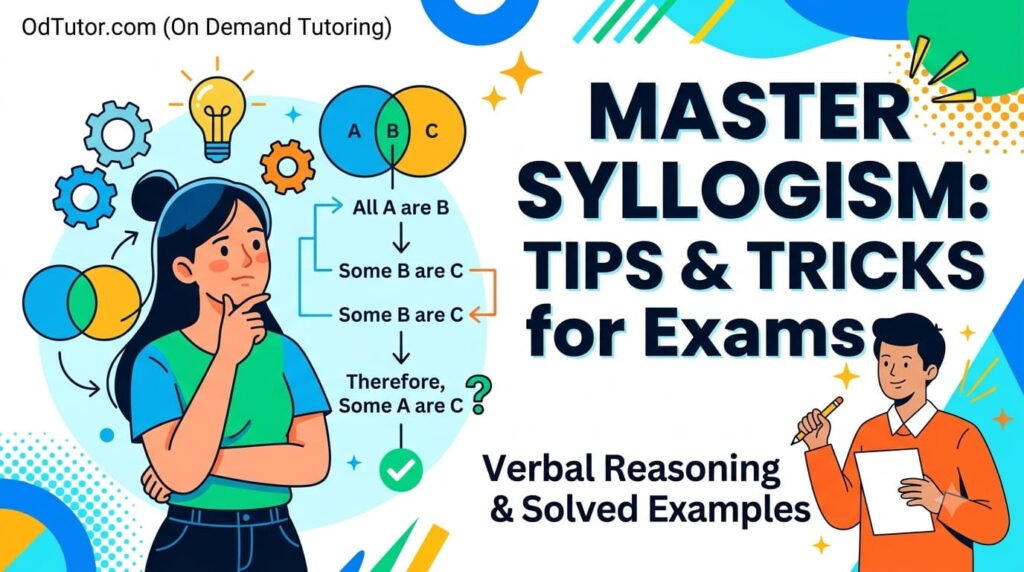
We’ve progressed through Logical Sequence of Words and Blood Relations, building systematic reasoning skills with each chapter. Today’s topic, Syllogism Questions, is perhaps the most pure logic-based topic in competitive exams. After training IBPS, SBI, SSC, and Railway aspirants for years, I’ve noticed that students approach syllogisms with two opposite extremes: some treat them as pure math, expecting perfect logical deduction; others dismiss them as impossible, relying on intuition rather than systematic reasoning. The real skill, which I want to share today, is understanding that syllogisms follow strict rules, but those rules are learnable and predictable. Once you master them, syllogism questions become some of the most reliable points in the exam because they don’t depend on vocabulary or cultural knowledge like other verbal reasoning topics. Let’s master this.
1. Understand the Basic Structure of a Syllogism
A syllogism consists of three statements: two premises and one conclusion. Your task is to determine whether the conclusion logically follows from the premises.
Basic structure: Premise 1: All dogs are animals. Premise 2: Buddy is a dog. Conclusion: Buddy is an animal. (True conclusion)
Key terminology:
- Major premise: the first statement (usually contains the predicate of the conclusion)
- Minor premise: the second statement (usually contains the subject of the conclusion)
- Conclusion: what we’re testing for logical validity
- Middle term: the term that appears in both premises but not the conclusion (in the example above, “dog”)
Understanding this structure matters because it gives you a systematic way to check whether a conclusion is valid. You’re not evaluating the conclusion’s truth in the real world; you’re evaluating whether it logically follows from the given premises.
2. Master the Three Types of Statements Used in Syllogisms
Syllogisms use four standard statement types, each with specific logical properties:
Type A (Universal Affirmative): “All X are Y.” Example: “All students are learners.”
- Quantity: Universal (covers all members)
- Quality: Affirmative (says something is true)
Type E (Universal Negative): “No X are Y.” Example: “No teachers are lazybones.”
- Quantity: Universal (covers all members)
- Quality: Negative (says something is not true)
Type I (Particular Affirmative): “Some X are Y.” Example: “Some politicians are honest.”
- Quantity: Particular (covers only some members)
- Quality: Affirmative (says something is true)
Type O (Particular Negative): “Some X are not Y.” Example: “Some scientists are not philosophers.”
- Quantity: Particular (covers only some members)
- Quality: Negative (says something is not true)
This classification matters because different combinations of statement types lead to valid or invalid conclusions. For example, if both premises are negative (E or O statements), no valid conclusion can be drawn. If both premises are particular (I or O statements), no valid conclusion can be drawn. These rules eliminate many invalid combinations immediately.
3. Learn the Standard Validity Rules for Syllogisms
Competitive exams rely on standard logical rules. Mastering these rules lets you evaluate any syllogism systematically:
Rule 1: The middle term must be distributed at least once. (Distribution means the statement refers to ALL members of that category.)
Rule 2: If a term is distributed in the conclusion, it must be distributed in its premise.
Rule 3: From two negative premises, no valid conclusion can be drawn.
Rule 4: If one premise is negative, the conclusion must be negative.
Rule 5: If the conclusion is negative, one premise must be negative.
Rule 6: From two particular premises, no valid conclusion can be drawn.
Rule 7: If one premise is particular, the conclusion must be particular.
These rules seem abstract, but applying them is mechanical. For each syllogism, check whether it violates any of these seven rules. If it violates even one rule, the conclusion is invalid.
4. Use Venn Diagrams to Visualize Syllogisms Visually
While the rules above work mechanistically, many students find Venn diagrams more intuitive. This visual approach lets you “see” whether a conclusion follows logically.
For example: Premise 1: All cats are animals. Premise 2: Mittens is a cat. Conclusion: Mittens is an animal.
Drawing this:
- Draw three overlapping circles: one for cats, one for animals, one for Mittens.
- Premise 1 says cats are inside the animals circle.
- Premise 2 says Mittens is inside the cats circle.
- If Mittens is in cats, and cats are in animals, then Mittens must be in animals.
- Conclusion is valid.
For negative statements, the diagram shows exclusion rather than inclusion. For particular statements, you place a specific point in the appropriate region rather than filling the entire region.
During exam prep, practice both the rule-based approach and the diagram-based approach. The rule-based method is faster under time pressure; the diagram-based method catches errors when you’re unsure.
5. Identify Invalid Conclusions Caused by Rule Violations
Most invalid syllogisms in exams violate at least one standard rule. Learning to spot these violations quickly saves time:
Violation of Rule 1 (Undistributed Middle): Premise 1: All trees are plants. Premise 2: All flowers are plants. Conclusion: All flowers are trees. (Invalid) The middle term “plants” is not distributed in either premise, violating Rule 1.
Violation of Rule 3 (Two Negative Premises): Premise 1: No cats are dogs. Premise 2: No dogs are birds. Conclusion: No cats are birds. (Invalid, even though it might seem logical) Two negative premises means no valid conclusion possible.
Violation of Rule 4 (Negative Premise, Affirmative Conclusion): Premise 1: All doctors are professionals. Premise 2: Some engineers are not professionals. Conclusion: Some engineers are doctors. (Invalid) One premise is negative, so the conclusion must be negative too.
Learning to recognize these patterns prevents you from selecting conclusions that feel intuitively true but violate logical rules.
6. Distinguish Between Logical Validity and Truth in the Real World
This is perhaps the most important conceptual insight for syllogism success: a logically valid conclusion is not the same as a true statement in reality.
Example of logically valid but untrue: Premise 1: All humans are plants. Premise 2: All plants are immortal. Conclusion: All humans are immortal. (Logically valid, but not true in reality)
This syllogism follows all validity rules perfectly, so the conclusion is logically valid. However, humans are not plants in reality, so the conclusion is false in the real world.
Competitive exams test logical validity, not real-world truth. You must evaluate the conclusion based on whether it follows from the premises, regardless of whether the premises or conclusion are true in reality. This distinction prevents your real-world knowledge from interfering with logical reasoning.
7. Recognize When Multiple Conclusions Might Be Valid
Some syllogism questions ask which of several conclusions is valid. This requires testing each conclusion against the same premises.
Example: Premise 1: All students are learners. Premise 2: Some athletes are students. Test Conclusion A: All athletes are learners. (Test this against premises) Test Conclusion B: All learners are students. (Test this against premises) Test Conclusion C: Some athletes are learners. (Test this against premises) Test Conclusion D: No athletes are learners. (Test this against premises)
Only Conclusion C is valid: “Some athletes are learners” follows because “some athletes are students” and “all students are learners,” so “some athletes must be learners.”
The key: test each conclusion independently, applying the validity rules. Often, only one conclusion is valid, but occasionally multiple conclusions could be valid. Exams typically ask for the “best” or “most direct” conclusion in such cases.
8. Handle Categorical and Conditional Syllogisms
The standard syllogisms discussed so far are categorical syllogisms (using categories like “all,” “some,” “none”). However, some exams include conditional syllogisms (using “if-then” logic).
Conditional syllogism example: Premise 1: If it rains, the ground gets wet. Premise 2: It rained today. Conclusion: The ground got wet. (Valid conditional syllogism)
Conditional syllogisms follow different rules:
- If the condition (if-part) is true and the statement (then-part) is connected, the conclusion is valid.
- Affirming the consequent (the then-part) does not guarantee validity.
For example: Premise 1: If it rains, the ground gets wet. Premise 2: The ground is wet. Conclusion: It rained. (Invalid: ground could be wet for other reasons)
Most competitive exams focus on categorical syllogisms, but knowing conditional logic helps if such questions appear.
9. Practice With Previous Years’ Syllogism Questions to Build Pattern Recognition
As with every other topic in this series, building speed and accuracy with syllogisms comes through consistent practice with real exam examples, not through memorizing rules in isolation.
Spend time solving syllogism questions from previous years’ papers. You’ll notice that exams repeat similar logical structures; recognizing these patterns becomes automatic through repetition. Some exams heavily test undistributed middle violations; others test two-negative-premise rules more frequently. Identifying your exam’s testing patterns helps you focus practice efficiently.
Keep an error log. When you miss a syllogism question, note which rule was violated. Over time, you’ll recognize certain violation types instantly, saving valuable seconds during the exam.
10. Time Management and Exam Strategy for Syllogisms
Syllogism questions typically take 25-40 seconds once you’ve built pattern recognition. However, complex syllogisms might take up to 60 seconds, which is acceptable given the complexity.
Strategic approach: read the two premises carefully, form a mental image of what must logically follow, then check each conclusion option against this mental model. This quick-intuition-plus-verification approach works for many test-takers.
If intuition fails, fall back on the systematic rule-checking approach: does this conclusion violate any of the seven validity rules? Apply the rules mechanically, and you’ll reach the correct answer even if intuition doesn’t immediately provide it.
Never guess on a syllogism question based purely on “it sounds right.” The entire point of syllogisms is testing whether you can distinguish logical validity from intuitive appeal. Take the time to verify your answer systematically.
How OdTutor Strengthens This Skill
Syllogism questions reward systematic rule application combined with visual reasoning, both developing fastest through guided practice with real exam examples. At OdTutor, our teachers help you master the seven validity rules, build fluency with Venn diagram representation, and develop the pattern recognition that makes you fast. With personalized feedback on whether your syllogism misses stem from rule-violation confusion, real-world-truth interference, or misunderstanding the premise statements, our trainers help you solve syllogisms with confidence under exam pressure.
Quick Practice Quiz for Syllogism: Verbal Reasoning
Here’s a short interactive quiz to test these techniques. Five Syllogism Questions mixing different validity types and complexity levels.
Syllogism Questions — Practice Sheet
Verbal Reasoning