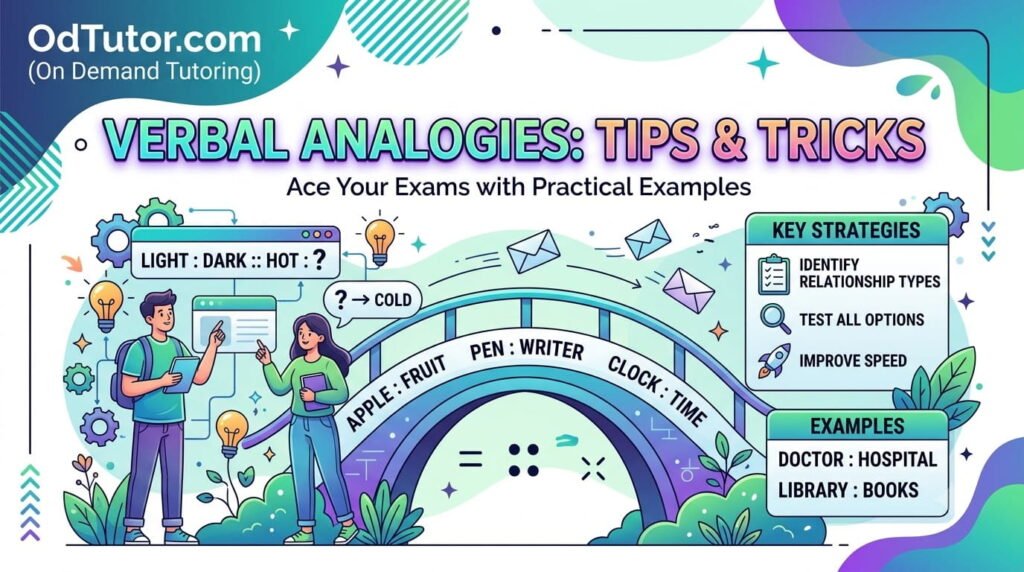
Eighteen articles into this series, and we’ve traveled from basic grammar through advanced comprehension, vocabulary, and mechanical skill-building. Today’s final topic, Verbal Analogies, is where everything converges. Analogies aren’t about knowing words in isolation; they’re about recognizing relationships between words, understanding how concepts connect, and applying that pattern-matching to unfamiliar word pairs. After training IBPS, SBI, SSC, and Railway aspirants for years, I’ve noticed that students who excel at analogies are those who understand that every analogy is testing one specific relationship, and your job is to identify that relationship first, then find the pair that matches it. This is the culmination of all the skills we’ve built across this series. Let’s master it.
1. Understand That Analogies Test Relationships, Not Just Word Similarity
The fundamental insight: an analogy is not asking “which word is like the first word?” It’s asking “which pair of words has the same relationship as the first pair?” This distinction completely changes how you approach the problem.
For example, consider: Dog : Puppy :: Cat : ? The answer is Kitten, not because cat and kitten are somehow “like” dog and puppy, but because the relationship “adult animal : baby animal” is the same in both pairs.
If you approach analogies by thinking “what’s similar between dog and puppy?” you might say “both are animals, both have four legs, both are mammals,” which is true but unhelpful. Instead, ask “what is the specific relationship between dog and puppy?” Answer: “a dog is an adult, a puppy is the young version.” Now apply that relationship to cat: “which word is the young version of a cat?” Answer: Kitten.
This relationship-first thinking is what separates students who guess at analogies from students who solve them systematically. Every strong analogy solver I’ve trained uses this approach: identify the relationship, test it against each option, select the pair that matches.
2. Master Common Analogy Types
Competitive exams test specific types of relationships repeatedly. Recognizing which type you’re dealing with helps you identify the relationship faster and verify your answer more confidently.
Part-to-Whole: Finger : Hand, Petal : Flower, Chapter : Book. A finger is part of a hand; a petal is part of a flower.
Cause-and-Effect: Heat : Sweat, Study : Knowledge, Gravity : Fall. Heat causes sweat; study causes knowledge.
Antonyms (Opposite): Happy : Sad, Courage : Cowardice, Expand : Contract. These pairs are direct opposites.
Synonyms (Similar): Happy : Joyful, Begin : Start, Huge : Enormous. These pairs have very similar meanings.
Object-and-Purpose: Knife : Cut, Pen : Write, Thermometer : Measure. A knife is used for cutting; a pen is used for writing.
Classification (Category): Rose : Flower, Tiger : Animal, Ford : Car. A rose is a type of flower; a tiger is a type of animal.
Degree (Intensity): Warm : Hot, Like : Love, Drizzle : Downpour. These represent increasing intensity on a spectrum.
Attribute (Quality): Sugar : Sweet, Snow : White, Rose : Red. These show what quality something has.
Worker-and-Tool: Carpenter : Hammer, Surgeon : Scalpel, Artist : Brush. These show who uses what tool.
Recognizing these types isn’t about memorizing categories — it’s about noticing that when you identify the relationship type, you can predict the pattern more confidently.
3. Build Your Relationship Statement Explicitly
The most powerful analogy-solving technique is building an explicit relationship statement before looking at options. This forces you to think precisely about what connects the first pair, and it gives you a clear criterion for testing each option.
For example, given: Architect : Building :: ?
Don’t just think “architect and building are related.” Instead, build a statement: “An architect is a person who designs a building.” Now test each option against this statement:
- Farmer : Crop? Does “a farmer is a person who designs a crop”? No, a farmer grows crops.
- Engineer : Bridge? Does “an engineer is a person who designs a bridge”? Yes, this matches.
- Composer : Orchestra? Does “a composer is a person who designs an orchestra”? Not quite — a composer writes music, not designs orchestras.
The correct answer is Engineer : Bridge because it matches your relationship statement exactly.
Practice building these explicit statements for every analogy during your study phase. This habit, reinforced through practice, becomes automatic under exam pressure, making you faster and more accurate.
4. Recognize Distractor Patterns in Analogies
Exams don’t just include random wrong answers, they include strategically chosen distractors that trap students who aren’t thinking carefully about the relationship.
Distractor Type 1, Related but Wrong Relationship:
Analogy: Pen : Write :: ?
- Correct: Hammer : Pound (object-purpose relationship)
- Distractor: Pen : Paper (these are related, but the relationship is different — pen writes on paper, not pen-purpose)
Distractor Type 2, Reverse Relationship:
Analogy: Cause : Effect :: ?
- Correct: Study : Knowledge (cause-effect)
- Distractor: Knowledge : Study (this reverses the relationship — wrong direction)
Distractor Type 3, Partial Match:
Analogy: Child : Adult :: ?
- Correct: Kitten : Cat (young-to-old progression)
- Distractor: Child : Parent (these involve progression but different relationship — child-to-parent is offspring-to-parent, not young-to-old)
Distractor Type 4, Synonym Rather Than Analogy:
Analogy: Knife : Sword :: ?
- Correct: Car : Truck (both are similar but distinct objects of a category)
- Distractor: Knife : Blade (these are nearly synonymous — a blade is essentially part of a knife)
Learning to recognize these distractor patterns prevents you from selecting an option that “feels” related without actually matching the precise relationship.
5. Test Your Relationship Statement Against Every Option
Never select an answer based on “it sounds right.” Always verify by testing your relationship statement against each option, eliminating those that don’t fit.
Given: Doctor : Patient :: ?
Relationship statement: “A doctor is a professional who treats a patient.”
Option A: Teacher : Student
Does “a teacher is a professional who treats a student”? No — a teacher educates, not treats. Eliminate.
Option B: Judge : Defendant
Does “a judge is a professional who treats a defendant”? No — a judge adjudicates, not treats. Eliminate.
Option C: Therapist : Client
Does “a therapist is a professional who treats a client”? Yes, this matches. Select.
This systematic testing prevents careless mistakes and builds confidence in your answer. Under exam pressure, when you’re tired and moving quickly, this deliberate verification saves you from errors.
6. Watch for Contextual Shifts in Analogy Meanings
Some words have multiple meanings, and analogies sometimes exploit this by using different senses of a word in the first pair versus the options.
For example: Bank : Money :: ?
Does “bank” mean “financial institution” or “riverbank”?
If the relationship is “place where money is kept,” then Bank : Money makes sense with the first definition.
Testing options:
- Library : Books (place where books are kept) — matches if bank means “place of storage”
- Shore : River (land beside water) — doesn’t match unless we switch to the riverbank meaning
The correct answer depends on which meaning of “bank” is intended. Careful reading of the relationship helps you determine which meaning applies, and thus which option is correct.
This is where skills from the Comprehension article matter, understanding context and multiple word meanings becomes crucial.
7. Recognize When Analogies Test Figurative or Conceptual Relationships
Not all analogies test literal relationships. Some test figurative meanings or abstract connections.
For example: Heart : Love :: ?
“Heart” is literally a body organ, but in this analogy it represents “the seat of love/emotion.”
The relationship is “symbol of / represents.”
Testing: Brain : Thought (brain represents thought) — matches.
Or: Anchor : Hope :: ?
“Anchor” literally keeps ships steady, but figuratively it represents “something that provides security/steadiness.”
The relationship is “symbol of security / stability.”
Testing: Beacon : Guidance (beacon provides guidance) — matches.
These figurative analogies reward the vocabulary and comprehension skills you’ve built throughout this series. Understanding connotation, symbolism, and metaphorical language, skills we covered in Synonyms and Comprehension, helps you recognize these non-literal relationships.
8. Build Speed Through Pattern Recognition and Practice
Just like every other skill in this series, analogy speed develops through consistent practice with exam-style questions, not through studying analogy “types” in isolation.
The pattern recognition that makes you fast comes from exposure. After solving 50+ analogies from previous years’ papers, you start recognizing relationship types instantly. The relationship “part-to-whole” becomes automatic to spot; cause-and-effect relationships jump out at you.
This recognition speed is why practicing with real exam analogies matters far more than studying generic analogy lists. Your brain learns through pattern exposure, not through rule memorization.
9. Integrate Analogies With Your Broader Verbal Ability Skill Set
Analogies don’t exist in isolation, they synthesize skills from every earlier topic in this series. Your strength in synonyms helps you recognize subtle meaning differences in analogy options. Your comprehension skills help you understand figurative relationships. Your vocabulary breadth helps you test more options confidently.
Every time you miss an analogy question, ask: “Did I miss this because I didn’t know a word? Because I didn’t understand the relationship? Because I tested incorrectly?” This meta-awareness helps you identify whether you need to strengthen vocabulary, relationship-spotting, or verification habits.
10. Exam Strategy and Time Management for Analogies
Analogy questions typically take 15-25 seconds once you’ve practiced sufficiently. The key habit: read the first pair, build your relationship statement, test against each option, eliminate systematically, then select.
Don’t rush through the relationship identification phase. Spending 5 seconds clearly identifying the relationship saves you from careless errors. Many students reverse this, they spend 2 seconds on the relationship and 20 seconds second-guessing their answer because they were never clear on the relationship to begin with.
Practice analogies consistently in full-length mock tests, since they appear scattered throughout the Verbal Ability section. This ensures you maintain speed and accuracy across extended testing, not just in isolated practice sets.
Finally, when you encounter an unfamiliar analogy during the exam, don’t panic. Build your best-guess relationship statement, test it against options, eliminate systematically. Often you’ll find the correct answer even if you don’t know all the words perfectly, because the relationship pattern is what matters most.
How OdTutor Strengthens This Skill
Verbal Analogies reward systematic relationship-spotting combined with broad vocabulary and careful verification, all developing fastest through guided practice with real exam examples. At OdTutor, our teachers help you master relationship identification, recognize common analogy types, learn from distractor patterns in previous years’ papers, and build the speed that comes from deliberate practice. With personalized feedback on whether your analogy misses stem from vocabulary gaps, relationship confusion, or verification errors, our trainers help you develop genuine analogy strength rather than lucky guessing.
Meta Description:
Quick Practice Quiz
Here’s a short interactive quiz to test these techniques — five Verbal Analogies questions mixing different relationship types and difficulty levels.
Verbal Analogies — Final Practice Sheet
Verbal Ability