
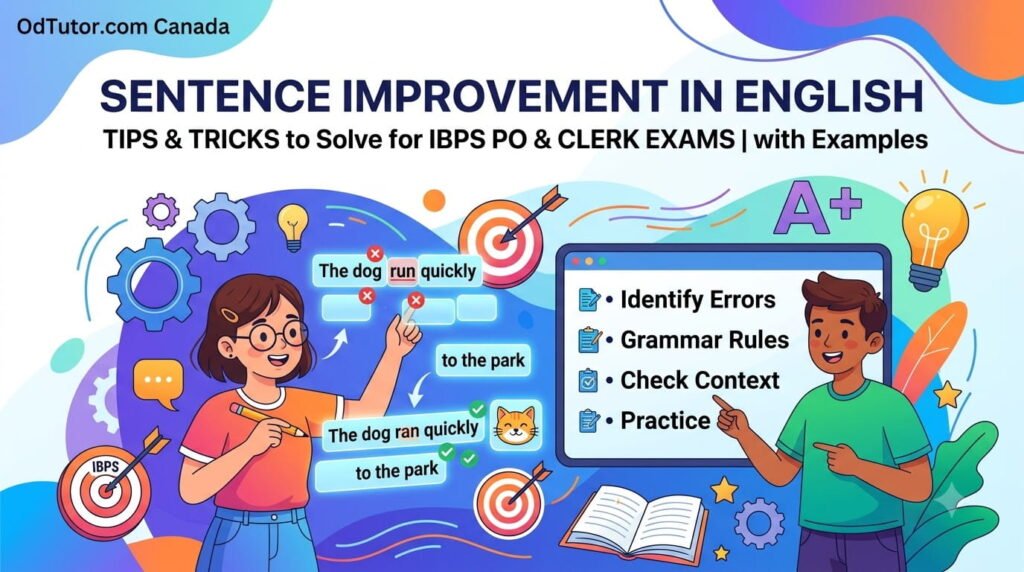
In my Sentence Formation article a couple of weeks ago, I touched briefly on sentence improvement as one of several related formats. But over the eight-part journey we’ve had so far in this series — Spotting Errors, Synonyms, Antonyms, Selecting Words, Spellings, Sentence Formation, and Ordering of Words — I’ve realized this topic genuinely deserves its own dedicated space, because it comes up constantly in doubt sessions with my IBPS, SBI, SSC, and Railway students. Sentence Improvement sits at an interesting intersection: it’s not just about spotting what’s wrong, like in Spotting Errors, but about actively choosing the best possible correction from several plausible-looking options. That extra decision-making layer is where most of the confusion happens, so let’s slow down and work through it properly.
1. Understand What Makes This Different From Spotting Errors
In Spotting Errors, you’re identifying which part of a sentence is wrong, sometimes without even being told what the correct version should look like. In Sentence Improvement, the sentence typically has one underlined portion, and you’re given four or five alternative phrasings, one of which is the original (usually labeled “No improvement” or similar), and your job is to choose the best replacement, or confirm the original is already correct.
This distinction matters because Sentence Improvement demands comparative judgment, not just error detection. You might correctly identify that something feels off about the underlined portion, but then face two or three options that all seem to fix it in slightly different ways — and only one is genuinely the best, most precise correction.
My first piece of advice is to treat this as a two-stage process. First, diagnose what’s specifically wrong with the underlined portion, exactly as you would in a Spotting Errors question. Second, and separately, evaluate each option against that specific diagnosis, rather than simply picking whichever option sounds smoothest or most sophisticated on a quick read.
2. Diagnose Before You Compare
The single most valuable habit I try to build in my students for this topic is diagnosing the exact problem before even glancing at the answer options. Read the sentence, isolate the underlined portion, and ask yourself specifically: is this a grammar issue (tense, subject-verb agreement, preposition), a redundancy issue, an awkward construction, or actually already correct?
For example: “The manager, along with his team, are working on the proposal.” The underlined portion here is “are working,” and the diagnosis is a subject-verb agreement issue — “along with his team” is a parenthetical phrase, not part of the core subject, so the verb should agree with the singular “manager,” giving “is working.”
Having this specific diagnosis in mind before scanning options prevents you from being pulled toward an option that fixes a different, perhaps more superficial issue while leaving the actual grammatical problem untouched. If you already know you’re looking for “is working” specifically, you’ll bypass distractor options far more quickly and confidently.
3. Be Alert to “Partial Fix” Distractors
One of the most common traps in Sentence Improvement questions is the partial-fix distractor — an option that corrects part of the sentence’s problem but introduces a new, different error, or leaves part of the original problem unaddressed. These options are specifically designed to catch students who recognize that something needs fixing but haven’t diagnosed the issue precisely enough.
Consider: “Despite of his best efforts, he could not complete the assignment on time.” The error here is “despite of,” which is a nonstandard combination — you should use either “despite” alone or “in spite of,” never both together. A partial-fix distractor might offer “In spite his best efforts,” which removes “despite” but incorrectly drops the necessary “of” from “in spite of,” introducing a new error while trying to fix the original one.
The correct option, in this case, would properly read either “Despite his best efforts” or “In spite of his best efforts.” Spotting this kind of trap requires reading each option carefully and completely, rather than assuming an option is correct just because it changes the obviously problematic word.
4. Watch for Options That Are Grammatically Correct but Contextually Wrong
Some Sentence Improvement questions include options that are, in isolation, perfectly grammatical sentences, but don’t fit the specific context, tone, or intended meaning established by the rest of the passage or sentence. This requires you to consider the full sentence’s meaning, not just the grammatical validity of the replacement phrase alone.
For instance: “The company reported a significant loss last quarter, which surprised investors who had expected consistent growth.” If the underlined portion is “which surprised investors,” and one option changes it to “which excited investors,” this is grammatically flawless but contextually wrong, since the sentence describes a loss, and a loss would not “excite” investors expecting growth.
This kind of trap reinforces something I’ve emphasized throughout this series: language questions in competitive exams test contextual precision, not just isolated grammatical correctness. Always re-read the full sentence with your chosen option substituted in, confirming that the complete sentence still makes logical sense, not just that the replacement phrase itself is grammatically sound.
5. Prioritize Concise, Formal Phrasing When Grammar Is Equal
When you’re faced with two or more options that all appear grammatically correct and contextually appropriate, competitive exams typically favor the more concise, formal option over a wordier or more casual alternative, reflecting the same preference for precision I discussed in my Sentence Formation article regarding redundancy.
For example, if choosing between “due to the fact that he was late” and “because he was late,” the second, more concise option is generally preferred in formal written English, assuming both are grammatically valid replacements for the underlined portion in question.
That said, conciseness should never come at the cost of clarity or necessary meaning. If a shorter option strips away information that changes the sentence’s intended meaning, the longer, more complete option is the better choice despite being less concise. This is why the diagnosis-first approach matters so much — you need to know exactly what the sentence needs to convey before judging which option expresses it most efficiently.
6. Recognize When “No Improvement” Is the Correct Answer
Just as I mentioned regarding “No Error” in my Spotting Errors article, many students psychologically resist selecting “No Improvement” as an answer, assuming that since a correction is being asked for, one of the alternative options must be correct. This bias leads to unnecessary, avoidable mistakes on questions where the original sentence is already grammatically and contextually sound.
If you’ve diagnosed the underlined portion and genuinely cannot identify a specific grammatical, redundancy, or contextual problem with it, don’t force yourself to find fault simply because alternative options are presented. Exams intentionally include a meaningful proportion of “No Improvement” correct answers precisely to test whether students can confidently recognize correctness, not just identify plausible-sounding changes.
Trust your diagnosis process here. If your careful, step-by-step analysis finds no genuine issue, selecting “No Improvement” with confidence is just as valid a skill as correctly identifying an error elsewhere.
7. Build a Mental Checklist for Common Error Types
Given the breadth of possible issues a Sentence Improvement question might test, having an ordered mental checklist to run through quickly helps you diagnose efficiently rather than staring blankly at an underlined portion, unsure where to start. Based on typical exam frequency, I recommend checking, in this order: subject-verb agreement, tense consistency, prepositions, articles, redundancy, parallelism, and finally, overall clarity and conciseness.
Running through this checklist doesn’t mean laboriously checking each category on every single question — with practice, this scan becomes fast and largely automatic, taking only a few seconds. But having this ordered structure in mind, especially early in your preparation, prevents the common experience of reading an underlined portion repeatedly without a clear sense of what specifically to look for.
This checklist approach connects directly back to the topics we’ve already covered in this series — the subject-verb agreement and tense issues from my Spotting Errors article, the redundancy concerns from Sentence Formation, and the parallelism rules discussed earlier all resurface here, reinforcing why building a strong foundation across each topic pays dividends across the others.
8. Practice With Full Sentences, Not Isolated Grammar Rules
A mistake I often see is students studying grammar rules in isolation — memorizing that “despite” doesn’t take “of,” or that collective nouns are usually singular — without practicing applying these rules within full, exam-style sentences under time pressure. Sentence Improvement specifically demands this applied skill, since you’re evaluating complete sentences and comparing several full-option replacements simultaneously, not simply recalling an isolated rule.
I recommend practicing with real previous-year Sentence Improvement questions from your specific target exam regularly, rather than relying solely on standalone grammar exercises. This builds familiarity with how your particular exam typically phrases distractor options, and which specific error categories it tends to favor most heavily.
Keep an error log specifically for this topic, noting not just which questions you got wrong, but why — did you misdiagnose the original problem, fall for a partial-fix distractor, or overthink a genuinely correct “No Improvement” sentence? This targeted reflection helps you correct your specific, recurring tendencies rather than generally “needing more grammar practice.”
9. Time Management for Exam Day
Sentence Improvement questions generally require slightly more time than straightforward vocabulary questions, since you’re comparing multiple full-option replacements rather than single words. Budget around 25-35 seconds per question once you’ve built solid diagnostic speed through consistent practice.
Diagnose first, then scan options specifically for a match to your diagnosis, rather than reading all options first and trying to intuitively judge which “sounds best” — this diagnostic-first order is consistently faster and more accurate based on what I’ve observed across years of coaching students through timed practice tests.
If you’re genuinely torn between two options after diagnosis, apply the conciseness and contextual-fit principles discussed earlier as your tiebreaker, and if you still can’t confidently decide, make your best-reasoned choice and move forward rather than spending disproportionate time on a single question.
Strengthening This Skill Through OdTutor
Sentence Improvement asks you to diagnose and then judge, and both skills sharpen fastest through guided, real-time practice. At OdTutor, our teachers work through genuine exam-style Sentence Improvement questions with you, helping you build the diagnostic checklist habit and spot partial-fix distractors before they cost you marks, with personalized feedback that turns each mistake into a clear, correctable pattern.