
Instructions
Total Questions: 20 | Marks: 4 each | No Negative Marking
Ray Optics – IIT JEE Notes (Set 17)
Nature of Light
Introduction
Ray optics studies the behavior of light using the concept of rays. It explains reflection, refraction, image formation, and optical instruments.
Rectilinear Propagation
Light travels in straight lines in a homogeneous medium.
Reflection of Light
Laws of Reflection
1. Angle of incidence equals angle of reflection.
2. Incident ray, reflected ray, and normal lie in the same plane.
Plane Mirror Properties
Image formed is virtual, erect, same size as object, and laterally inverted.
Spherical Mirrors
Types
Concave mirror and convex mirror.
Important Terms
Pole, center of curvature, principal axis, focus, and focal length.
Mirror Formula
Formula
1/f = 1/v + 1/u
Magnification
m = -v/u
Key Insight
Concave mirrors can form both real and virtual images, while convex mirrors always form virtual and diminished images.
Refraction of Light
Concept
Refraction is the bending of light when it passes from one medium to another due to change in speed.
Snell’s Law
n₁sinθ₁ = n₂sinθ₂
Refractive Index
Definition
Refractive index of a medium is the ratio of speed of light in vacuum to speed in that medium.
Formula
n = c/v
Key Insight
Higher refractive index means lower speed of light in the medium.
Total Internal Reflection (TIR)
Conditions for TIR
1. Light must travel from denser to rarer medium.
2. Angle of incidence must exceed critical angle.
Critical Angle
The angle of incidence in denser medium for which angle of refraction becomes 90°.
Applications
Optical fibers, prisms, binoculars, and diamond brilliance.
Optical Fiber
Working Principle
Optical fibers work on total internal reflection.
Applications
Communication systems, medical endoscopy, and internet transmission.
Refraction Through Lenses
Types of Lenses
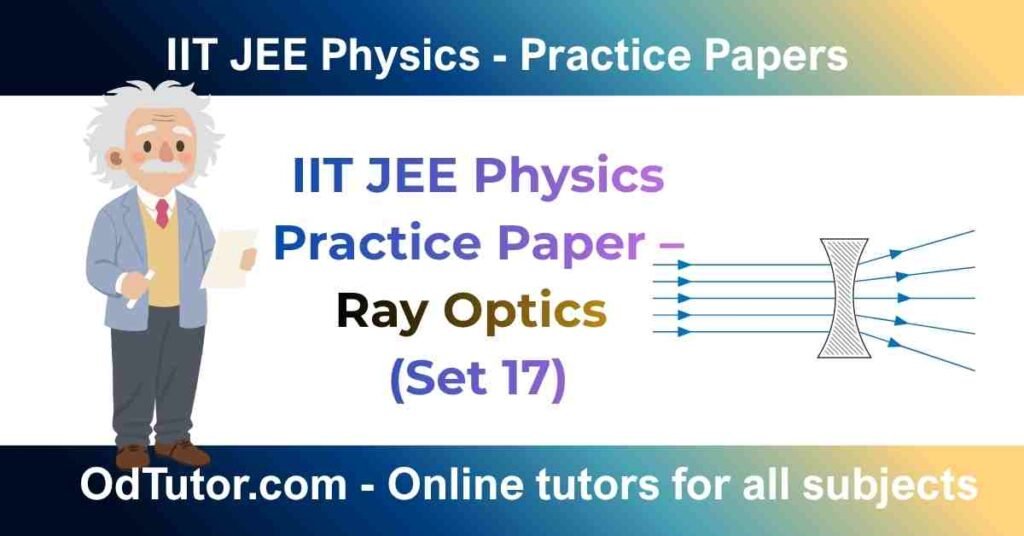
Convex lens (converging lens) and concave lens (diverging lens).
Lens Formula
1/f = 1/v – 1/u
Magnification
m = v/u
Power of Lens
Formula
P = 1/f
Unit
Diopter (D)
Key Insight
Convex lenses have positive power, while concave lenses have negative power.
Combination of Lenses
Equivalent Power
P = P₁ + P₂ + P₃ + …
Equivalent Focal Length
1/F = 1/f₁ + 1/f₂ + …
Dispersion of Light
Concept
White light splits into constituent colors when passing through a prism.
Reason
Different colors have different refractive indices.
Rainbow Formation
Process
Rainbow is formed due to refraction, dispersion, and total internal reflection of sunlight in water droplets.
Color Sequence
VIBGYOR – Violet to Red.
Human Eye
Parts of Eye
Cornea, iris, pupil, eye lens, retina, and optic nerve.
Image Formation
Image is formed on retina.
Defects of Vision
Myopia
Near objects are visible clearly but distant objects appear blurred.
Correction
Corrected using concave lens.
Hypermetropia
Distant objects are visible clearly but nearby objects appear blurred.
Correction
Corrected using convex lens.
Optical Instruments
Microscope
Used to observe very small objects with high magnification.
Telescope
Used to observe distant celestial objects.
Magnifying Glass
A convex lens used to increase angular size of nearby objects.
Important Relationships
Speed Relation
v = c/n
Critical Angle Relation
sinC = 1/n
Lens Maker Formula
1/f = (n – 1)(1/R₁ – 1/R₂)
Conceptual Insights
Key Understanding
Reflection changes direction of light, while refraction changes both speed and direction.
Common Mistakes
Students often confuse sign conventions in mirrors and lenses. Always use Cartesian sign convention carefully.
Important Exam Concepts
Conceptual Traps
Convex mirrors always produce diminished virtual images. Concave lenses always diverge light.
JEE Strategy
Practice ray diagrams, numerical problems, and sign conventions thoroughly. Focus on mirror formula, lens formula, and total internal reflection concepts.