A parent once asked me, about three months into working with her son, a question I still think about: "How would I even know if this is helping, or if he's just getting used to having help?" It's a fair question, and an uncomfortable one, because the honest answer is that a lot of tutoring in Canada doesn't get evaluated that closely. Sessions happen, homework gets done, report cards come home, and everyone assumes it's working simply because nothing looks obviously wrong.
After enough years of doing this work, I've come to believe that's the wrong way to measure it. Homework getting finished isn't the same as learning happening, and a student staying calm during a math test isn't the same as a student who could have solved it without support in the room. If a family is going to invest the time and money tutoring requires, it's worth knowing what genuine progress actually looks like, versus what just looks like progress.
The Difference Between Help and Dependence
The clearest warning sign I watch for, in my own sessions and when parents describe what's happening elsewhere, is a student who can perform a skill only while someone is sitting next to them. I've walked into a first session with a student who could solve an entire page of algebra problems flawlessly with a tutor present, and then completely freeze on the identical problem type alone on a test the following week. That's not a knowledge gap — it's a confidence and independence gap, and it's far more common than most parents expect.
Good tutoring should be actively working itself out of a job, at least with respect to any single skill. If a student needed heavy support on fractions in September and still needs the same level of support in February, something in the approach needs to change, even if the student "seems fine" in the room. I tell parents to ask their tutor directly, every month or so: which specific skills has my child gained independence on since we started? If the answer is vague, that's worth paying attention to.
What Progress Actually Looks Like
Real progress in tutoring is rarely dramatic. It looks like a student needing fewer hints to start a problem than they did a month ago. It looks like them catching their own mistake instead of waiting to be told it's wrong. It looks like homework taking forty minutes instead of ninety, not because the tutor did more of it for them, but because the student finally understands the underlying concept well enough to move through it on their own.
Grades matter, obviously, but they're a lagging indicator. A test grade reflects what happened weeks earlier, and it can be influenced by plenty of things unrelated to tutoring, from how well a student slept the night before to how a particular teacher writes exams. I'd rather a parent watch for smaller, weekly signs: is my child complaining less about the subject, are they attempting problems before asking for help, are they able to explain a concept back in their own words rather than just repeating steps.
That last one is probably the single best test I know. If a student can teach a concept back to you, even clumsily, they understand it. If they can only reproduce the steps in the exact order they were shown, they've memorized a procedure, not learned the underlying idea — and that difference shows up the moment a question is phrased slightly differently than they've seen before.
Frequency, Fit, and the Questions Parents Rarely Ask
Canadian families often default to once-a-week sessions without really examining whether that matches what their child actually needs. For a student who's mostly on track and just needs steady reinforcement, once a week is often plenty. For a student who's genuinely behind, or heading into a high-stakes period like final exams or a provincial assessment, once a week can be too thin to build real momentum, and twice a week for a shorter stretch is usually more effective than once a week indefinitely.
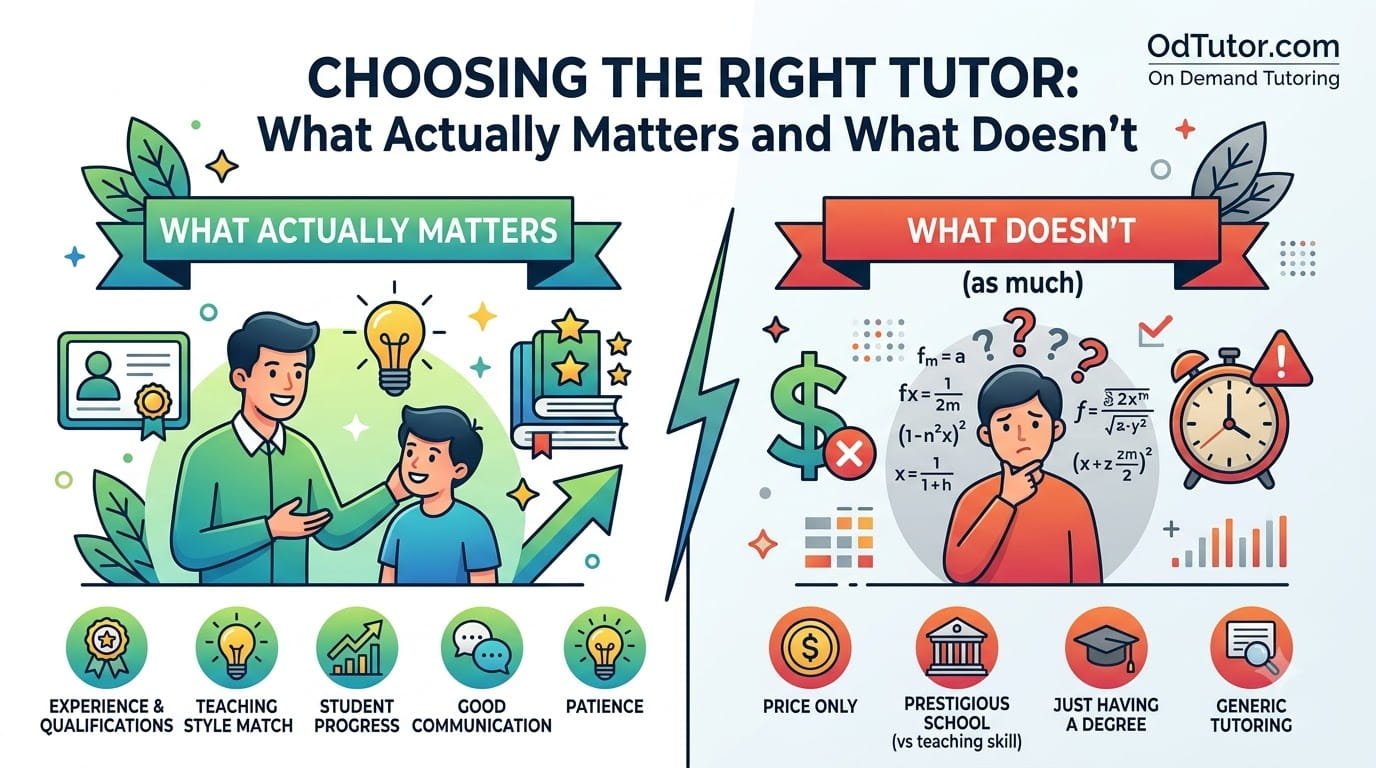
Fit matters just as much as frequency, and it's the piece I think gets the least attention. Tutoring is a relationship, and a student who's shut down and disengaged with one tutor can come alive with another covering the exact same material, simply because of how that person explains things or how patient they are with mistakes. I've taken over students from other tutors more than once where nothing about the curriculum changed, but the student's entire attitude toward the subject did, purely because the working relationship suited them better.
A few things I'd genuinely encourage every parent to ask, whether they're evaluating a tutor they've already hired or interviewing a new one:
- How do you know when a student has actually mastered something, versus just gotten through the homework? A good tutor should have a real answer here, not just "we do practice problems."
- What do you do when a student gets something wrong? The answer matters more than it sounds. A tutor who immediately gives the correct method is teaching differently than one who asks guiding questions and lets the student find the error themselves — and the second approach, though slower in the moment, tends to build far more durable understanding.
- How often do you communicate with parents, and what do those updates actually cover? Vague monthly check-ins that just say "doing well" tell you almost nothing useful.
- What happens in the first fifteen minutes of a session? Tutors who spend that time reviewing what was covered last time and connecting it to today's material are building real continuity. Tutors who jump straight into whatever homework is due that night are mostly managing a to-do list, not teaching.
Online Versus In-Person, and Why the Answer Isn't Universal
I get asked constantly whether online tutoring works as well as in-person, and the honest answer is that it depends heavily on the student and the subject. For older, self-directed students working on essay writing or exam prep, online sessions work extremely well, and the flexibility can even be an advantage. For younger students, or anyone who struggles with focus, the extra friction of a screen between tutor and student can genuinely get in the way, particularly for subjects like early math where a tutor benefits from being able to point directly at a student's written work and catch an error in real time.
If a family isn't sure which format suits their child, I'd suggest trying a short trial period in whichever format seems more convenient, and paying close attention to whether the student is actually engaged during sessions or just present. Distraction shows up differently online than it does across a table, and it's worth watching for specifically rather than assuming the format is neutral.
When It's Time to Step Back, Not Add More
One thing I don't say often enough to parents, mostly because it runs against the instinct that more support always helps: sometimes the right move with tutoring is to pull back, not add more. If a student has genuinely closed the gap on a skill and tutoring has quietly turned into just another homework-completion hour, continuing indefinitely can actually slow down the independence a student needs to build for the next level of school. I've had these conversations with families more than once, suggesting we scale back to biweekly, or pause entirely and revisit if a specific unit gets difficult again. It's not the outcome that keeps a tutor employed, but it's usually the right one for the student.
The Bottom Line
Tutoring is working when a student needs less help over time, not when sessions simply run smoothly. The clearest signs of real progress are quieter than a grade on a report card — fewer hints needed to start a problem, mistakes caught independently, concepts explained back in a student's own words rather than recited from memory. Frequency and format matter, but fit matters more, and it's worth asking direct questions about how a tutor actually teaches, not just whether homework gets finished. And every so often, the right adjustment isn't more tutoring at all, but knowing when a student has genuinely outgrown the support they started with.