Finding a tutor is more complicated than it should be. Parents typically start by searching for tutoring in their area, looking at reviews, checking rates, and often booking with whoever is available soonest. The assumption is that tutoring is tutoring — the subject matters, maybe the experience level matters, but beyond that, it's fairly interchangeable. The reality is far more nuanced, and getting the tutor-student fit wrong is one of the quickest ways to waste time and money on tutoring that doesn't actually work.
The challenge is that what makes a good tutor is partly about credentials and experience, but mostly about factors that are harder to assess from a website or a single conversation: how they explain things, how they respond when a student doesn't understand, how they structure a session, and whether their approach aligns with how that particular student learns best.
The Credentials and Experience That Actually Matter
Let's start with what's easiest to evaluate: what qualifications and experience a tutor has.
For core academic subjects in K-12 (math, English, sciences), a tutor should ideally have either formal education in that subject (a degree or significant coursework in the field) or proven experience teaching or tutoring it. This matters because someone can be personable and patient without having deep subject knowledge, and that combination typically doesn't produce strong learning outcomes. A student struggling with algebra needs someone who understands algebra deeply enough to explain why certain steps are necessary, not just someone who can work through problems.
For high school subjects, experience with that specific curriculum is valuable. Canadian provinces have different curricula, and even within a subject, the specific emphasis and pacing varies. A tutor experienced with Ontario's Grade 11 Functions curriculum knows the specific topics, the depth expected, and the types of problems likely to appear on the provincial exam. A tutor with math experience but no Ontario-specific experience might be fine, but they're starting from zero with the curriculum context.
For specialized subjects (test prep like SAT or ACT, or specific programs), relevant experience is important. Someone who's helped multiple students prepare for the SAT knows common pitfalls, high-leverage strategies, and how to pace preparation over time. Someone tutoring in that area for the first time is essentially learning on your child's dime.
Experience working with students at the specific grade or difficulty level matters too. A tutor experienced with Grade 10 students might be less effective with Grade 3 students, not because they lack knowledge, but because the approaches are entirely different — the patience required, the explanation strategies, the pacing, and even the session structure all differ significantly by age.
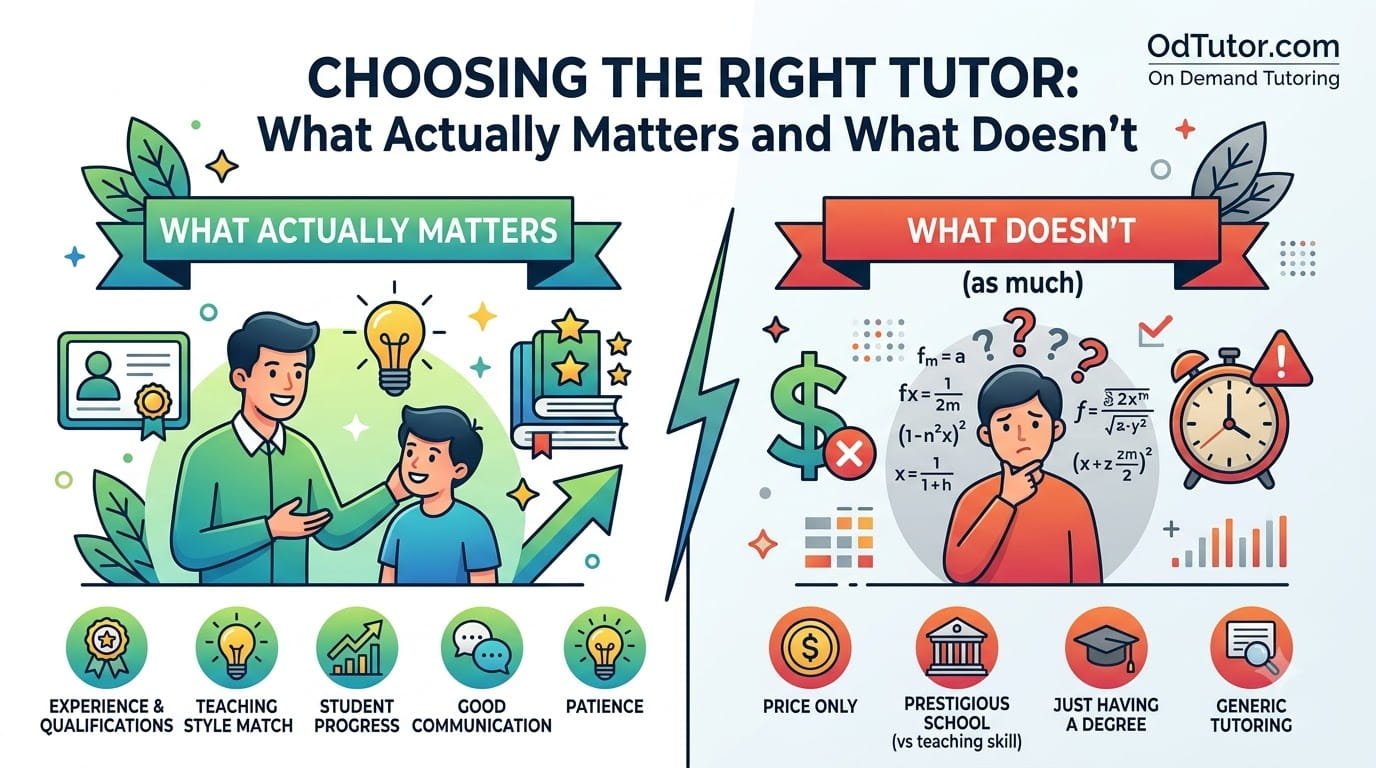
What doesn't necessarily matter as much as people assume: whether a tutor is credentialed as a teacher. Some excellent tutors are certified teachers; others are not. Teaching certification indicates that someone has met certain standards for subject knowledge and has had some training in pedagogy, which is valuable. But it doesn't guarantee they're good at one-on-one tutoring, which is a different skill than classroom teaching.
The Right Match Beyond Credentials
Credentials tell you whether someone has the basic knowledge. Fit tells you whether they can actually help your specific child learn.
Some tutors are structured and linear in their approach — they work through concepts systematically, building step by step. Other tutors are more exploratory — they ask questions to help a student discover concepts themselves. Some students thrive with the first approach because they need structure and clarity; others feel constrained by it and learn better through discovery. Neither approach is wrong; the match between approach and student learning style is what matters.
Some tutors are very patient with mistakes and take time to understand where a student's thinking went wrong. Others move quickly past mistakes to the correct method. Some students need that patience and time; others find it frustrating and want to move forward faster. Again, it's about fit.
Communication style matters. Some tutors explain concepts verbally and thoroughly; others use lots of visuals and diagrams. Some use humor and try to make sessions feel light; others are more serious and formal. Some are very directive about what the student should be doing; others give the student more autonomy in the session.
None of these differences make one tutor objectively better than another — they make a tutor better or worse for a specific student.
Questions to Actually Ask When Evaluating a Tutor
Rather than relying on reviews or website descriptions, which are often generic, here are questions worth asking directly:
How do you figure out what a student already knows? A good answer involves some form of initial assessment — either a conversation about what the student has learned in class, looking at recent work, or explicit questions to understand baseline knowledge. A vague answer suggests the tutor launches into teaching without understanding where the student is starting from.
What do you do when a student gets something wrong? The answer matters significantly. A tutor who immediately provides the correct method is teaching differently than one who asks guiding questions to help the student figure out their own mistake. Both can work, but they're fundamentally different approaches, and the right one depends on the student.
How do you involve the student in planning what to work on? Some tutors plan the entire session independently; others involve the student in deciding what to focus on. Neither is wrong, but it affects whether a student feels agency in the learning process.
Can you describe what you're trying to accomplish in a session? A concrete answer (e.g., "by the end of this session, I want the student to be able to solve multi-step equations independently") indicates intentionality. A vague answer suggests sessions aren't clearly structured.
How often do you communicate with parents, and what does that include? Regular, specific communication helps you understand what's happening and whether the tutoring is aligned with what the school is doing. Infrequent or vague communication makes it harder to monitor whether the tutoring is actually working.
What's your approach if a student isn't progressing? This reveals whether the tutor reflects on and adjusts their approach, or whether they assume a student simply isn't trying hard enough. Good tutors adjust their strategy when something isn't working.
Trial Sessions and When to Make a Decision
Most tutors will do an initial session to assess what a student needs and how they work together. A trial session is valuable not just for the tutor to understand the student, but for you to observe how the tutor works.
A few things worth paying attention to during a trial session:
- Does the tutor ask questions to understand what the student knows and needs, or do they immediately start teaching?
- Is the student engaged, or do they seem shut down or bored?
- Does the tutor explain things in ways that make sense, or do explanations feel confusing?
- Does the student seem more confident or less confident by the end of the session?
- Is there a sense that the tutor has a plan for how to help, or does the session feel reactive?
You don't need the trial session to be perfect — sometimes sessions take time to hit their stride. But if something fundamental feels off (the student is completely disengaged, the tutor seems dismissive, the approach doesn't match what you were hoping for), that's worth addressing before committing to ongoing tutoring.
Online, In-Person, and Hybrid Models
Where tutoring happens affects the experience differently than many people expect.
In-person tutoring allows for direct interaction with physical materials, real-time observation of the student's work, and the ability to quickly point to something on paper or adjust a diagram. For some subjects and students, this is significantly more effective. For others, it doesn't matter much.
Online tutoring offers flexibility in scheduling and location, eliminates travel time, and can be particularly effective for older, self-directed students. For younger students or those who need high levels of support and attention, the screen can create a barrier that makes it harder to build rapport and stay focused.
Some tutors offer hybrid models — mostly online but occasional in-person sessions, or vice versa. This can be effective, though consistency matters more than flexibility; switching back and forth frequently can be disorienting.
The choice between models should depend on your specific situation (geography, schedule, child's learning profile) rather than assuming one is universally better than others.
Cost and Value
Tutoring rates in Canada vary widely depending on geography, subject, and tutor experience — anywhere from CAD $20 per hour for a high school student tutoring a younger student, to CAD $75+ per hour for experienced tutors in specialized areas.
Higher cost doesn't guarantee better results, but extremely low cost sometimes indicates a tutor who doesn't have much experience or subject expertise. There's a rough correlation — experienced, knowledgeable tutors tend to charge more — but it's not perfect. A tutor charging CAD $40 per hour might be better for your child than one charging CAD $70 per hour.
The value of tutoring isn't primarily in the hourly rate — it's in whether that tutoring actually closes a gap or builds a skill. One hour of highly effective tutoring produces more value than five hours of mediocre tutoring, even though the mediocre tutoring costs more. This is another reason that fit and finding the right approach matter so much.
Making a Decision and Giving it Time
Once you've identified a tutor who seems like a reasonable fit, it's worth giving the arrangement time to work before deciding whether it's actually effective. Initial awkwardness is normal — both the tutor and student are adjusting to working together. A few sessions in, the relationship usually settles.
That said, if something fundamental is wrong (the student actively dreads sessions, there's no rapport building despite multiple sessions, the tutor is unhelpful or dismissive), it's worth addressing quickly rather than hoping it will improve. Sometimes a different tutor is genuinely the better choice.
The Bottom Line
Choosing a tutor matters far more than many families realize, because finding the right fit dramatically affects whether tutoring actually works. Credentials and experience matter as a baseline — someone should have genuine subject knowledge and relevant experience. Beyond that, the match between the tutor's approach, communication style, and personality and your child's learning preferences is what determines whether tutoring produces real learning. Trial sessions, direct questions about approach, and willingness to adjust if something isn't working create the best conditions for tutoring to be effective.