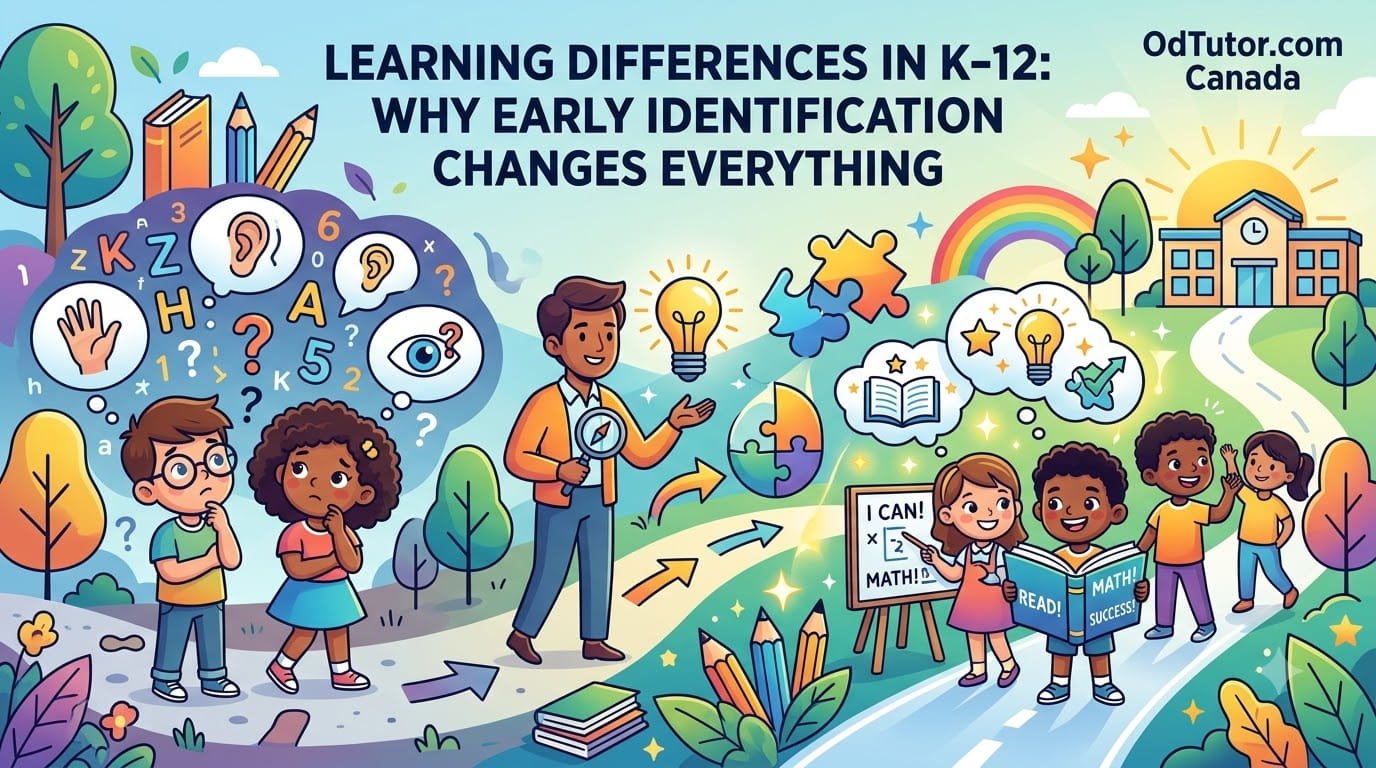
The parent who called me had a Grade 4 student who was "just lazy." That's the phrase she used, and I heard it almost apologetically, as if she felt badly labeling her own child that way. He could read if someone sat with him and pushed, but left to himself, he'd avoid it entirely. Writing assignments took hours. Math had always been hard, but she'd assumed he'd catch up eventually. Now, halfway through fourth grade, he was falling noticeably behind, and the school was suggesting she consider assessment for learning disabilities.
She wanted my perspective. Did I think he was lazy, or did I think something else was going on?
After working with him for three sessions, I had a pretty clear answer: he wasn't lazy. What he was, was exhausted. Reading didn't come naturally, so every page required extraordinary effort. By the time he'd deciphered enough words to understand a sentence, he'd forgotten the beginning. He'd developed incredible avoidance strategies — not because he was unmotivated, but because his brain was working four times as hard to do something his peers found relatively automatic. By fourth grade, that exhaustion had compounded into what looked like laziness from the outside: why push yourself through something so draining when you can avoid it?
This is, without question, the most important conversation I have with Canadian families, and it happens far too rarely at the right time. Learning differences — dyslexia, dyscalculia, attention differences, processing speed variations, and others — aren't character flaws or signs of low intelligence. They're neurological differences in how a brain processes information. And when they're caught early, properly assessed, and handled well, they don't become the limiting factor they become when they're missed or dismissed for years.
Why Early Detection Matters More Than Most People Realize
There's a window, particularly in the early elementary years, when learning differences are easier to address and when catching them early prevents the cascade of consequences that follows years of struggling. A child who's still learning to read, who can receive focused intervention in Grade 1 or 2, can develop strong reading skills through explicit, structured instruction. The same child, left unaddressed until Grade 4 or 5, has already developed years of avoidance patterns, lost confidence, and is now simultaneously trying to catch up on fundamental skills while keeping pace with grade-level content in everything else.
The social and emotional cost is just as real. A child who struggles with reading but gets support early develops a sense that "this is hard for me, but I can learn it with help." A child who's struggled silently for three years develops a very different narrative: "I'm stupid" or "I can't do school" or "Everyone else gets this but me." Those beliefs don't evaporate once you finally identify the underlying issue.
I've worked with students from Grade 2 through Grade 12, and the pattern is remarkably consistent: the earlier a learning difference was caught and addressed, the less significant a barrier it became. The students who were identified in Grades 1 and 2 often ended up doing quite well academically by high school, not because their learning difference disappeared, but because they'd built strategies, received targeted instruction, and developed resilience around the challenge. Students who weren't identified until Grade 7 or 8 were fighting not just the learning difference, but years of lost confidence and increasingly complicated academic content.
What Learning Differences Actually Look Like in the Classroom
The problem with waiting until a child is "obviously" struggling is that learning differences don't always look obvious until they've become severe. Here are the signs I watch for, because they're the ones that suggest a child might benefit from assessment even when they're not yet dramatically behind:
In reading and writing: A child who's in Grade 2 or 3 and still confusing letter sounds, or reversing letters and numbers beyond the point where that's developmentally typical. A child who can decode individual words but struggles to understand what they've read — they can say the words aloud but can't answer questions about the passage. A child whose handwriting is significantly messier or slower than peers, or who avoids writing tasks. Spelling that's phonetically creative in ways that seem inconsistent with what they've been taught.
In math: A child who understands the concept when you explain it verbally, but can't reliably remember number facts (addition and subtraction basics in early grades, multiplication tables later). A child who counts on their fingers well into Grade 3 or 4. A child who can solve one type of problem but can't transfer that understanding when the problem is phrased slightly differently. A child who loses track of where they are in a multi-step problem, not because they don't understand the steps, but because they genuinely lose their place.
In attention and organization: A child who can focus intensely on things they love but absolutely cannot focus on assigned work, even when the work isn't actually that difficult. A child who loses things constantly, not through carelessness but because they genuinely forget where they put things. A child whose homework is dramatically more time-consuming than it should be — an assignment that should take thirty minutes takes ninety because there's so much starting and stopping, getting back on track, and refocusing.
In processing: A child who needs things repeated multiple times before understanding, not because they're not listening, but because they need more time to process language. A child who misunderstands instructions or asks questions that suggest they've interpreted something in an unexpected way. A child who is slow to retrieve information from memory — they know the answer but can't get it out quickly.
None of these things, in isolation, necessarily means a learning disability. Children develop at different rates, and there's genuine variation in how quickly different skills emerge. But clusters of these signs, or signs that persist well beyond when most peers have moved past them, are worth taking seriously.
The Assessment Process in Canada: What Actually Happens
Many Canadian parents hesitate to pursue assessment because they're not sure what it involves, or they worry about labels, or they assume it's a lengthy medical process. In reality, most provinces have relatively straightforward pathways.
A parent can typically request that a child be assessed through their school, usually by talking to the classroom teacher or school psychologist. The school will then conduct a psycho-educational assessment, which usually takes several hours and includes tests of cognitive ability, academic achievement, attention, processing speed, and sometimes behavior. The assessment is conducted by a school psychologist and is free. It usually takes a few weeks to months depending on the school's capacity, and at the end, the family receives a detailed report identifying whether there's a learning disability or other factor affecting learning, and recommendations for support.
Alternatively, parents can pursue a private assessment through a psychologist or psychometrician, which happens faster but costs money (typically CAD $1,500 to $3,500 depending on the comprehensiveness of the assessment). Both the school assessment and a private assessment provide the documentation needed to access accommodations and support.
It's worth knowing that assessment doesn't diagnose character flaws or low intelligence. A child can be intellectually gifted and have dyslexia. A child can be average in overall ability but have significant strengths in some areas and challenges in others. The assessment describes how that specific child's brain works, not how "smart" they are in some general sense.
What Happens After Assessment
If an assessment identifies a learning difference, the next step is usually creating an Individual Education Plan (IEP) or a similar formal document outlining the child's needs and the support they'll receive. This might include things like extra time on tests, preferential seating, use of specific tools (like a calculator or text-to-speech software), small group instruction in specific skills, or modified assignments.
It's crucial to understand that accommodations aren't "cheating" or giving a child an unfair advantage. They're equalizing the playing field. A child with dyslexia using text-to-speech software isn't cheating on a reading comprehension test — they're accessing the content in a way that works with their brain's wiring rather than against it. The goal of accommodations is to remove the barrier caused by the learning difference so the child can actually demonstrate what they know.
I've watched this make a dramatic difference. A student I worked with had dyscalculia (a math-specific learning difference) and received accommodations allowing her to use a calculator for complex calculations on tests. Suddenly, the math tests assessed whether she understood concepts and procedures, not whether she could fight her brain's inability to reliably retrieve basic facts. Her confidence and her grades both improved significantly.
What Parents Should Do Right Now
If you have a child in K-12 and you're reading this thinking "wait, that sounds like my kid," here's what I'd actually recommend:
Start by talking with the classroom teacher. A good teacher sees a lot of children and can tell you whether they're observing the same patterns at school that you're seeing at home. If multiple adults are seeing similar concerns, that's worth pursuing further. If it's only at home, there might be other factors (sleep, stress, screen time, home environment) that are worth addressing first.
If the teacher confirms they're seeing similar concerns, ask about the assessment process at your school. Every province and school board handles this slightly differently, but most have a formal process for requesting assessment. Don't feel like you need to have a diagnosis already — the point of assessment is to figure out what's actually going on.
In the meantime, avoid the temptation to just push harder or assume the child will catch up eventually. Some children do catch up naturally. Many don't, and the years of struggle take a real toll. If something seems off, it's worth investigating, and investigation costs nothing but time.
The Stigma That Lingers (And Why It Shouldn't)
One more thing worth addressing directly: many parents hesitate to pursue assessment because they worry about labeling their child, as if identifying a learning difference somehow damages them. I understand that impulse, but I've seen the actual outcomes in both directions. A child who's identified and supported thrives far more than a child who's left struggling and unsupported, even if the unsupported child eventually catches up on their own. The emotional toll of years of struggle is real, and it affects confidence, resilience, and willingness to take academic risks for years afterward.
Learning differences are also far more common than most people assume. Roughly one in five people have some form of learning disability. You likely know adults who are successful in their careers and lives who have dyslexia, ADHD, or other learning differences. The difference between those adults and adults who struggled throughout school often isn't intelligence or capability — it's whether they got support and accommodation when they needed it.
The Bottom Line
Learning differences in K-12 don't go away if you ignore them, and they don't become more obvious only when a child is dramatically behind. They're most effectively addressed when they're caught early, when a child still has confidence and hasn't spent years developing avoidance strategies. If your child is struggling with reading, writing, math, attention, or organization in ways that seem beyond normal variation or typical development, it's worth talking to their teacher and exploring assessment. Identifying a learning difference isn't a diagnosis of failure — it's often the beginning of the support that allows a child to actually succeed.