I once spent an entire tutoring session watching a Grade 7 student copy notes from her textbook onto flashcards. It took her forty-five minutes to create maybe thirty cards, and when I asked her how she'd use them, she said she'd review them the night before a test. She was confident this was studying. Her parents were relieved that she was finally "taking studying seriously." Nobody had really taught her what studying is supposed to do, or whether this particular approach was going to move the needle on her understanding.
That flashcard session is a perfect metaphor for a lot of what passes for "study skills" in Canadian homes and schools. It looks productive. It involves quiet work and effort. It involves materials that seem educational. But it often doesn't actually improve learning. The student ends up spending hours on activities that create the appearance of study without the substance.
After years of working with students who've developed genuine study habits and others who've perfected the performance of studying without learning much, I've become convinced that most Canadian families don't really understand what study skills are, or how they differ from doing homework. And that gap costs a lot of wasted time and genuine lost learning.
What Study Skills Actually Are (And Aren't)
Let's start with definitions, because the terminology here matters. Homework is work assigned by teachers, to be completed outside of class, usually graded. Study skills are the strategies a student uses to learn material, whether or not there's assigned homework involved. They're different things, and conflating them is exactly where most families go wrong.
A student can do all their homework religiously and still have weak study skills. Conversely, a student can skip some homework but develop such strong independent study skills that they learn the material anyway. The goal is the second scenario, building genuine capacity to learn on their own, not just compliance with homework completion.
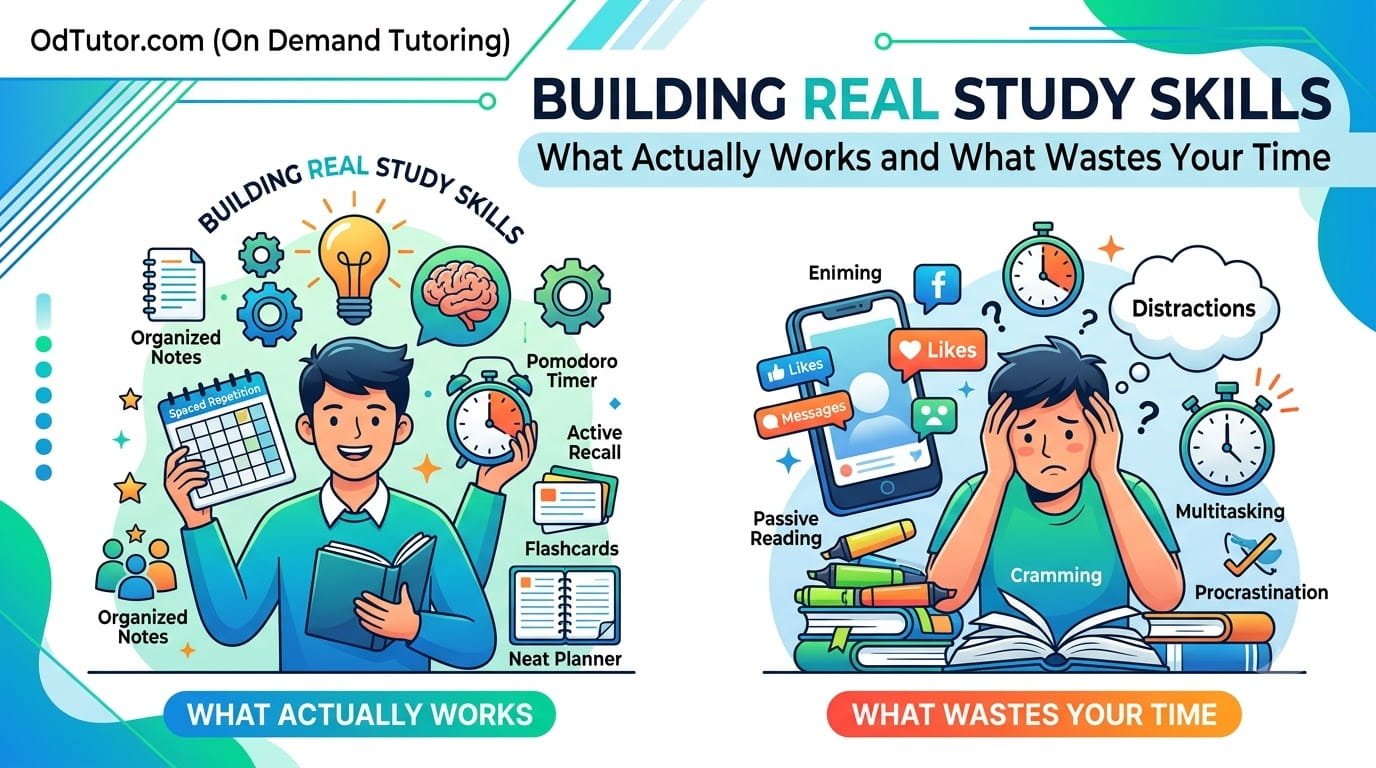
Real study skills include things like: breaking complex material into manageable pieces, identifying what you don't understand and asking for clarification, retrieving information from memory deliberately rather than just re-reading notes, teaching concepts back in your own words, connecting new information to things you already know, and spacing out practice over time rather than cramming everything into one session.
None of these require special materials or expensive tools. They require intention and understanding of how learning actually happens.
The Strategies That Actually Work (And Why)
I'm going to name a few evidence-based study strategies, because they come up constantly with students, and knowing which ones are worth time and which ones are more performance than substance is genuinely useful.
Spaced retrieval practice: This is probably the most reliable study strategy that exists. Instead of studying material once and cramming before a test, you review material multiple times over an extended period. Research consistently shows this leads to better retention than massed practice (studying the same thing repeatedly in one session). For a student preparing for a test three weeks away, studying for fifteen minutes every few days beats studying for three hours the night before, even though the total time might be less.
The practical version: make a simple list of key concepts or questions from a unit. Review that list every few days, testing yourself on what you remember. It sounds almost too simple, but the spacing is what matters. Your brain locks in information when there's a gap where you have to retrieve it from memory.
Active recall: This means testing yourself on information rather than just re-reading. The difference between reading notes you've written and covering them up and trying to remember them is the difference between performance and actual learning. When you re-read, it feels familiar, which your brain interprets as "I know this." When you test yourself and can't remember, that's uncomfortable, but that discomfort is the signal that learning is happening.
Elaboration: This means explaining concepts in your own words, connecting them to things you already know, or asking "why" and "how" questions about the material. A student who reads "photosynthesis converts light energy to chemical energy" and moves on hasn't learned it the way a student who asks "why is light energy important if the plant can just get energy from soil" or "what's actually different about chemical energy that makes it useful" has learned it.
Interleaving: This means mixing up different types of problems or concepts rather than practicing one type repeatedly. If a math student practices ten problems of the same type in a row, it feels productive, but they're not actually learning to discriminate which strategy to use. If they practice problems that are mixed up, including some where they have to figure out which strategy applies first, that's harder and less satisfying in the moment, but it builds actual skill.
The strategies that don't work as well as they feel like they should: highlighting, re-reading, summarizing (unless it's done in a way that requires synthesis rather than just condensing), and creating fancy study materials like color-coded notes or elaborate visual organizers. These aren't harmful exactly, but they're often a form of productive procrastination, they feel like studying, they create physical artifacts that look studious, but they don't produce learning as effectively as the strategies above.
The Homework Conversation Nobody Has Right
Here's where I usually lose parents a little bit, because it contradicts conventional wisdom about homework. Ready?
Your job as a parent is not to ensure homework gets done. Your job is to create conditions where your child develops the independence and skills to manage their own learning. Those are almost opposites.
A parent who hovers over homework, checks every answer, prompts the student when they get stuck, and generally ensures completion is solving the immediate problem (homework gets done) but creating a long-term problem (the student never develops independent problem-solving capacity). A parent who says "homework is your responsibility, and I trust you to figure out what you need to do" is creating temporary friction but building actual capacity.
The right approach sits somewhere in the middle. It's not hands-off, but it's also not hands-on. It looks like:
-
Creating a consistent time and place where homework happens (the routine matters more than you'd think)
-
Asking your child to explain what they're working on and what they're supposed to learn from it (not checking answers, just understanding the purpose)
-
If your child is struggling, asking "what part is confusing?" rather than explaining how to do it
-
If your child can't figure something out, suggesting they ask the teacher tomorrow rather than you staying up late trying to teach it
-
Letting your child experience the natural consequences of not doing homework (getting it wrong, getting feedback from the teacher) rather than buffering them from those consequences
This is harder than just doing the homework with them, which is probably why so many families don't do it this way. But over the course of a few years, the difference in independence is dramatic.
Study Skills by Grade: What Matters When
Different grades involve different cognitive demands, and study skills need to evolve accordingly.
Elementary (Grades 1-6): The foundation is building organized homework habits and the ability to follow multi-step assignments. Memorization matters (multiplication facts, sight words, history dates), but the bigger goal is developing the ability to work independently for gradually longer periods. Study skills here look like having a consistent homework spot, breaking bigger assignments into parts, and learning to check your own work.
Middle school (Grades 7-8): This is when real note-taking starts to matter, because students need to capture information for later study rather than just listening passively. Organizing materials (keeping notebooks coherent, managing multiple subjects) becomes important because the workload is larger. Time management skills start to matter because students now have multiple teachers assigning work. This is also when spaced retrieval practice and testing yourself becomes relevant for subjects with more content to memorize.
Early high school (Grades 9-10): The note-taking and organization skills from middle school need to be solid by now. Adding to that: reading textbooks effectively (most students have never actually learned how to do this), preparing for longer assessments, and starting to manage competing deadlines across multiple subjects.
Late high school (Grades 11-12): This is when metacognition matters, the ability to think about your own thinking, to know what strategies work for you specifically, to adjust your approach based on what's working. Some students are naturally reflective; others need to be coached into this. By Grade 12, a student should have a reasonably clear sense of "here's how I study math most effectively" or "I know I need to start essays this much time before the deadline or I struggle with quality."
The Conversation to Have with Your Teenager
If you have a high school student, here's a conversation worth having: "What's your most effective study strategy right now?" If they say "I don't know" or "just do the homework," that's a sign their study skills aren't very intentional yet. If they can articulate something like "I work better with other people around me, so I study at the library where there are people but we can't talk" or "I review notes every few days starting a week before a test," they've got more intentionality.
You can build on that intentionality. Ask what strategies they've tried that didn't work. Ask whether they space studying out or cram. Ask whether they test themselves on material or just re-read. Ask whether they connect new information to things they already know. Most students have never explicitly thought about these things, and asking the questions is often enough to trigger reflection that leads to better choices.
The Bottom Line
Study skills aren't something your child either has or doesn't have by some genetic accident, they're learned behaviors that improve with conscious practice and feedback. The students who develop strong study skills aren't usually the ones with the highest IQs; they're the ones who've figured out how their brain actually learns and built habits that align with that. Teaching study skills explicitly, naming the strategies that work, explaining why they work, and regularly asking your child to reflect on what's working for them, pays off far more than monitoring homework completion or creating elaborate study materials. And pulling back from homework management as your child gets older, even though it feels riskier, is actually what builds the independence that will carry them through university and beyond.